Korea's pop-culture industry billed ₩15.4tn. Its artists average ₩1.5m a month from performing.
A statutory government survey counted every registered Korean talent agency and production house, and asked the people signed to them what they earn. The answers do not look like the industry's press releases.
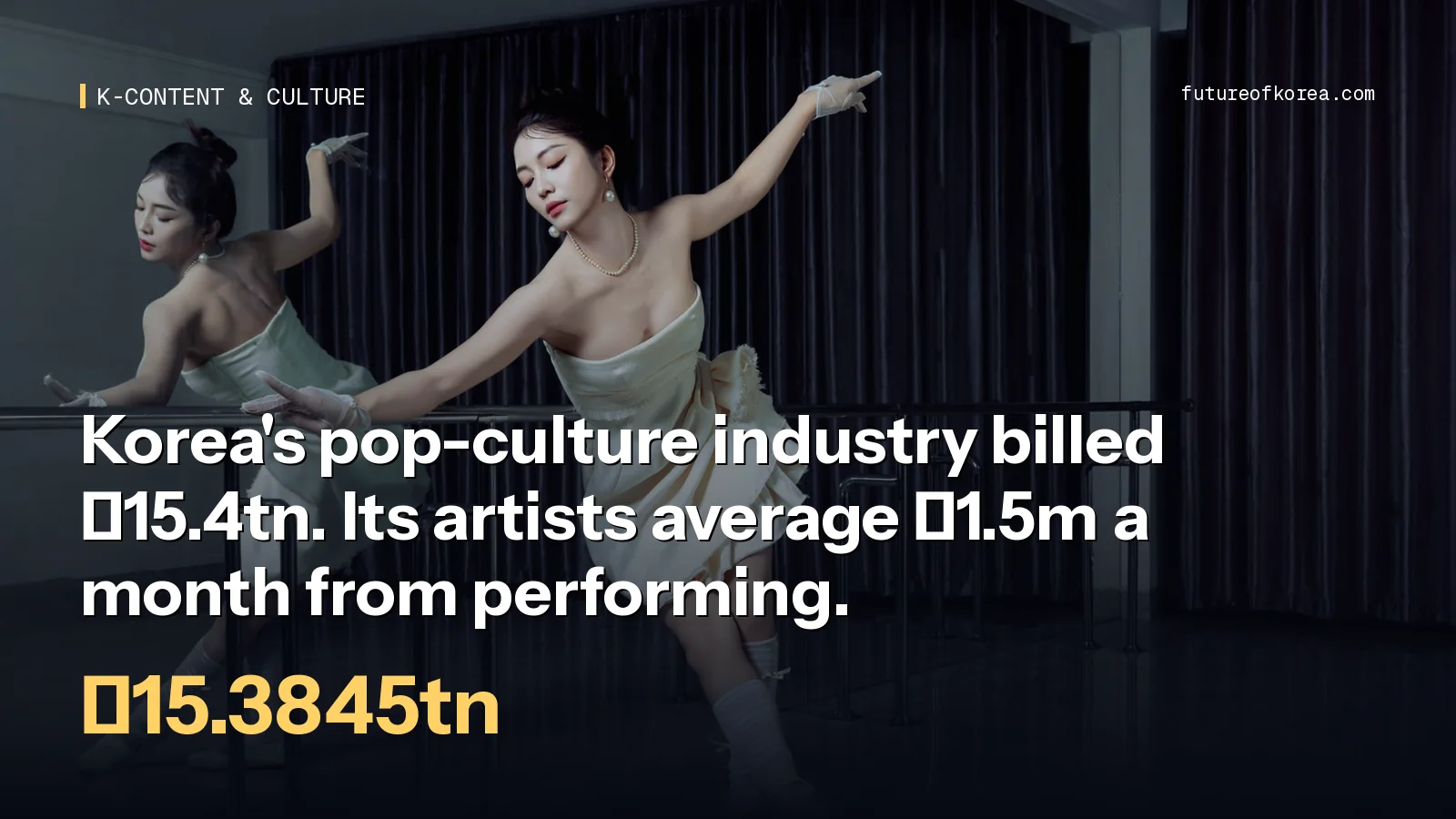
Photograph by Đậu Photograph on Pexels.
Every registered Korean talent agency and production house, added together, billed ₩15.3845tn in 2024. The 12,092 artists signed to those agencies earned an average of ₩1.507m a month from popular-arts work. A full-time job at Korea’s 2026 minimum wage of ₩10,320 an hour pays ₩2,156,880 a month.
Both numbers come from the same survey, published by the culture ministry and the Korea Creative Content Agency on 23 January 2026.
The industry grew 34.5% in two years
The Popular Culture and Arts Industry Survey is not a trade estimate. It is a statutory count, required by the Popular Culture and Arts Industry Development Act, first run in 2015 and repeated every second year. The 2025 edition covers calendar 2024. It reached 6,760 companies — 4,471 registered as planning-and-management businesses, the agencies, and 2,289 as production businesses — plus 1,907 individual workers.
Total revenue: ₩15.3845tn, against ₩11.4362tn in 2022. That is a 34.5% rise over two years, and the largest figure the survey has recorded.
The ministry’s own explanation for the jump has three parts, and only one of them is about music being more popular. The count of registered agencies rose from 3,758 to 4,471. Revenue at the listed agencies expanded. And the big firms had a good couple of years. Two of those three are a bigger denominator rather than a better business.
Overseas revenue is smaller than the fandom implies
Split the agencies out from the production houses and they billed ₩9.5077tn between them: ₩7.8020tn at home, ₩1.7057tn abroad.
The overseas line grew 61.7% from 2022, against 35.5% domestically. It is still 17.9% of what agencies bill.
That needs reading carefully rather than dismissively. This is revenue recognised by Korean-registered corporate entities. A stadium show in São Paulo promoted by a local partner, merchandise sold through a foreign subsidiary, a distribution deal booked offshore — none of it necessarily lands in this number. What the figure measures is the money that comes back through the Korean company, and on that measure the domestic market still pays most of the wages.
Set it against the national content accounts and the proportion stops looking surprising. Korea exported $14,075.43m of content in 2024, a record. Music accounted for $1,801.45m of it, or 12.8%. Games accounted for $8,503.47m, or 60.4%. The country that exports K-pop exports roughly five dollars of video games for every dollar of music.
What the artists actually earn
12,092 people were under agency contract in 2024, up 6.5% from 11,355 two years earlier. Singers are the largest group at 5,020, or 41.5%. Actors follow at 4,709, or 38.9%. Broadcast personalities account for 1,264, or 10.5%.
Their average total monthly personal income was ₩3.151m. Of that, ₩1.507m came from popular-arts activity — 47.8%. The other half came from somewhere else.
| Monthly average, 2024 | Artists | Production staff |
|---|---|---|
| Total personal income | ₩3.151m | ₩3.275m |
| From the main occupation | ₩1.507m | ₩2.774m |
| Share from the main occupation | 47.8% | 84.7% |
Source: 2025 Popular Culture and Arts Industry Survey, MCST/KOCCA, 2024 basis.
The people who build the stage earn more than the people who stand on it, and they earn it more reliably. That is not a scandal. It is what a tournament labour market looks like from the inside: a small number of enormous winners, a long tail of contracted professionals doing something else on Tuesday to cover the rent, and a mean that sits between the two while describing neither.
Which is the caveat that matters here. ₩1.507m is an average across an industry whose top ten earners are on television. The median is not published. It is lower.
The intake is shrinking
963 trainees, spread across 211 companies. Down from 1,170 in 2022 — a fall of 17.7%. Singers-in-waiting are 613 of them, 63.7%.
The arithmetic worth sitting with is that 211 companies out of 4,471 have any trainees at all. Nineteen agencies in twenty are managing people, not developing them.
So the industry’s revenue grew a third in two years, its roster of contracted artists grew 6.5%, and the pipeline behind that roster shrank by a sixth. Some of that is the majors running leaner debut cycles. Some is the cost of carrying an unpaid-for trainee through several years in a market where a debut is no longer the only route in. Whatever the mix, the survey’s own numbers say the sector is monetising a bigger existing roster rather than manufacturing a larger new one. That shows up in what the listed agencies reported for the second quarter of 2026, where touring and merchandise, not new acts, carried the revenue.
Song Jin, who heads KOCCA’s content industry policy research centre, framed the remaining gap in the release as protecting trainees and fixing unfair contracts — the two groups the standard form reaches least well. The 963 trainees are precisely the cohort with no standard contract to be counted under.
None of this makes the boom fake. ₩15.3845tn is real money and 34.5% in two years is a real growth rate. It does mean the two most quoted claims about the industry — that it is primarily an export business, and that being signed to a Korean agency is a livelihood — are both, on the government’s own numbers, less than half true. The export share of agency revenue is 17.9%. The share of an artist’s income that comes from art is 47.8%.
For anyone weighing a career on either side of that contract, the second number is the one to plan around. It sits below a full month at Korea’s statutory minimum wage, and it is a mean.
Figures current as of 8 September 2026, drawn from the 2025 Popular Culture and Arts Industry Survey (2024 basis, published 23 January 2026), the 2025 Content Industry Survey (2024 basis, published 27 February 2026), the e-나라지표 cultural industry indicator page updated 26 March 2026, and the Minimum Wage Commission’s 2027 award, which records the 2026 rate of ₩10,320 an hour.
Useful links & tools
Official portals and primary data sources for this topic. Opens in a new tab.
- KOCCA domestic industry statistics — Where the content and pop-culture survey reports are published, in full, for free
- e-나라지표 — cultural industry indicators — Revenue, exports and employment for all eleven content sectors, back to 2005
- Popular Culture and Arts Industry Development Act — The statute behind agency registration, the standard contract and the survey itself
- Korean Artist Welfare Foundation — Income support, insurance and legal help for registered artists, including performers
Frequently asked questions
How much do artists signed to Korean entertainment agencies earn?
The government’s 2025 Popular Culture and Arts Industry Survey, covering 2024, puts average total monthly personal income for artists under agency contract at ₩3.151m. Only ₩1.507m of that — 47.8% — came from popular-arts activity itself; the balance came from other sources. Production staff surveyed alongside them averaged ₩3.275m a month, of which ₩2.774m, or 84.7%, came from their main job. These are means across 1,907 surveyed workers, not medians, and a small number of very high earners pulls a mean upward in an industry shaped like this one.
How many people are actually signed to Korean talent agencies?
12,092 as of the 2024 survey year, up 6.5% from 11,355 in 2022. Singers are the largest group at 5,020 people (41.5%), followed by actors at 4,709 (38.9%) and broadcast personalities at 1,264 (10.5%). Separately, 963 trainees were registered across 211 companies — meaning 95.3% of Korea’s 4,471 licensed agencies had no trainees at all. Aspiring singers made up 613 of those trainees, or 63.7%.
What is the Popular Culture and Arts Industry Survey?
A statutory survey mandated by the Popular Culture and Arts Industry Development Act, first run in 2015 and conducted every two years by the Ministry of Culture, Sports and Tourism with the Korea Creative Content Agency. The 2025 edition, published on 23 January 2026, covers calendar 2024 and reached 6,760 companies — 4,471 registered planning-and-management businesses and 2,289 production businesses — plus 1,907 individual workers drawn from a population built with the Korean Artist Welfare Foundation.
Does the ₩15.4tn figure include listed agencies like HYBE and JYP?
Yes. The survey counts companies registered as popular-culture planning businesses, which includes the listed majors, and the ministry attributes part of the 34.5% two-year jump to revenue growth at listed agencies alongside a rise in the number of registered firms from 3,758 to 4,471. The figure is revenue booked by Korean-registered entities. Activity run through overseas subsidiaries and local promoters sits outside it, which is why it is smaller than headline estimates of K-pop’s global economic footprint.
Sources & further reading
Every figure in the key takeaways is numbered to the source it was read from. Sources marked primary are the statistics office, central bank, exchange, regulator or filing itself.
- 1‘대중문화예술산업 매출 15조원 돌파, 역대 최대 규모 34.5% 급성장’ — 2025 대중문화예술산업 실태조사 (2024 basis)primary — Ministry of Culture, Sports and Tourism / Korea Creative Content Agency, January 2026 · verified 2026-09-08
- 2문화산업 현황 — 콘텐츠산업 매출액·수출액·고용 (Cultural industry indicators)primary — e-나라지표 / Ministry of Culture, Sports and Tourism, updated March 2026 · verified 2026-09-08
- 3콘텐츠산업, 매출 157조 원, 수출 141억 달러로 성장세 유지 (2025 Content Industry Survey, 2024 basis)primary — Ministry of Culture, Sports and Tourism, February 2026 · verified 2026-09-08
- 42027년 적용 최저임금안 시간급 10,700원 (2027 minimum wage award, with the 2026 rate)primary — Ministry of Employment and Labor / Minimum Wage Commission Secretariat, July 2026 · verified 2026-09-08
- 5대중문화예술산업발전법 (Popular Culture and Arts Industry Development Act)primary — Korea Ministry of Government Legislation · verified 2026-09-08
Read next
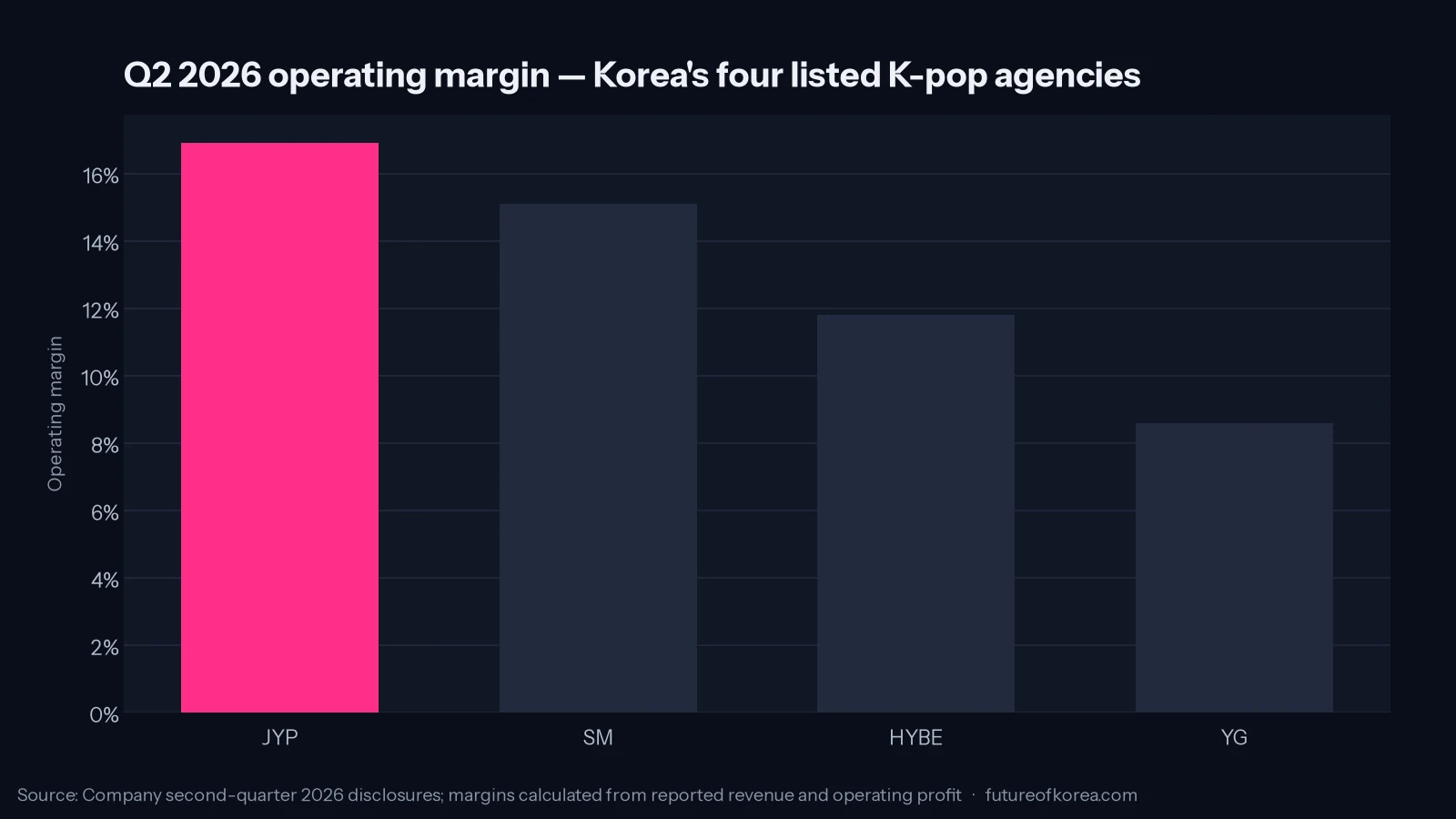
K-pop's first trillion-won quarter: what the touring economy actually earns
HYBE became the first Korean music company to book more than a trillion won of revenue in a quarter — and its shares fell 9.8% the next day. Reading all four listed agencies' second-quarter numbers together explains why: the industry's growth has moved into its lowest-margin business line.
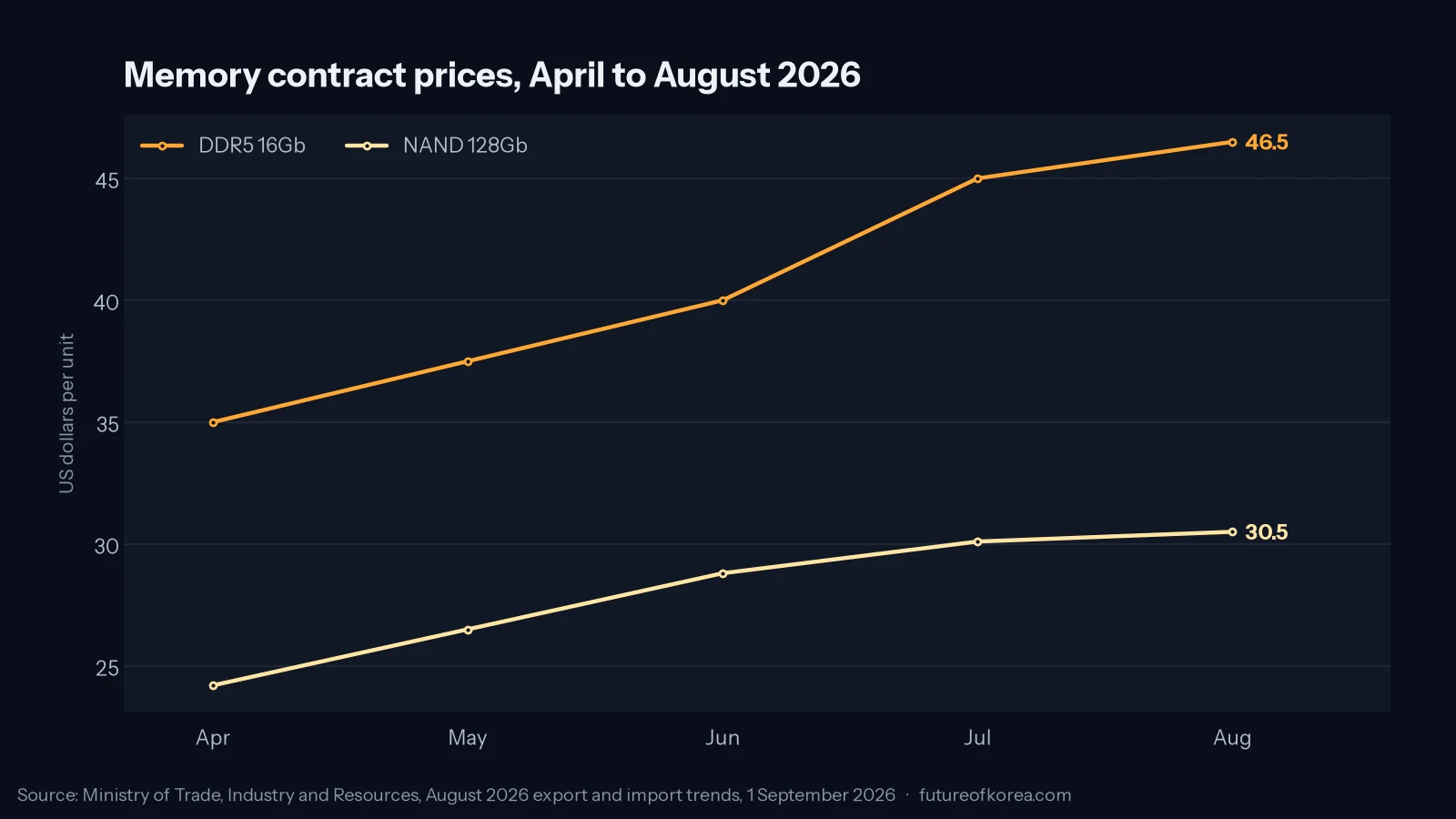
Korea's exports grew 68.7% in August. Strip out three product lines and they grew 2%.
August was Korea's third-biggest export month on record and produced a $34.75bn trade surplus. Almost the entire year-on-year gain came from three lines, and all three are priced rather than produced.
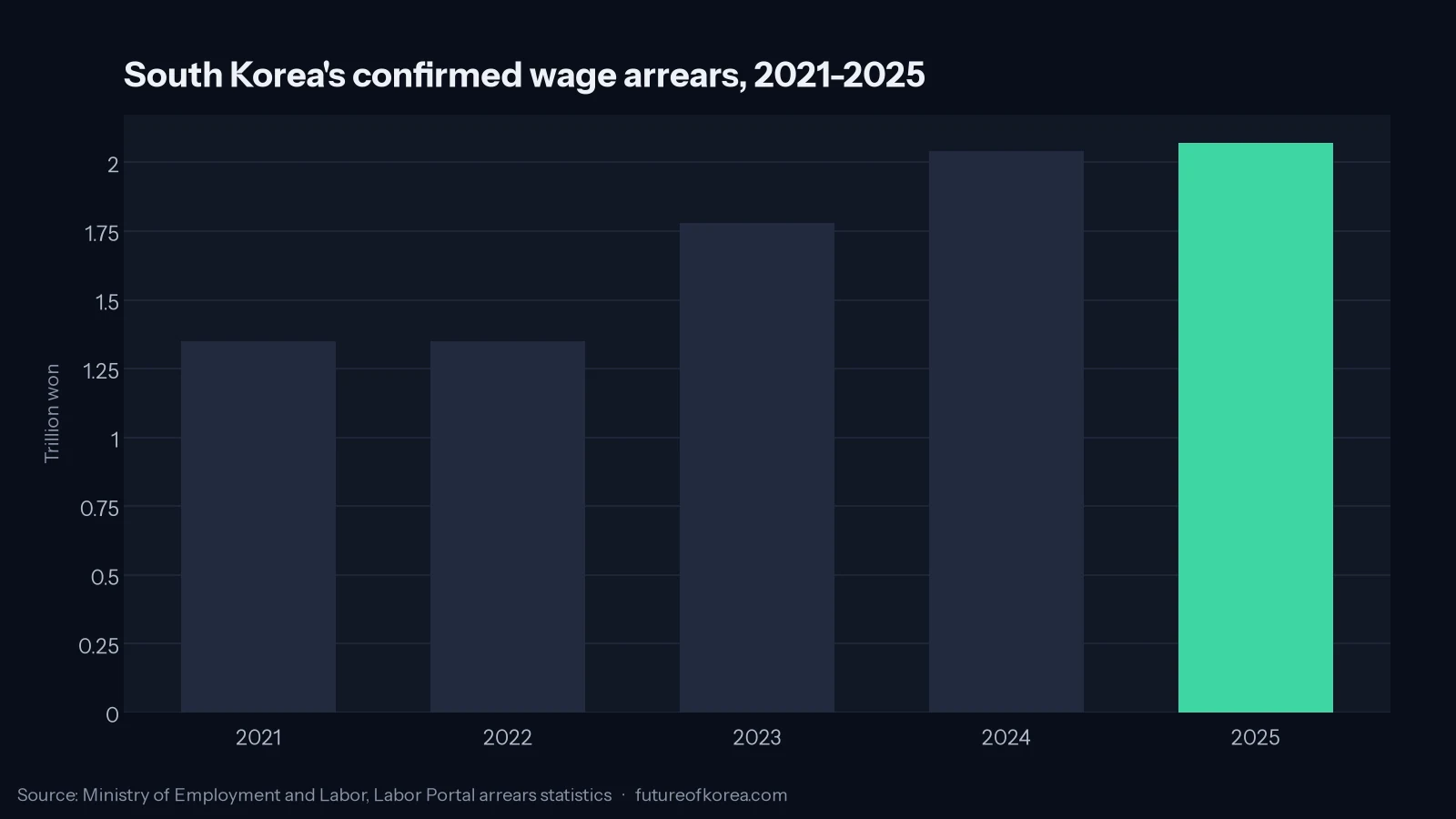
Unpaid severance is 45% of Korea's wage arrears — and the penalty rises this month
Almost half of everything Korean employers failed to pay their workers this year was severance. Here is why the money is missing, what the law says you are owed, and what changes on 18 September.