K-pop's first trillion-won quarter: what the touring economy actually earns
HYBE became the first Korean music company to book more than a trillion won of revenue in a quarter — and its shares fell 9.8% the next day. Reading all four listed agencies' second-quarter numbers together explains why: the industry's growth has moved into its lowest-margin business line.
On 28 July 2026, HYBE reported that it had earned ₩1.45tn ($993m) in three months. No Korean music company had ever booked a trillion won in a quarter. Revenue had more than doubled year on year, operating profit was up 159.3% to ₩170.9bn, and net profit had risen more than sixfold.
The next day the shares fell 9.8%.
That gap — between the best quarter the industry has ever printed and the market’s reaction to it — is the most useful thing to happen to K-pop as a business in years, because it forces an honest look at where the money actually comes from. Read alongside the numbers from SM, JYP and YG, all four of which have now reported, it says something specific: K-pop’s growth has moved into its lowest-margin business line, and the industry is still learning to price that.
The four agencies, in one table
All figures are second-quarter 2026, consolidated, as disclosed by each company.
| Agency | Ticker | Revenue | YoY | Operating profit | YoY | Operating margin |
|---|---|---|---|---|---|---|
| HYBE | KOSPI 352820 | ₩1,450.0bn | +105.5% | ₩170.9bn | +159.3% | 11.8% |
| SM Entertainment | KOSDAQ 041510 | ₩349.6bn | +15.4% | ₩52.9bn | +11.0% | 15.1% |
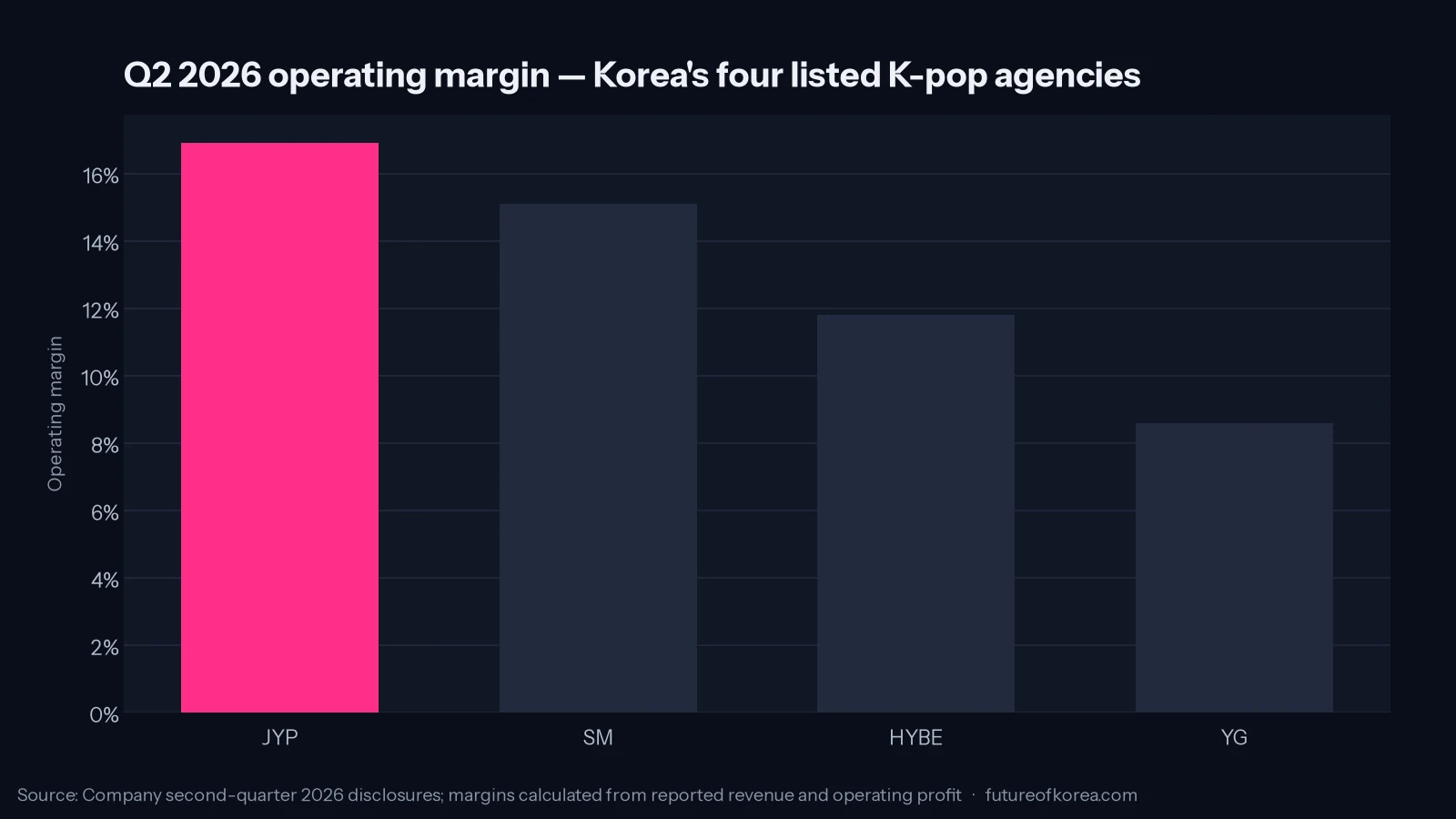
| JYP Entertainment | KOSDAQ 035900 | ₩183.0bn | −15.1% | ₩31.0bn | −41.4% | 16.9% |
| YG Entertainment | KOSDAQ 122870 | ₩127.8bn | +27.2% | ₩11.0bn | +31.2% | 8.6% |
Two things jump out. HYBE’s revenue was roughly twice the other three combined. And HYBE’s operating margin was lower than SM’s and JYP’s — the shrinking one.
Why a record quarter compressed the margin
A concert and an album are not the same kind of revenue, and the difference is not small.
An album is a manufactured good. Unit costs are fixed and known, distribution is cheap, and the artist’s share is set by contract. Merchandise behaves similarly — HYBE’s merchandise and licensing line, a company record at ₩310.6bn, is the kind of revenue analysts had been modelling, with gross margins commonly cited around 50%.
A stadium show is a production business. Before anything reaches the label there is venue hire, staging, freight, crew, insurance, local promoters and — critically — a revenue share with the artist that scales with the artist’s standing. A globally established act commands a payout ratio a rookie group cannot. So the more successful the tour, the more of the gross goes out the door before it becomes profit.
HYBE’s own CFO said as much on the earnings call: the gross-margin decline was “primarily due to an increase in concert revenue, which has higher associated costs such as venue fees and revenue sharing with artists.” Consolidated gross margin fell to about 32%, from 43% in the previous quarter. Labour costs rose by roughly ₩30bn on incentives and global hiring.
JYP is the control experiment
The cleanest evidence that this is a mix effect rather than a management failure comes from the agency that did worst.
JYP’s revenue fell 15.1% and operating profit fell 41.4% — and the reason is almost entirely that Stray Kids’ dominATE world tour was on the road in the comparison quarter of 2025 and the group’s next tour did not open until July 2026, after the quarter closed. Look at the lines:
| JYP revenue line | Q2 2026 | YoY |
|---|---|---|
| Concerts | ₩39.9bn | −35.7% |
| Merchandise | ₩43.9bn | −34.5% |
| Physical albums | ₩37.0bn | +36.7% |
The touring lines collapsed. The recorded-music line grew — catalogue sales of Stray Kids albums rose from about 120,000 units in Q2 2025 to 420,000 in Q2 2026. And JYP still posted the highest operating margin of the four, at 16.9%, precisely because the low-margin revenue was the revenue that went missing.
This is the whole argument in one company. Touring adds enormous revenue and comparatively little margin; when it goes away, revenue falls hard and margin holds up.
What SM and YG add
SM’s quarter is the moderate case: consolidated revenue up 15.4% to ₩349.6bn, operating profit up 11.0% to ₩52.9bn — profit again growing more slowly than revenue. On a standalone basis the pattern is starker still: revenue up 9.2%, but standalone operating profit down 4.6% and net profit down 18.1%, even as appearance revenue rose 27.9% and concert revenue 23.6%. Growth in every activity line, less of it reaching the bottom.
YG is the counter-case, and it is instructive. Revenue rose 27.2% and operating profit rose slightly faster, at 31.2% — because the growth came from album releases by TREASURE and BABYMONSTER plus the merchandise attached to them, not from a stadium run. YG’s absolute margin is the lowest of the four at 8.6%, but the direction of travel in the quarter was the right one. Its touring quarter is still ahead: BIGBANG’s 20th-anniversary tour opens at Goyang Stadium on 21 August and runs to 33 shows across 19 cities.
How much of HYBE’s fall was HYBE?
Less than the headline implies, and this matters for anyone reading the chart cold.
HYBE fell 9.8% to ₩170,300 on 29 July, having been down as much as 16.1% intraday, and lost roughly ₩2.85tn of market value across two sessions. But those sessions sat inside the worst stretch of Korea’s 2026 market crash, when the KOSPI itself was falling in double digits and the exchange was tripping market-wide circuit breakers. Foreign investors were selling the index, not auditing K-pop margins.
What is specific to HYBE is the reason the disappointment was available to sell: the results beat consensus on revenue and profit but missed on margin, with the 11.8% operating margin below the 12.7% one broker had modelled. In a calm tape that is a down day. In late July 2026 it was a rout.
The boom underneath the share prices is not in question
It is easy to read a 9.8% drop as a verdict on K-culture. The wider data says otherwise.
Korea drew 10.71 million foreign visitors in the first half of 2026, up 21% year on year, and their card spending passed ₩10tn — a threshold reached about three months earlier than in 2025. In June alone, 1,993,128 people arrived, up 23%, with China (649,582, +36.2%), Japan (348,216) and Taiwan (223,127) leading. Arrivals through regional airports outside Seoul grew 42.5%, against 18.2% for Incheon and Gimpo.
On the export side, KOCCA’s most recent annual content-industry trend report put total content exports at $14.91bn, up 5.9%, with music the fastest-growing genre at 32.4% — driven, the agency said, by expanded overseas concerts. HYBE says Arirang topped US vinyl and CD sales and helped lift Korea to the world’s third-largest music exporter, behind the United States and the United Kingdom.
There is also a currency effect worth naming. A large and rising share of these companies’ revenue is earned in dollars and yen and reported in won, so the won’s persistent weakness flatters the translated figures. It is a real tailwind, and it is not operating performance.
The honest conclusion
K-pop in 2026 is bigger than it has ever been and structurally less profitable per won of revenue than it was when albums and fan platforms carried the growth. Both statements are true, and the second is not a scandal — it is what happens when an industry successfully converts a fandom into a live-events business. Live music is a scale business with thin unit economics everywhere in the world; there is no reason Korea would be exempt.
The interesting question for the next four quarters is whether the agencies can attach enough high-margin revenue to each show to hold the blended margin while the touring volume keeps climbing. HYBE has said that is the plan. JYP’s quarter shows what the ledger looks like when the tour stops. YG’s shows what it looks like when albums carry the load.
For anyone weighing exposure to any of this, note that none of the four has a liquid US listing — the practical routes into Korean equities for non-residents run through a broker with genuine KRX access, and broad Korea funds are semiconductor vehicles that happen to hold a little entertainment. Read the disclaimer: nothing here is investment advice.
Figures current as of 13 August 2026. Second-quarter results as disclosed by HYBE (28 July), SM Entertainment (5 August), YG Entertainment (7 August) and JYP Entertainment (12 August); filings are searchable at DART. Tourism figures are Ministry of Culture, Sports and Tourism data for the first half of 2026, released 28 July; content-export figures are from the Korea Creative Content Agency’s annual trend analysis report. Margin figures are calculated from reported revenue and operating profit and may differ from company-defined measures.
Useful links & tools
Official portals and primary data sources for this topic. Opens in a new tab.
- DART — Korean corporate disclosure system — Every filing HYBE, SM, JYP and YG make. Quarterly and semi-annual reports carry the segment detail press releases summarise.
- Korea Exchange market data portal — Share prices, market capitalisation and investor-type flows for all four tickers.
- KOCCA Welcon — content industry statistics — The Korea Creative Content Agency's quarterly and annual content-industry trend reports, including export data by genre.
- Korea Tourism Organization — tourism statistics — Monthly inbound arrivals by nationality and entry point — the demand-side counterpart to the concert numbers.
- Circle Chart — Korea's official album and streaming chart, and the source most album-shipment claims trace back to.
Frequently asked questions
Why did HYBE's share price fall on a record quarter?
Because the composition of the revenue disappointed, not the size of it. Analysts had modelled growth led by merchandise, which carries a gross margin near 50%; what arrived was growth led by concerts, which carry venue costs and artist revenue-share. Consolidated gross margin fell to about 32% from 43% the previous quarter and the operating margin of 11.8% came in below sell-side estimates. The shares fell 9.8% on 29 July, in a week when the broader KOSPI was also in severe drawdown.
Are concerts less profitable than albums for a K-pop agency?
Per won of revenue, yes. A concert grosses far more than an album but pays out venue hire, production, staging, crew, local promoters and a revenue share to the artist before anything reaches the label. Physical albums and merchandise are manufactured goods with fixed unit costs and much thinner payout structures. This is why a tour year can double revenue while barely moving margin — and why merchandise attached to a tour matters more to profit than the tickets do.
How big is HYBE compared with SM, JYP and YG now?
In the second quarter of 2026 HYBE’s revenue of ₩1.45tn was larger than SM (₩349.6bn), JYP (₩183bn) and YG (₩127.8bn) combined, by roughly a factor of two. That gap is cyclical as well as structural: HYBE had the largest touring act in the world on the road, and JYP had none. On operating margin the ranking inverts — JYP was the most profitable of the four despite shrinking.
What is the BTS Arirang tour and why does it dominate these numbers?
Arirang is BTS’s fifth full-length album, released in March 2026 after the members completed mandatory military service, and the world tour of the same name opened in April. HYBE attributes the bulk of its second-quarter growth to it: concert revenue rose 243.3% year on year, and the group also headlined the halftime show at the FIFA World Cup final on 19 July. HYBE artists played 119 shows across 12 acts in the first half, with more than 200 more scheduled for the second.
Can foreign investors buy these companies directly?
HYBE trades on the KOSPI (352820); SM (041510), JYP (035900) and YG (122870) trade on the KOSDAQ. None has a liquid US-listed ADR, so exposure means either a broker with genuine Korea Exchange access or a Korea fund that happens to hold them — and broad Korea ETFs are dominated by semiconductors, not entertainment. This is general information, not investment advice.
Is the K-content boom actually translating into money outside the agencies?
Yes, and by wider measures than share prices. Korea recorded 10.71 million foreign arrivals in the first half of 2026, up 21% year on year, and foreign card spending passed ₩10tn — about three months earlier than in 2025. KOCCA’s most recent annual trend report put total content exports at $14.91bn, up 5.9%, with music the fastest-growing genre at 32.4%. The tourism and export channels are compounding even in quarters when the equities are not.
Sources & further reading
Every figure in the key takeaways is numbered to the source it was read from. Sources marked primary are the statistics office, central bank, exchange, regulator or filing itself.
- 1HYBE posts record quarterly revenue on BTS comeback, concert boom — Korea JoongAng Daily, July 2026 · verified 2026-08-13
- 2Tour costs trigger 16% HYBE shares drop despite record revenue — Outlook Respawn, July 2026 · verified 2026-08-13
- 3SM Entertainment Q2 revenue rises 15.4% on global tours, IP growth — Seoul Economic Daily, August 2026 · verified 2026-08-13
- 4YG Entertainment shares rise on new album revenue — Aju Press, August 2026 · verified 2026-08-13
- 5Tourist arrivals to Korea jump as spending tops 10 trillion won — Korea JoongAng Daily / Ministry of Culture, Sports and Tourism, July 2026 · verified 2026-08-13
- 6Korean content exports rise 5.9% on K-culture boom — Seoul Economic Daily, reporting KOCCA, April 2026 · verified 2026-08-13
- 7Electronic disclosure system — preliminary Q2 2026 results filings of HYBE, SM, JYP and YGprimary — Financial Supervisory Service (DART) · verified 2026-08-13
- 8Market data portal — prices and market capitalisation, KOSPI and KOSDAQprimary — Korea Exchange · verified 2026-08-13
Read next
Korea's pop-culture industry billed ₩15.4tn. Its artists average ₩1.5m a month from performing.
A statutory government survey counted every registered Korean talent agency and production house, and asked the people signed to them what they earn. The answers do not look like the industry's press releases.

Korea will charge 90% after your 300th outpatient visit. Last year that was 7,765 people.
The cabinet cut the excess-use threshold from 366 visits a year to 301 on 8 September. Fewer than eight thousand people crossed the old line — which is the clearest sign the rule is not really aimed at them.
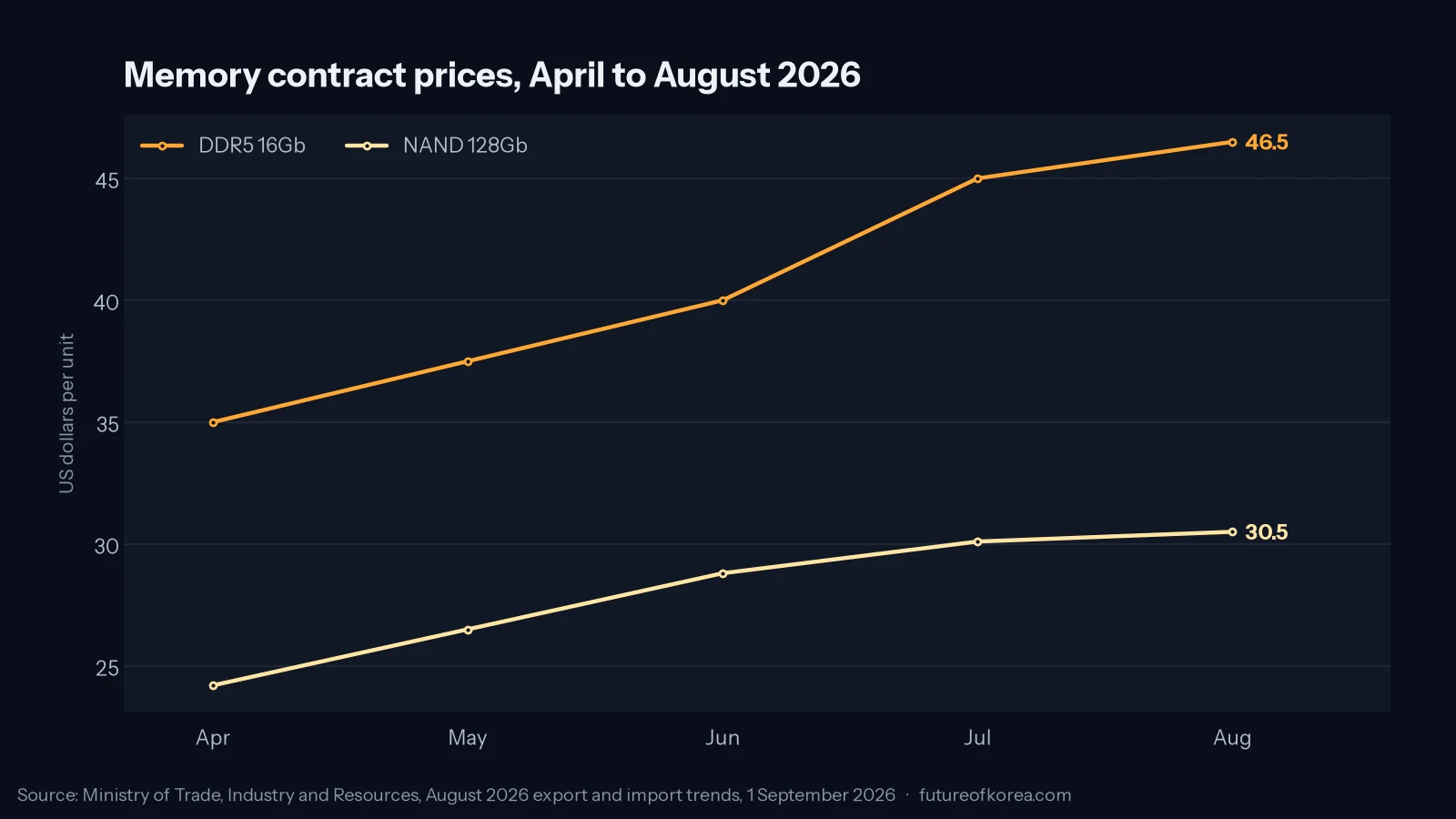
Korea's exports grew 68.7% in August. Strip out three product lines and they grew 2%.
August was Korea's third-biggest export month on record and produced a $34.75bn trade surplus. Almost the entire year-on-year gain came from three lines, and all three are priced rather than produced.