Korea's 2027 minimum wage is 10,700 won an hour. The number that actually binds is 12,840.
The Ministry of Employment and Labor finalised the 2027 minimum wage at 10,700 won an hour on 5 August. Anyone scheduled 15 hours a week or more is owed a fifth on top of that, which is why so many Korean part-time contracts stop at 14.
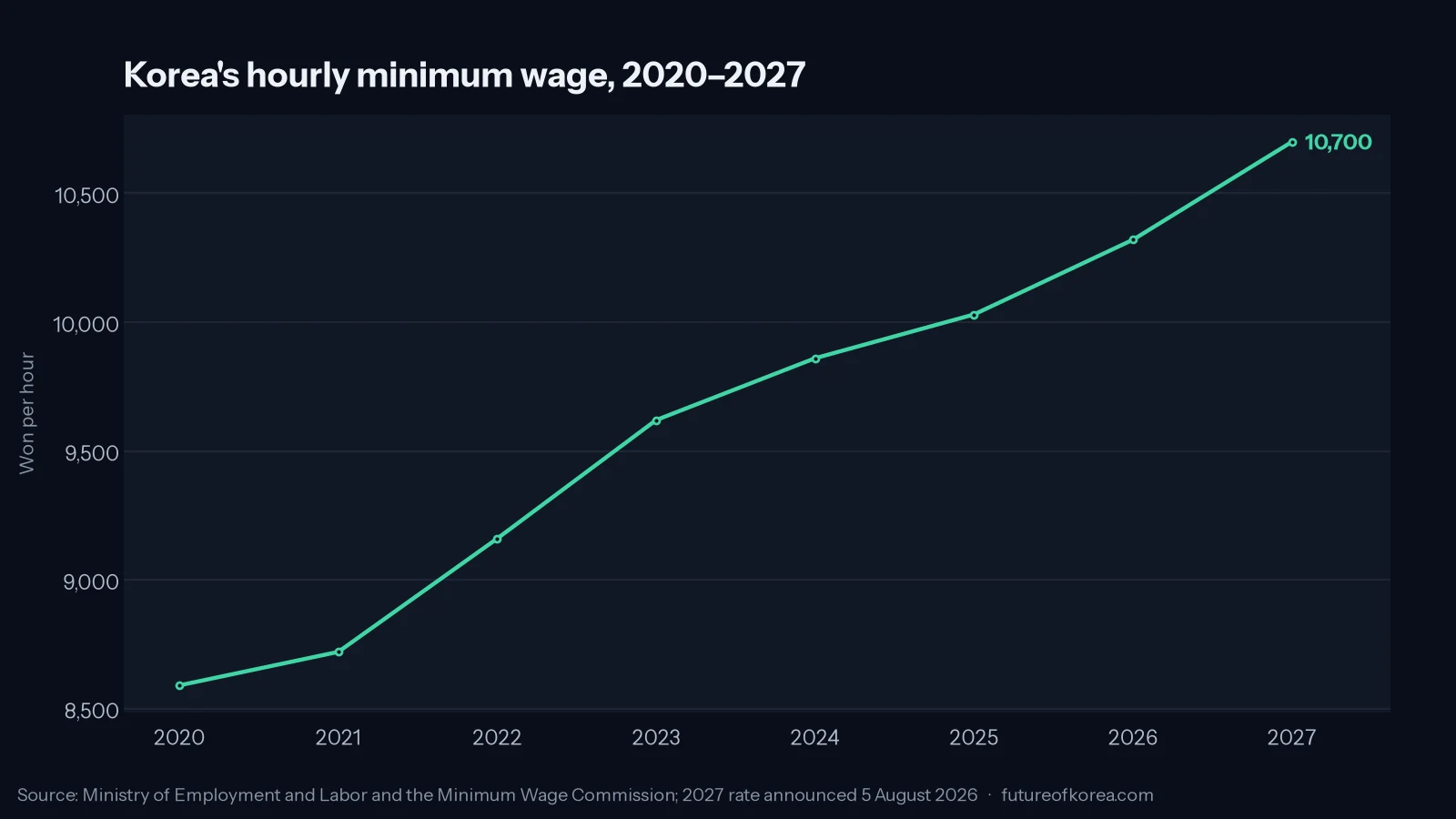
Korea’s minimum wage rises to 10,700 won an hour on 1 January 2027. The Ministry of Employment and Labor finalised it on 5 August, after rejecting objections from both the militant union federation and the small-business lobby. But 10,700 is not what an hour of work costs an employer, and it is not what a part-timer on a full week earns per hour worked.
The number that binds is 12,840.
Where the extra 20% comes from
Article 55 of the Labor Standards Act gives one paid day off a week to any worker whose scheduled hours average 15 or more. Paid, not merely off. For someone scheduled 40 hours, that day is worth eight hours of wages, so the employer pays for 48 hours and receives 40. The allowance has a name in Korean — 주휴수당, jubyu sudang — and no equivalent in most countries readers arrive from, which is why it is the single most misread line on a Korean payslip.
The arithmetic is a multiplier, not a rounding error. Forty-eight divided by forty is 1.2. Apply it to the headline rate and every hour actually worked costs 12,840 won.
This is also why the government’s own monthly conversion is 2,236,300 won rather than 1,861,800. The 209 hours in that calculation are not hours anyone works. They are 48 paid hours a week averaged across a month: 40 granted for labour, 8 granted for the rest day. Korea has published the minimum wage on this basis for decades, so dollar comparisons of “the Korean minimum wage” circulating abroad routinely understate what a compliant employer spends by a fifth.
| At ₩10,700 an hour, from 1 January 2027 | Amount |
|---|---|
| One hour worked | ₩10,700 |
| One hour worked, weekly holiday pay included | ₩12,840 |
| One 8-hour day | ₩85,600 |
| One 40-hour week, holiday pay included | ₩513,600 |
| One month, 209 paid hours | ₩2,236,300 |
Why so many Korean shifts stop at 14 hours
All of it switches off below fifteen.
Article 18(3) of the Labor Standards Act, with Article 30 of its Enforcement Decree, excludes workers whose scheduled weekly hours average under 15 over a four-week period from the weekly paid holiday entirely — and from statutory annual leave with it. Their rate is 10,700 won and stays 10,700 won.
That is a 20% cut in the hourly wage bill, available to any employer willing to write “14” on a contract instead of “20”. Korean has a phrase for the practice: 쪼개기 알바, splitting a job into fragments. It is what you are looking at when a café advertises three separate 14-hour openings rather than one 42-hour position, and it is a large part of why Korea’s part-time sector schedules the way it does.
The test is scheduled hours, not hours worked, and it averages over four weeks. A worker contracted for 14 hours who is routinely rostered 18 has crossed the threshold in substance, and the entitlement follows the substance. That argument is worth having before it becomes a claim rather than after.
A 3.7% award, against 2.8% inflation
The Commission reached the figure on 14 July after all 27 members voted. Labour opened at 8.7%, business at 2.0%, and the employer proposal was adopted 15 to 11 with one spoiled ballot. The ministry then ran a formal objection window; the Korean Confederation of Trade Unions and the Korea Federation of Micro Enterprise each filed one, and both were rejected before the rate was gazetted on 5 August.
Consumer prices rose 2.8% in July, after 3.1% in May and 3.2% in June. On those readings the 2027 award leaves well under a percentage point of real gain, and the margin is thinner than it looks: core inflation on the OECD basis reached 2.6% in July, a 31-month high, and the government expects August’s headline print to run about 0.6 points hotter on a base effect from last year’s temporary mobile-fee discounts. Durable goods and personal services, as the National Data Agency’s own trends officer noted, do not come down easily once they go up.
How many people this touches depends on which survey you believe. The ministry publishes two estimates side by side: 660,000 workers, an impact rate of 3.8%, on the Survey of Labour Conditions by Employment Type — and 2,978,000 workers, 13.3%, on the supplementary survey of the Economically Active Population.
The two differ by a factor of four and a half. The first reads establishment payroll records; the second asks households what they are actually paid. The space between them is roughly the shape of Korea’s micro-business and informal labour market, which is to say the workers most likely to be underpaid and least likely to appear in a payroll file at all. Publishing both is honest. It also concedes that nobody knows the number.
The Commission’s public-interest members attached a recommendation to the decision: that the government stand up a task force in the second half of 2026 to review the minimum wage system itself, not merely the annual rate. That is a committee asking to be reformed, which is not a routine thing for a committee to do.
Your visa changes none of this
The Minimum Wage Act applies to every business employing one worker or more, and the Commission states the point without qualification — regardless of employment status or nationality, naming temporary, daily, part-time and foreign employees. E-9 workers, E-7 professionals, F-series holders and D-2 students working within the hours their visa permits sit under the same floor as everyone else.
A contract that sets a lower wage is not merely unenforceable. The Act voids the offending provision and substitutes the legal rate, so the employer owes the difference whether or not the worker signed. Underpayment carries up to three years’ imprisonment with labour or a fine of up to 20 million won, and both may be imposed at once. A separate duty requires the rate to be posted somewhere staff can see it by the day before it takes effect, on pain of an administrative fine up to 1 million won.
There is one real carve-out, and it is narrower than employers tend to claim. On a contract of one year or more, the first three months may be paid at 90% — 9,630 won in 2027. It is unavailable on fixed-term contracts of under a year, and unavailable in occupations the ministry designates as simple labour, which is most of the part-time work where it would otherwise be reached for first.
Figures current as of 24 August 2026, sourced to the Ministry of Employment and Labor, the Minimum Wage Commission, the National Data Agency and the outlets listed below.
Useful links & tools
Official portals and primary data sources for this topic. Opens in a new tab.
- Minimum Wage Commission (English) — The statutory body that sets the rate — scope of application, employer obligations and the penalty provisions, in English
- Ministry of Employment and Labor (English) — Where the annual notification lands, plus English guidance on working hours, holidays and wage claims
- MOEL civil affairs portal — File a wage-arrears or minimum-wage complaint online rather than queuing at a regional office
- National Law Information Center (English) — Translations of the Minimum Wage Act and the Labor Standards Act, including Article 55 on the weekly paid holiday
Frequently asked questions
What is the effective minimum hourly wage in Korea for 2027?
The statutory rate is 10,700 won an hour from 1 January 2027. For a worker whose scheduled hours average 15 or more a week, Article 55 of the Labor Standards Act adds one paid day off per week, which is worth a further 20% of the wage bill. That makes the effective floor 12,840 won for every hour actually worked. Below 15 scheduled hours a week the weekly holiday entitlement does not apply and the rate stays at 10,700 won.
Does the Korean minimum wage apply to foreign workers?
Yes, without exception based on nationality. The Minimum Wage Commission states that the Act covers workers as defined in the Labor Standards Act at any business employing one or more people, regardless of employment status or nationality, and names temporary, daily, part-time and foreign employees explicitly. E-9, E-7, F-series and D-2 students working within their permitted hours are all covered. A contract setting a lower wage is void as to the shortfall, and the legal rate is substituted automatically.
Can an employer pay less during a probationary period?
Only in a narrow case. Where the employment contract runs for one year or more, the employer may pay 90% of the minimum wage for the first three months — 9,630 won an hour in 2027. It is not available on fixed-term contracts shorter than a year, and it does not apply to occupations the Ministry of Employment and Labor designates as simple labour, which covers much of the part-time restaurant, retail and delivery work where it would otherwise be used most.
What happens to an employer who pays below the minimum wage?
Underpayment carries up to three years’ imprisonment with labour or a fine of up to 20 million won, and the Minimum Wage Act allows both to be imposed together. A separate obligation requires employers to post the applicable rate where staff can see it by the day before it takes effect; failing to do so carries an administrative fine of up to 1 million won. Complaints go to a regional employment and labour office or through the ministry’s civil affairs portal.
Sources & further reading
Every figure in the key takeaways is numbered to the source it was read from. Sources marked primary are the statistics office, central bank, exchange, regulator or filing itself.
- 12027년 적용 최저임금안 시간급 10,700원 (2027 minimum wage set at ₩10,700 per hour)primary — Ministry of Employment and Labor / Minimum Wage Commission Secretariat · verified 2026-08-24
- 22027년 적용 최저임금안 시간급 10,700원 — full release text and PDF — KDI Economic Information and Education Center, July 2026 · verified 2026-08-24
- 3Minimum Wage System — scope of applicationprimary — Minimum Wage Commission, Republic of Korea · verified 2026-08-24
- 4Minimum Wage System — obligations of the employer and penalty provisionsprimary — Minimum Wage Commission, Republic of Korea · verified 2026-08-24
- 5July Consumer Inflation Eases to 2.8%, First Sub-3% Reading in Three Months — Seoul Economic Daily, August 2026 · verified 2026-08-24
- 6Korea Sets 2027 Minimum Wage at 10,700 Won per Hour — Seoul Economic Daily, August 2026 · verified 2026-08-24
- 7S. Korea sets 2027 minimum wage at 10,700 won per hour, up 3.7% — The Korea Herald, July 2026 · verified 2026-08-24
Read next
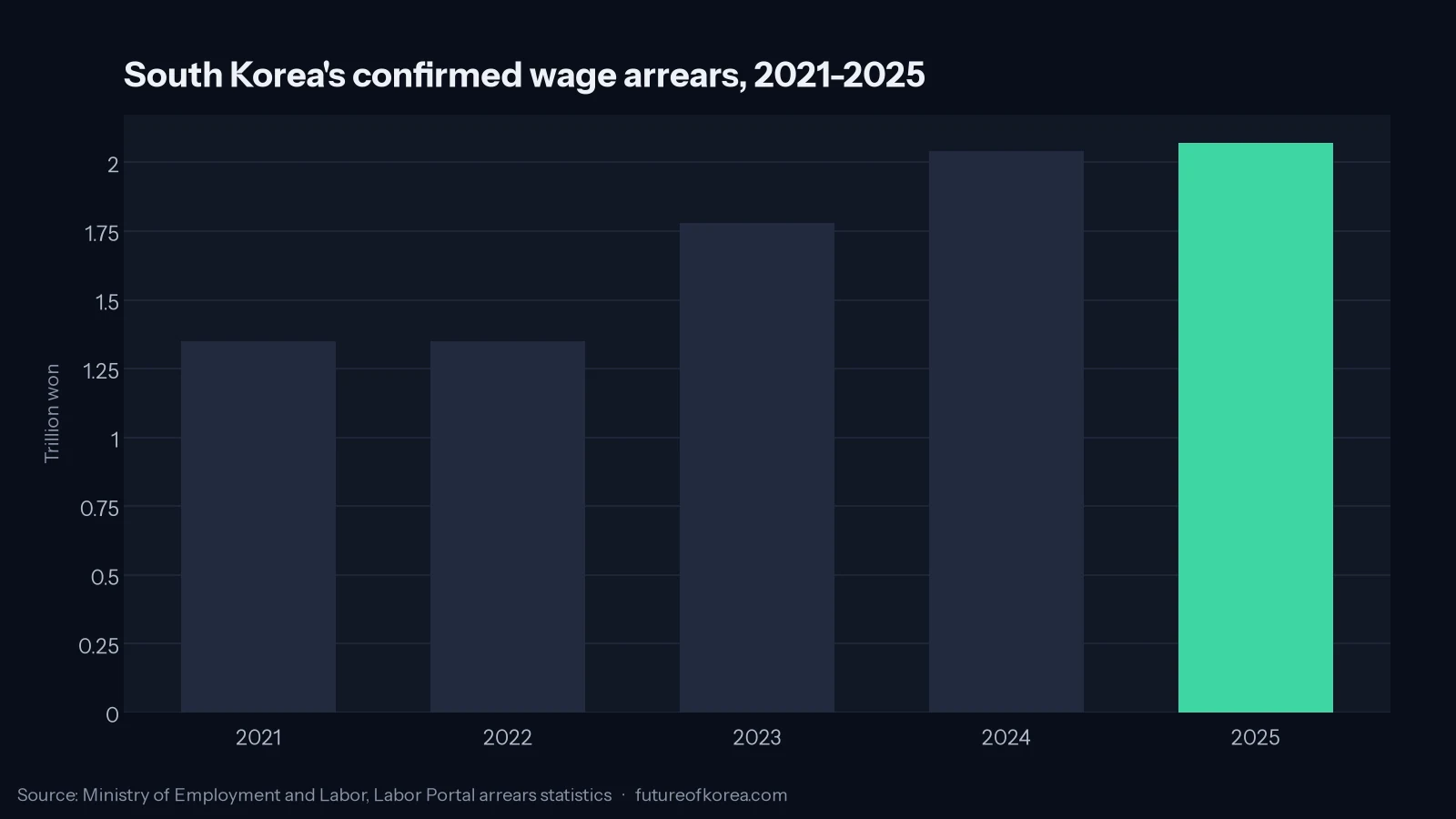
Unpaid severance is 45% of Korea's wage arrears — and the penalty rises this month
Almost half of everything Korean employers failed to pay their workers this year was severance. Here is why the money is missing, what the law says you are owed, and what changes on 18 September.
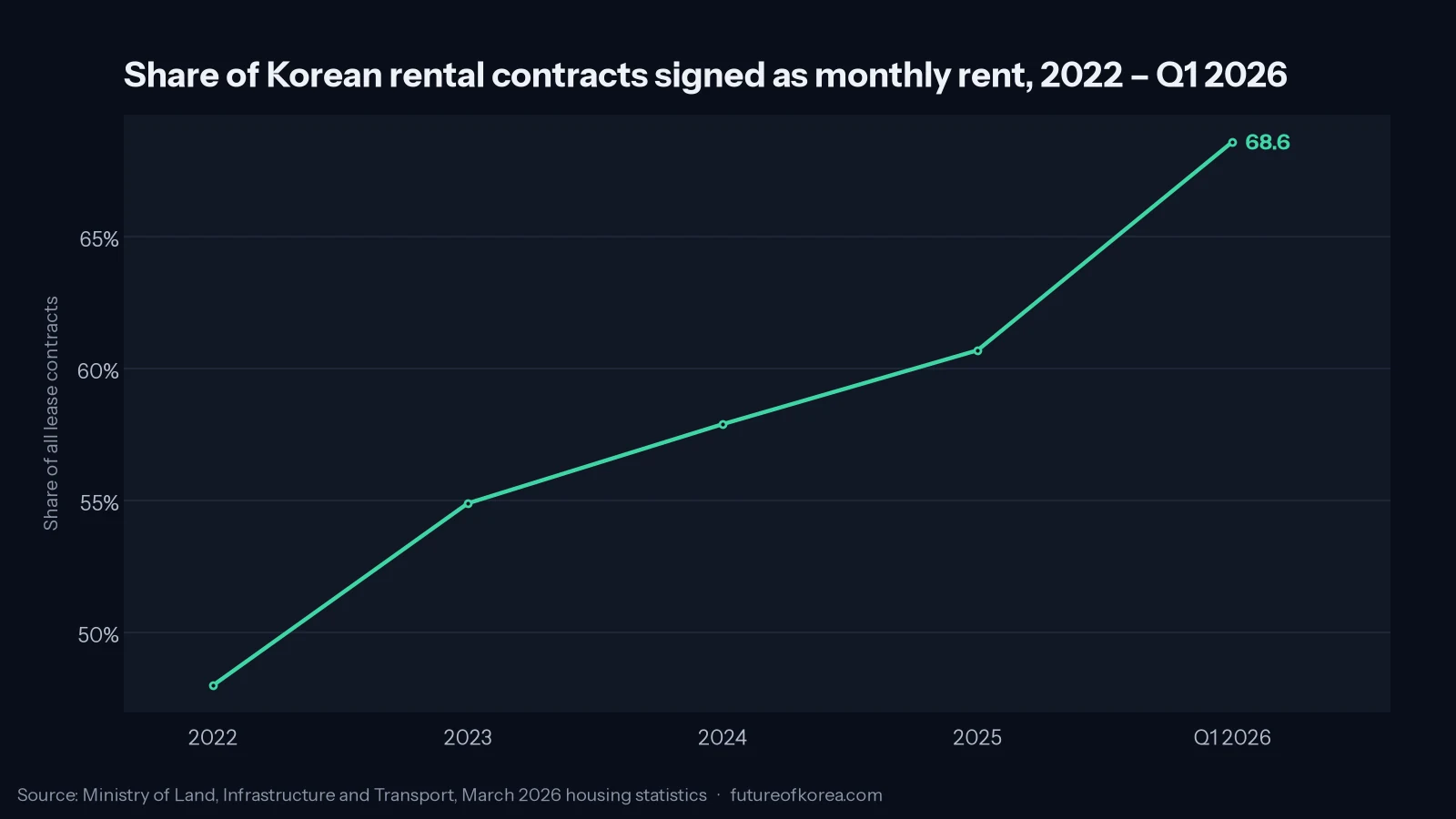
Korea will hold your jeonse deposit for you — and lend it to builders
From November, a state guarantor rather than a landlord will hold the deposit on some Korean leases. HUG invests the money in housing project-finance loans and pays the landlord the return as monthly income.
Korea's flat tax for foreign workers is going to 21% — and the break-even moves ₩20m
The 2026 tax reform package raises the optional flat rate for foreign employees by two points and extends the scheme to 2029. The rate rise pushes the salary at which electing it pays from about ₩133 million to about ₩154 million.