Korea's exports grew 68.7% in August. Strip out three product lines and they grew 2%.
August was Korea's third-biggest export month on record and produced a $34.75bn trade surplus. Almost the entire year-on-year gain came from three lines, and all three are priced rather than produced.
Korea exported $98.25bn of goods in August, 68.7% more than a year earlier. Three product lines — memory chips, computers and refined petroleum — supplied 98% of that increase. Take those three out and the rest of Korea’s export economy grew by about 2%.
The headline is real money. August was the third-largest export month Korea has recorded, behind $102.0bn in June and $99.0bn in July, and the trade surplus came to $34.75bn, a third straight month above $30bn. Through eight months the cumulative surplus is $202.5bn. The comparable figure a year ago was $40.3bn.
Semiconductors alone were $46.65bn, up 209.0%. That is the largest month in the history of the series and 47.5% of everything the country shipped.
The arithmetic of a 69% month
The Trade Ministry’s release notes that exports excluding semiconductors still rose 20%. That is correct, and it is the more encouraging way to put it.
It also leaves computers inside the “excluding semiconductors” bucket. Computers were $6.24bn, up 419.5%, and the ministry’s own text explains why: NAND flash prices, in enterprise SSDs. That is memory sold in a metal case rather than on a module.
| Line | Aug 2026 | Aug 2025 | Change |
|---|---|---|---|
| Semiconductors | $46.65bn | ~$15.10bn | +209.0% |
| Computers | $6.24bn | ~$1.20bn | +419.5% |
| Petroleum products | $6.84bn | ~$4.14bn | +65.3% |
| Everything else | ~$38.52bn | ~$37.80bn | +1.9% |
| Total | $98.25bn | ~$58.24bn | +68.7% |
The 2025 column is derived: the ministry publishes current levels and growth rates, not prior-year levels. Those three lines added $39.3bn of the $40.0bn total increase.
Nothing in the number is capacity
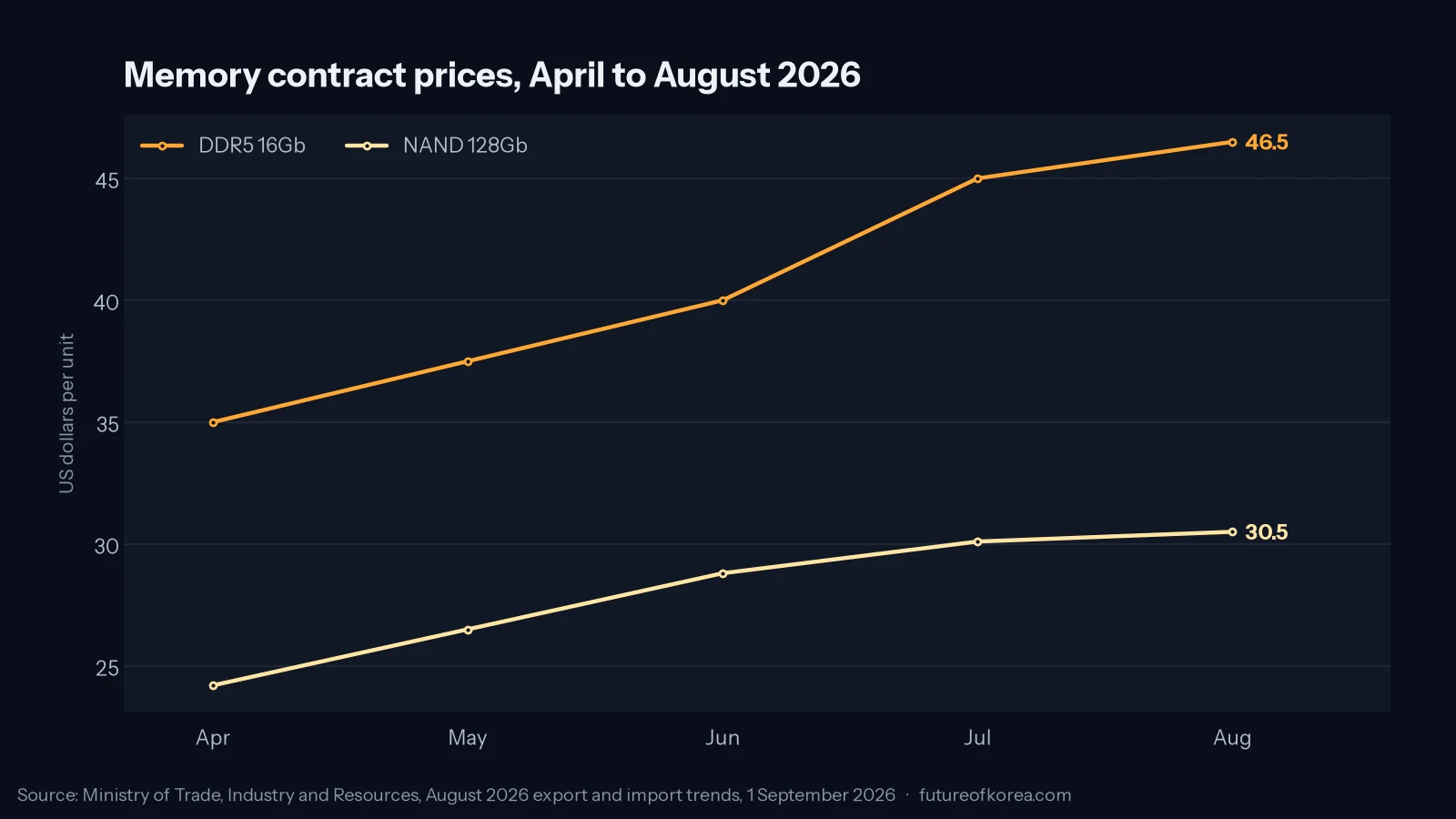
The DDR5 16Gb fixed contract price ran $35.00 in April, $37.50 in May, $40.00 in June, $45.00 in July and $46.50 in August. 128Gb NAND went from $24.20 to $30.50 over the same five months. No fab was built in that window.
Refined petroleum tells the same story from the other end, where the volumes are published. Export value rose 65.3%; shipped volume fell 2.2%. The unit price was $1,143 a tonne, up 69.1%, on Dubai crude at $88.80 a barrel, up 27.9% after disruption around the Strait of Hormuz. Petrochemicals: value up 12.2%, volume down 7.0%.
What is actually shrinking
Cars fell 29.8% to $3.85bn. The ministry attributes that to summer shutdowns shifting from late July 2025 into early August 2026, plus a partial strike — a timing artefact that should unwind in September. Ships fell 45.9% to $1.69bn on delivery scheduling, which says nothing about the order book and rather more about the gap between winning orders and booking revenue.
Displays fell 5%. Household goods fell 3%, home appliances 2%, textiles were flat. General machinery managed 1.8% and steel 7.9%, the latter on American data-centre construction rather than anything sold into Europe, where the new tariff-rate quota is biting.
The genuinely healthy small lines are small. Batteries were $0.60bn, up 24.0% and positive for a fourth month. Cosmetics were $1.31bn, up 52.1%. Bio-health was $1.41bn, up 22.3%. Together those three are less than a tenth of the semiconductor line.
The China number needs reading twice
Exports to China rose 119.3% to $24.10bn. In the first 25 days of August, chips to China were $13.4bn, up 320% — while petrochemicals to China fell 5%, wireless handsets 4% and displays 14%. The bilateral relationship did not improve. One product got expensive.
The United States took $16.50bn, up 89.3%, with computer exports over the first 25 days up 1,040% and cars down 43%. On the import side Korea bought $2.57bn of semiconductor manufacturing equipment, up 117.3%, which is the one line in the release that points at future capacity rather than current pricing.
What a surplus this size does next
The Bank of Korea put July’s current account surplus at $42.08bn, with a goods balance of $40.43bn — the 39th consecutive monthly surplus and the second largest ever recorded. August’s trade figures imply another very large print when that release lands in early October.
A surplus of that scale normally lifts a currency. It has not, and the reasons are structural rather than cyclical — the subject of why the won stays weak while exports boom. It does, though, remove one argument against tightening, and the Bank of Korea’s own dot plot already sits above the current 3.00% base rate.
Figures current as of 7 September 2026. Export, import and product-line data are provisional customs clearance figures from the Ministry of Trade, Industry and Resources release of 1 September 2026, revisable until annual statistics are finalised in February 2027. Balance of payments figures are Bank of Korea provisional data published 4 September 2026. Prior-year product levels are derived from published growth rates.
Useful links & tools
Official portals and primary data sources for this topic. Opens in a new tab.
- MOTIR press releases — monthly export and import trends — Where the trade release lands on the first day of each month, with the full twenty-category table
- Korea Customs Service trade statistics — The underlying clearance data, including the 1–20 provisional release each month
- Economic Statistics System (ECOS) — Bank of Korea data portal — balance of payments, terms of trade and the won
- K-stat trade statistics — Korea International Trade Association's front end for the customs series, easier for long back-runs by HS code
Frequently asked questions
How much did Korea export in August 2026?
Korea shipped $98.25bn of goods in August 2026 on a customs clearance basis, 68.7% more than in August 2025, and imported $63.51bn, leaving a trade surplus of $34.75bn. It was the third-largest export month Korea has recorded, behind $102.0bn in June 2026 and $99.0bn in July 2026. The figures are provisional and can be revised until the annual statistics are finalised in February 2027.
Is Korea's export boom driven by volume or by price?
Mostly by price. The DDR5 16Gb contract price rose from $35.00 in April 2026 to $46.50 in August, and 128Gb NAND from $24.20 to $30.50. Refined petroleum export value rose 65.3% while shipped volume fell 2.2%, and petrochemical volume fell 7.0% even as value rose 12.2%. Memory shipment volumes are not published monthly, so the price effect cannot be isolated exactly, but the direction is unambiguous.
Which Korean export categories fell in August 2026?
Cars fell 29.8% to $3.85bn and ships fell 45.9% to $1.69bn — the ministry attributes the car figure to summer shutdowns moving from late July 2025 to early August 2026 plus a partial strike, and the ship figure to delivery scheduling. Displays fell 5%, household goods 3% and home appliances 2%. Six of the twenty main export categories declined.
Why does the government say exports excluding semiconductors rose 20%?
Because the calculation removes the line labelled semiconductors and leaves everything else, including the computer category. Computers rose 419.5% to $6.24bn, and the ministry’s own text attributes that to NAND flash prices in enterprise SSDs. Removing semiconductors and computers together, and refined petroleum alongside them, leaves growth of roughly 1.9%. Both figures are arithmetically correct; they answer different questions.
Sources & further reading
Every figure in the key takeaways is numbered to the source it was read from. Sources marked primary are the statistics office, central bank, exchange, regulator or filing itself.
- 12026년 8월 수출입동향 (August 2026 export and import trends)primary — Ministry of Trade, Industry and Resources · verified 2026-09-07
- 22026년 7월 국제수지(잠정) (Balance of payments, July 2026, provisional)primary — Bank of Korea, via KDI Economic Information and Education Center · verified 2026-09-07
- 32026년 8월 1일 ~ 8월 20일 수출입 현황 [잠정치]primary — Korea Customs Service, via KDI Economic Information and Education Center · verified 2026-09-07
- 42026년 8월 수출입 동향 (release record) — Ministry of Trade, Industry and Resources, via KDI · verified 2026-09-07
Read next
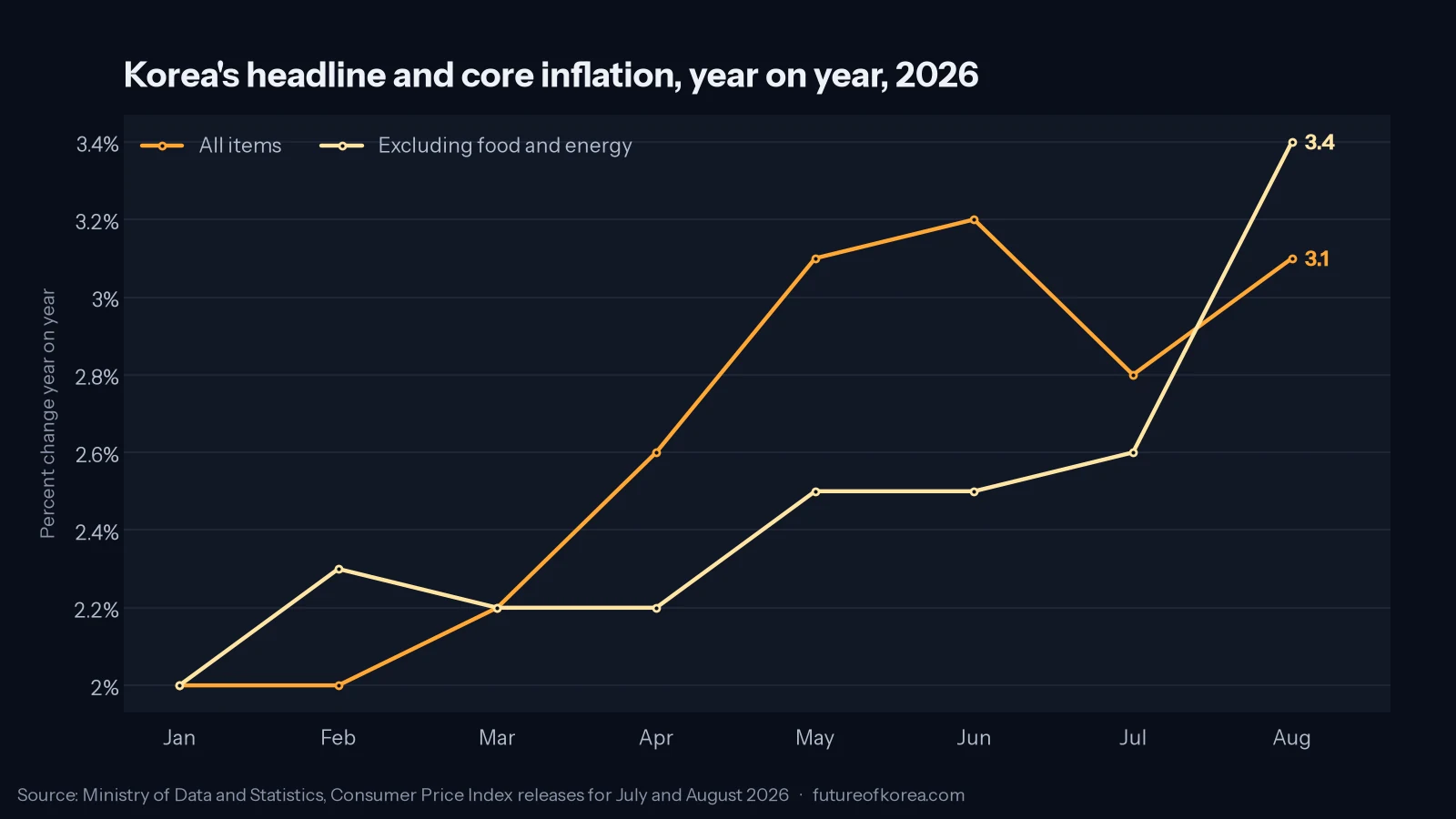
Korea's core inflation hit 3.4%. A phone bill from last August did most of it.
Consumer prices rose 3.1% in August and core inflation rose 3.4%, the sharpest one-month acceleration of the year. Strip out a single expenditure group and the same data show inflation falling.
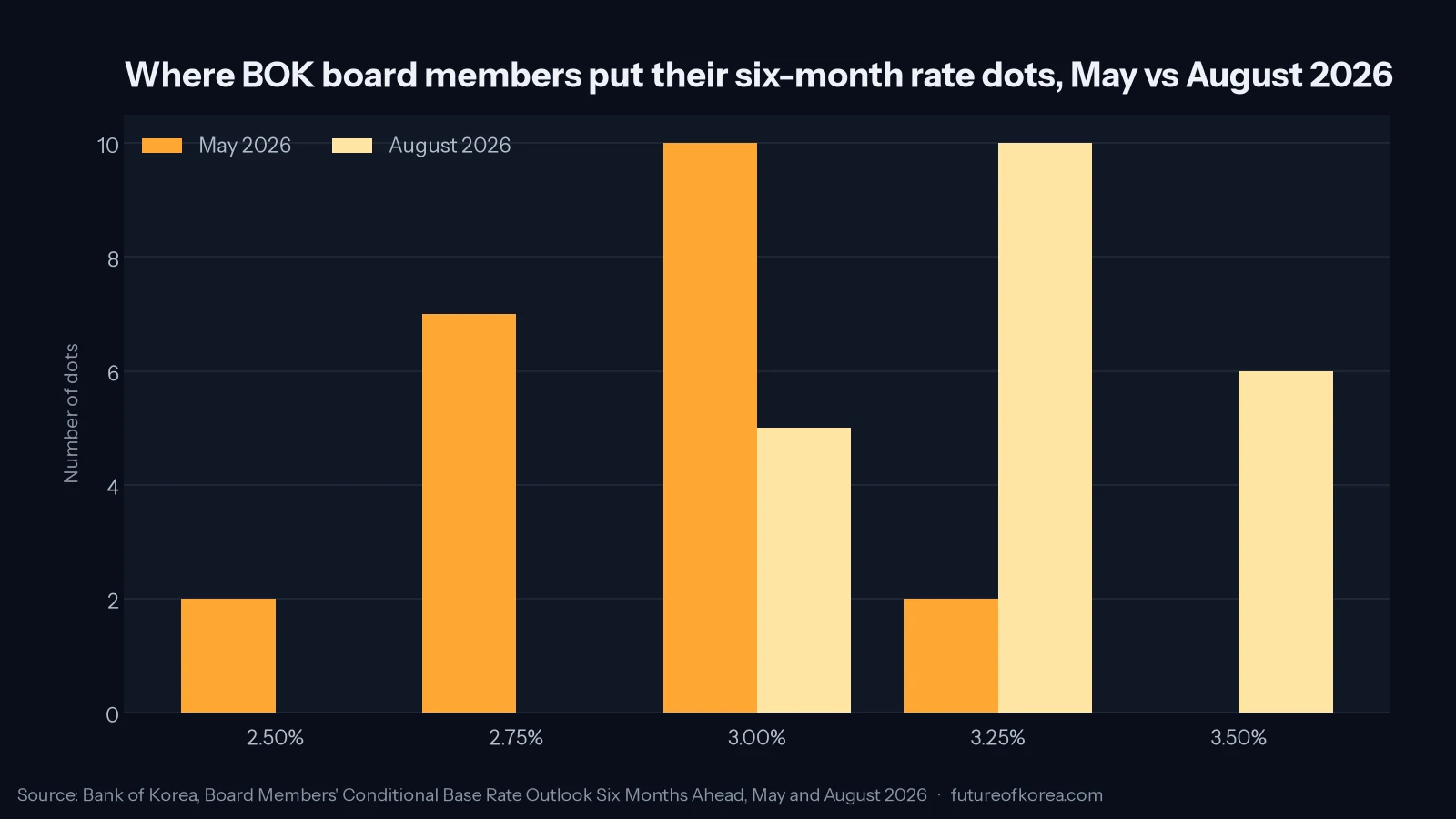
The Bank of Korea went to 3%. Its own dot plot says that is not the top.
A second consecutive quarter-point hike takes Korea's base rate to 3.00%. The more consequential release was the board's six-month rate outlook, which moved up almost as a bloc.
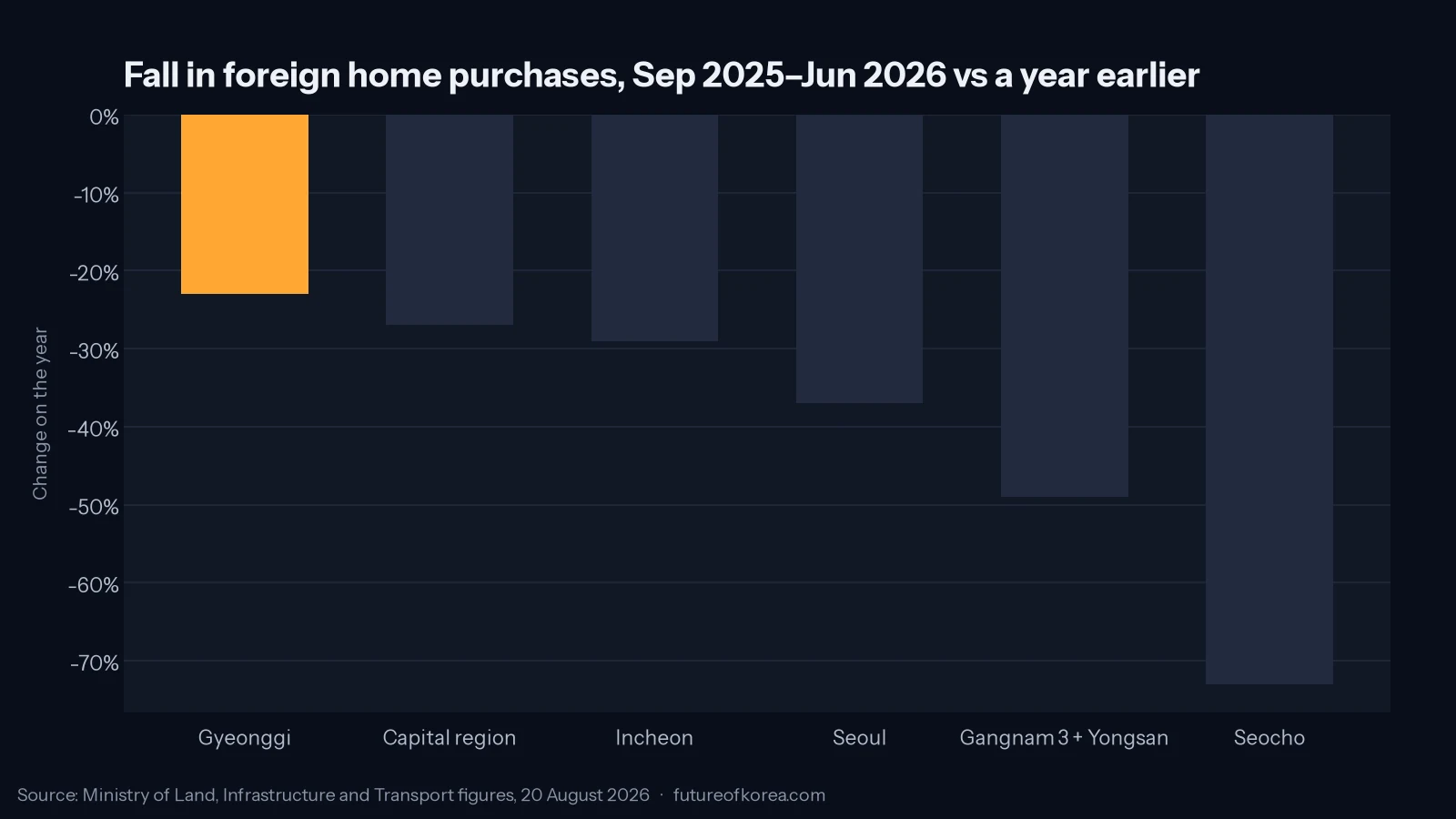
Korea extended its foreign home-buying permits. The buyers were never in Gangnam.
The Ministry of Land, Infrastructure and Transport kept its capital-region permit zone for another year and added 353 islands. The transaction data underneath shows a policy aimed at Gangnam catching a market in Bucheon.