Korea will charge 90% after your 300th outpatient visit. Last year that was 7,765 people.
The cabinet cut the excess-use threshold from 366 visits a year to 301 on 8 September. Fewer than eight thousand people crossed the old line — which is the clearest sign the rule is not really aimed at them.

Photograph by RDNE Stock project on Pexels.
From 1 January, Korea will charge patients 90% of the bill for every outpatient visit after their 300th in a calendar year. The current trigger is the 366th. The cabinet approved the change on 8 September, and it takes effect with the new counting year.
Almost nobody will pay it. On the National Health Insurance Service’s own count, of the roughly 48.4 million people who used outpatient care in 2025, 7,765 went more than 300 times. That is one person in every six thousand.
The people at the far end of the curve
Those 7,765 averaged 344.7 visits each — about six attendances a week, every week, for a year. The ministry also found at least one person who recorded 1,775 visits in twelve months, which works out at just under five a day including weekends.
Children, pregnant women, patients registered under the severe-illness copayment scheme who are being treated for that condition, and registered severely disabled patients are all excluded, as they were under the 365-visit rule that took effect on 1 July 2024. Anyone else can ask the insurance service’s excess-use review committee to certify that the visits were medically necessary, in which case the ordinary rate applies.
Lowering the trigger by 65 visits will not save the fund a meaningful amount of money. Cases at 344 visits a year are clinically strange, and most of them will be exempted on review. Treat the number as a boundary marker rather than a cost-control measure.
The measure that will actually change behaviour arrives in December
The same package sets up something considerably more consequential. From 24 December 2026, the Health Insurance Review and Assessment Service will run a system that lets a doctor see what treatment a patient has already received elsewhere at the moment of prescribing. It starts with CT and MRI scans and expands from there, wired into hospital electronic records so the check happens inside the existing workflow.
This addresses the problem the visit cap does not. Korea’s outpatient volume is not driven by seven thousand outliers. It is driven by everyone. The ministry puts the 2024 figure at 17.9 outpatient visits per person against an OECD average of 6.6 — a ratio of 2.7 to one. In 2021 the comparison was 15.7 against 5.9. The gap is widening, not closing.
Much of that volume is duplicated rather than excessive. A patient who visits three clinics for the same complaint gets scanned three times, because none of the three can see what the others did. Korea has never had a way to stop that at the point of care. Now it will, for the two imaging modalities that cost the most.
The freeze that makes the cost control necessary
The same morning, before the cabinet met, the Health Insurance Policy Deliberation Committee froze the contribution rate for 2027 at 7.19%, and left the property-assessment point value for local subscribers at ₩211.5. It is the third freeze in four years; the rate has moved once since 2023, by a tenth of a percentage point last January. Our guide to what foreign residents actually pay for Korean health insurance sets out how that rate translates into a monthly bill.
The committee’s stated reasons are worth reading closely. Five consecutive years of operating surplus. A reserve of ₩30.2tn at the end of 2025, worth 3.5 months of spending. An extra ₩1.1tn of government support in the 2027 budget. And, listed alongside the rest, expected growth in contribution income from the semiconductor upturn.
That last one is not decoration. Contributions are levied on wages, the chip industry pays some of the highest wages in the country, and Korea’s export boom is concentrated in three product lines of which memory is the largest. A health insurance rate held flat for a year is now partly a bet on DRAM pricing.
And it is expanding coverage substantially. From December the copayment for 1.36 million patients with rare and severe intractable conditions drops from 10% to 7%, and to 5% in the first half of 2028. From January 2027, edentulous over-65s become eligible for two subsidised implants — about 70,000 people, worth roughly ₩2.28m each. The ministry puts the whole package at ₩800bn a year across 1.97 million patients.
Two changes that affect ordinary payroll
Buried in the same decree are two administrative fixes worth knowing about. From 1 October 2026, an employee facing an extra premium bill after the annual reconciliation can spread it over up to twelve months whenever the amount exceeds the minimum monthly premium — ₩10,080 on the 2026 employee share. The old threshold was a full month’s own premium, so a worker paying ₩150,000 a month could not spread a ₩140,000 bill.
Employers get until 31 March, rather than 10 March, to file the remuneration data the reconciliation needs. In the 2025 round, 10.26 million of the 16.56 million people reconciled were handled by direct employer filing — and 7.13 million of those could have been settled from National Tax Service records that simply had not arrived in time.
Figures current as of 9 September 2026, drawn from Ministry of Health and Welfare announcements of 8 September 2026 and 30 June 2024, and the National Health Insurance Service contribution rate table.
Useful links & tools
Official portals and primary data sources for this topic. Opens in a new tab.
- MOHW press release on the enforcement decree amendment — The 8 September announcement, with the exemption categories and the commencement date for each change
- NHIS member portal — Where your own visit count for the year is recorded, under Health iN then My Health Management
- HIRA — Runs the new treatment-history checking system that starts with CT and MRI on 24 December 2026
- NHIS contribution rate table — The official rate for every year — the place to confirm that 7.19% carries into 2027
Frequently asked questions
How many doctor visits can I make in Korea before the 90% copayment applies?
Three hundred in a calendar year, counted from 1 January 2027. The 301st outpatient visit and every visit after it in that year carries a 90% copayment instead of the usual 20% or so. The count runs from 1 January to 31 December and resets each year. Days of hospitalisation and days covered by a prescription are excluded from the tally, so the number refers to attendances rather than days of treatment.
Who is exempt from the 300-visit rule?
Children, pregnant women, people registered under the severe-illness copayment programme who are being treated for that registered condition, and registered patients with severe disabilities are excluded automatically. Anyone else can apply to the National Health Insurance Service’s excess-use review committee, which can grant an exemption where the visits are medically necessary. If the exemption is granted, the ordinary copayment rate applies instead of 90%.
How do I check how many outpatient visits I have used this year?
The National Health Insurance Service publishes a running count in its member portal at nhis.or.kr and in The건강보험 app, under Health iN and then My Health Management, where treatment and prescription records are listed. Hospitals and clinics can also see whether a patient has passed the threshold through the service’s eligibility-check system at the reception desk, and are expected to tell the patient before treatment.
Did Korean health insurance premiums go up for 2027?
No. The Health Insurance Policy Deliberation Committee froze the contribution rate at 7.19% on 8 September 2026, and left the property-assessment point value for local subscribers at ₩211.5. The ministry cited five consecutive years of operating surplus, a reserve worth 3.5 months of spending, an extra ₩1.1tn of government support in 2027, and expected contribution growth from the semiconductor upturn.
Sources & further reading
Every figure in the key takeaways is numbered to the source it was read from. Sources marked primary are the statistics office, central bank, exchange, regulator or filing itself.
- 1필요한 진료는 보호하고, 과도한 외래 이용은 합리적으로 관리한다 (Protecting necessary care, managing excessive outpatient use)primary — Ministry of Health and Welfare, September 2026 · verified 2026-09-09
- 2건강보험 보장 수준 높아진다 (Health insurance coverage widens; 2027 contribution rate decision)primary — Ministry of Health and Welfare, September 2026 · verified 2026-09-09
- 3年 365회 초과 외래진료에 대하여 본인부담률 90%로 상향 조정 (Copayment raised to 90% above 365 outpatient visits a year)primary — Ministry of Health and Welfare, June 2024 · verified 2026-09-09
- 4Contribution Rateprimary — National Health Insurance Service · verified 2026-09-09
Read next
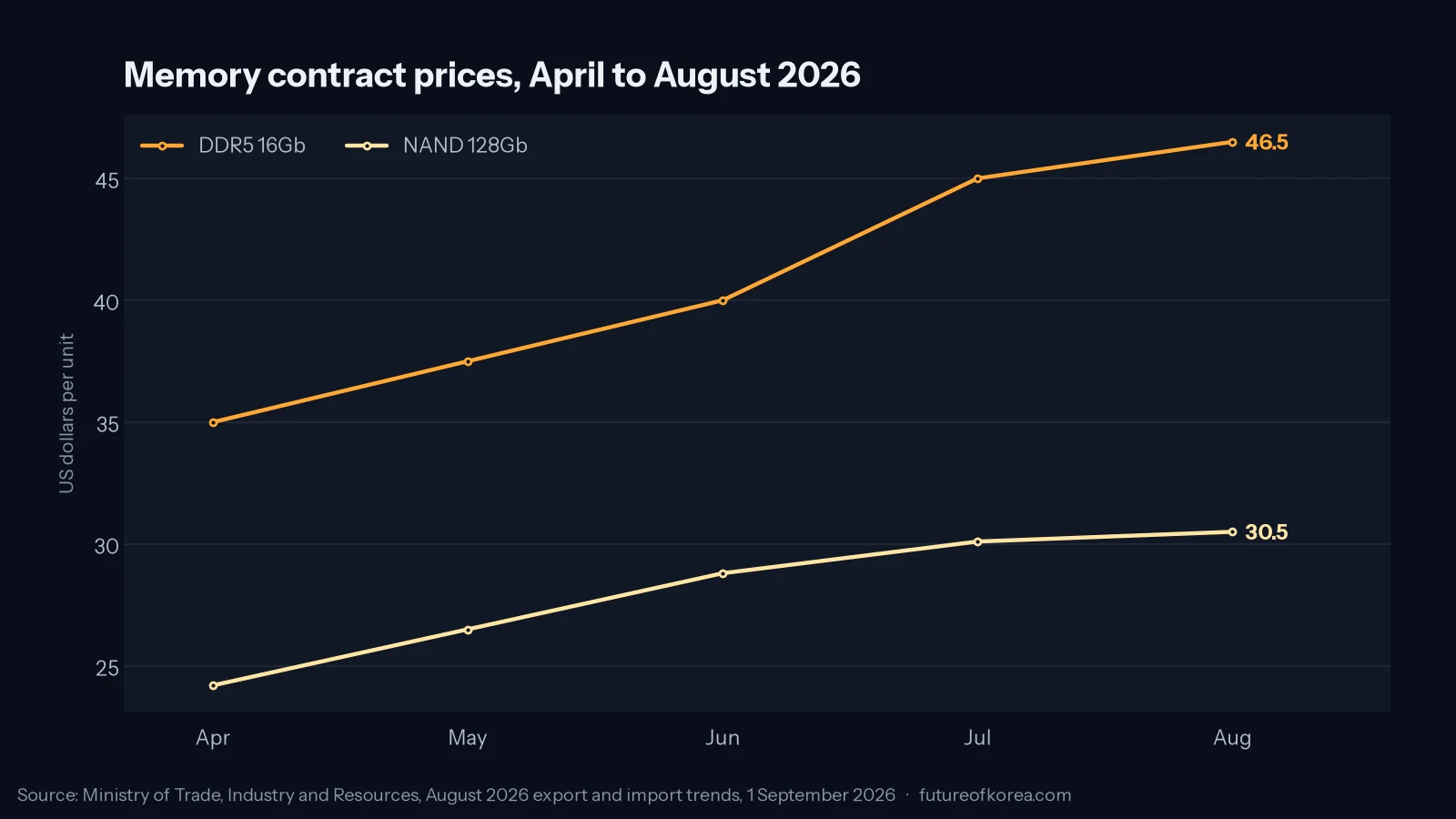
Korea's exports grew 68.7% in August. Strip out three product lines and they grew 2%.
August was Korea's third-biggest export month on record and produced a $34.75bn trade surplus. Almost the entire year-on-year gain came from three lines, and all three are priced rather than produced.
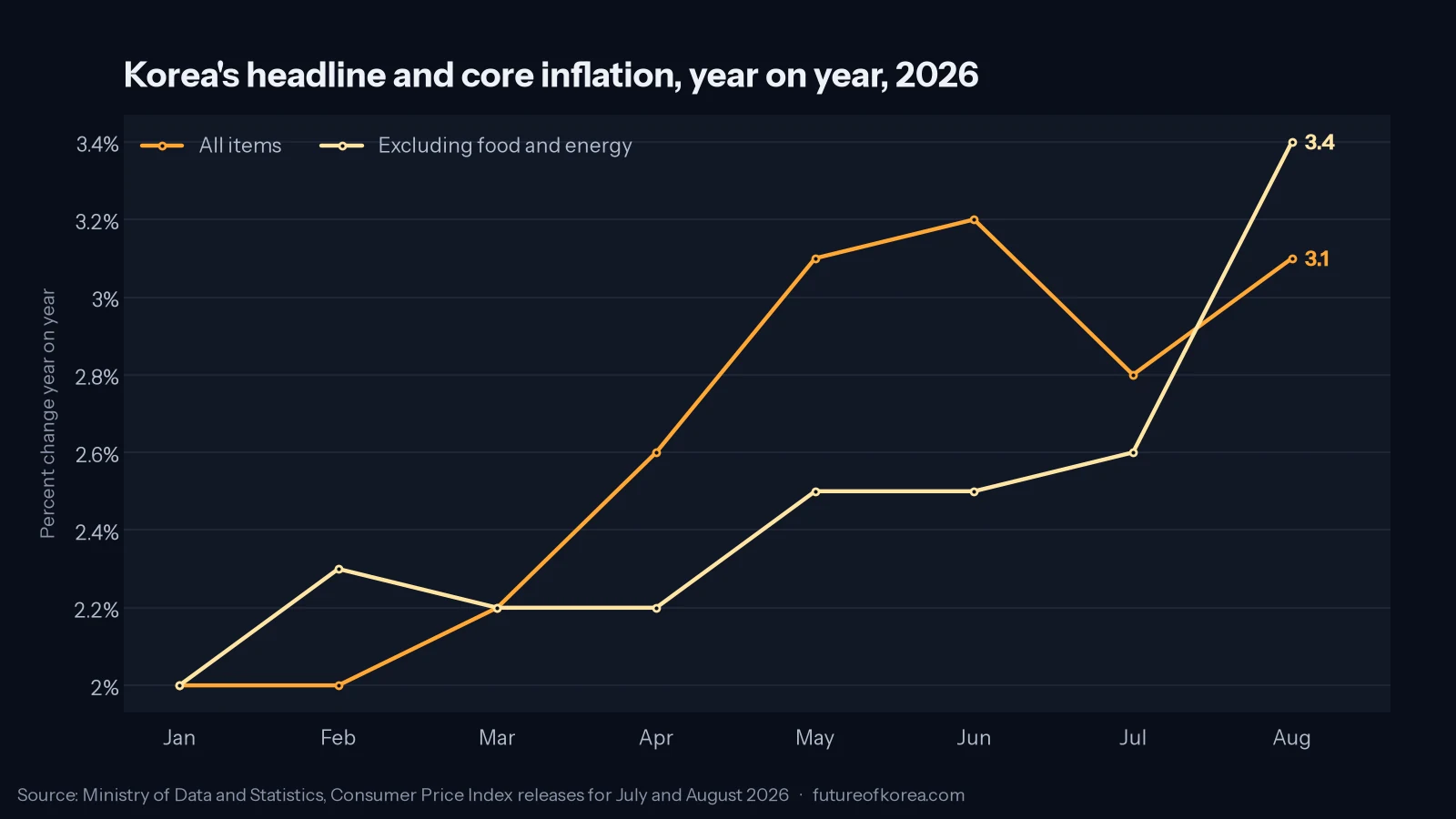
Korea's core inflation hit 3.4%. A phone bill from last August did most of it.
Consumer prices rose 3.1% in August and core inflation rose 3.4%, the sharpest one-month acceleration of the year. Strip out a single expenditure group and the same data show inflation falling.
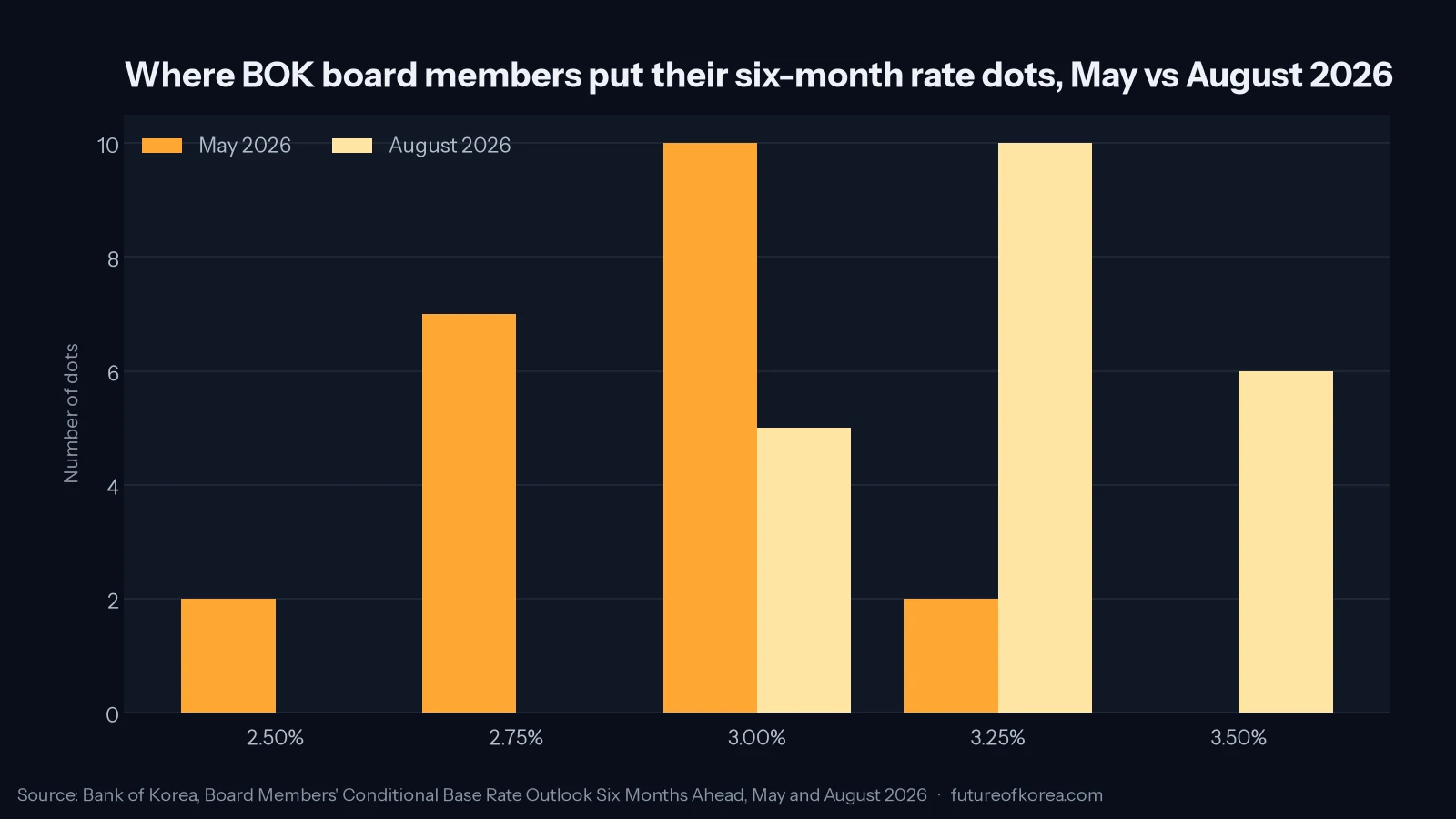
The Bank of Korea went to 3%. Its own dot plot says that is not the top.
A second consecutive quarter-point hike takes Korea's base rate to 3.00%. The more consequential release was the board's six-month rate outlook, which moved up almost as a bloc.