Unpaid severance is 45% of Korea's wage arrears — and the penalty rises this month
Almost half of everything Korean employers failed to pay their workers this year was severance. Here is why the money is missing, what the law says you are owed, and what changes on 18 September.
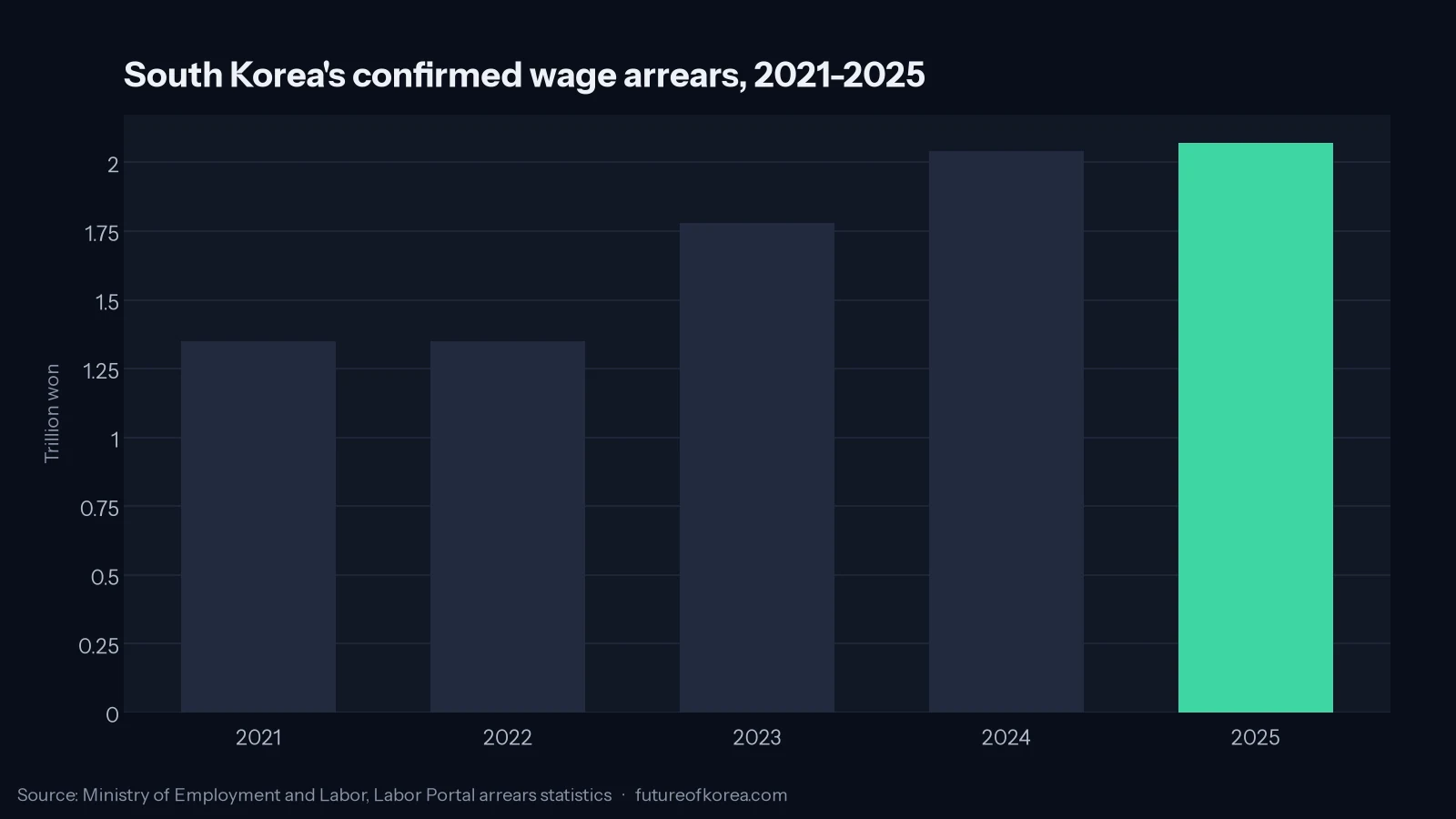
Korean employers were confirmed to owe their workers ₩1,081.4bn in the first seven months of 2026. Of that, ₩491.9bn was retirement benefits — severance, 퇴직금 — against ₩527.8bn in ordinary unpaid wages. Almost half of the country’s wage-theft problem is a single payment that comes due on the day someone leaves.
That is not an accident of the reporting. It is the design of the scheme.
Severance in Korea is a promise, not a fund
Under Article 8 of the Employee Retirement Benefit Security Act, an employer owes at least 30 days of average wage for every year of continuous service, payable to anyone who has worked a year or more and averaged 15 hours a week. Average wage is the previous three months of pay divided by the days in that period; where that is lower than ordinary wage, ordinary wage applies instead. The formula the Labour Ministry uses is daily average wage × 30 × (days of service ÷ 365).
For a worker on ₩4m a month with five years in, that is roughly ₩20m. Article 9 gives the employer 14 days from the last working day to hand it over.
Here is the part most people never think about until they need to: for three-quarters of Korean workplaces, nobody has set that money aside. The 2005 Act created funded pension plans — defined benefit, defined contribution, held at an outside financial institution — as an alternative to the old unfunded severance scheme. It did not abolish the old scheme. Twenty-one years on, the Ministry of Data and Statistics counted 442,000 workplaces with a funded plan at the end of 2024, out of 1,646,000 eligible. An adoption rate of 26.5%.
So for most employees of most Korean companies, severance is a number in the accounts. Whether it becomes money depends on whether the company can pay on the day you resign.
The arrears are concentrated where the funding isn’t
Split the ₩1,081.4bn by employer size and the pattern is exact. Workplaces with fewer than five employees account for ₩367.8bn. Those with five to 29 account for ₩435.2bn. Together, ₩803.0bn — 74% of everything owed. Companies with 300 or more staff account for ₩20.3bn, under 2%.
Large employers converted to funded plans long ago; the ministry-sponsored tripartite task force puts adoption above 90% among firms with 300 or more staff. Small employers did not, and small employers are where the arrears live. The money is missing from precisely the balance sheets that never held it.
| Employer size | Arrears, Jan–Jul 2026 | Share |
|---|---|---|
| Under 5 staff | ₩367.8bn | 34.0% |
| 5–29 | ₩435.2bn | 40.2% |
| 30–99 | ₩172.3bn | 15.9% |
| 100–299 | ₩85.3bn | 7.9% |
| 300+ | ₩20.3bn | 1.9% |
Source: Ministry of Employment and Labor, cumulative to 31 July 2026.
Foreign nationals were owed ₩87.8bn of the total — 8.1%. That share is worth reading against the fact that foreign workers are heavily concentrated in manufacturing and construction firms of exactly the size that dominates the table above. If you are on an E-9 at a 20-person parts supplier in Gyeonggi, you are in the highest-risk cell of the grid.
What changes on 18 September
Parliament amended the Act on 17 March 2026. Most of it took effect on 1 July: the small-business retirement pension fund scheme, previously open to firms of 30 or fewer, now covers firms under 100, and the self-employed can pay into a contributor account of their own.
The penalty provisions were held back six months. From 18 September 2026, withholding retirement benefits carries up to five years’ imprisonment or a fine of up to ₩50m, up from three years or ₩30m. The stated purpose in the legislature’s own explanatory note is deterrence — raising employers’ sense of exposure so the arrears do not happen in the first place.
Whether a heavier sentence deters a company that has run out of cash is a fair question. It does change the negotiating position of the worker standing in front of a labour inspector, which is where most of these cases are actually settled: of the ₩1,081.4bn confirmed to July, ₩748.4bn was resolved through inspector-supervised settlement and ₩333.0bn referred to prosecutors.
The unfunded scheme is being abolished
On 6 February 2026 a tripartite task force of the Labour Ministry, the two national union federations, the employers’ federation and the SME federation signed a joint declaration agreeing to two things: external funding of retirement benefits becomes mandatory for every workplace, and a trust-based pension structure is introduced alongside the existing contract-based one.
The government reported the follow-up plan to the emergency economic ministers’ meeting on 11 March. It committed to finalising the trust-based design by July, legislating the amendment within the year, and phasing the mandate in by workplace size after a survey of small-business liquidity. A separate strand looks at the people the Act does not reach at all — workers under one year of service, platform and dependent-contractor workers.
The phase-in schedule has not been published. Until it is, the practical position is unchanged: unless your employer runs a DB, DC or SME fund plan, your severance is unsecured credit extended to your employer, at 30 days of wage per year, with no interest and no collateral.
Two things follow for anyone planning an exit. If you are leaving Korea, sort the payment channel first — Article 9(2) requires severance to go into an IRP account, and departure from the country is one of the listed exceptions, but the exception applies to workers on employment-permitted statuses who leave after resigning. Getting that wrong from abroad is far harder to fix than getting it right in advance. And if you are on the way out of a job at a small company, the calculation of whether to leave in March or in June is not only about your notice period; it is also about the employer’s cash position on the fourteenth day after your last one.
The rest is the ordinary machinery of Korean employment. What you are actually owed on departure depends on service length and average wage, which is why the 21% flat-tax break-even for foreign workers and the rules on who gets a National Pension refund both change the arithmetic of a resignation date. Severance is usually the largest of the three, and the only one where the money may not exist yet.
Figures current as of 6 September 2026, drawn from the Ministry of Employment and Labor’s arrears statistics (cumulative to 31 July 2026, new basis excluding double-counted amounts), the Ministry of Data and Statistics’ 2024 Retirement Pension Statistics published 15 December 2025, and the Employee Retirement Benefit Security Act as amended by Act No. 21475 of 17 March 2026.
Useful links & tools
Official portals and primary data sources for this topic. Opens in a new tab.
- MOEL severance calculator — The Labour Ministry's own calculator — enter your service dates and last three months of pay
- Labor Portal complaint filing — Where an unpaid-wages complaint is actually lodged, online, without a lawyer
- Wage arrears statistics — Monthly arrears totals by type, employer size, industry and nationality
- Employee Retirement Benefit Security Act — The statute itself, with amendment history, at the national law information centre
- Labour Ministry customer centre (1350) — Free advice line and written enquiry service, with interpretation available
Frequently asked questions
Who is entitled to severance pay in Korea?
Anyone who has worked for the same employer for at least one continuous year, averaging 15 or more hours a week over four weeks. Nationality and visa type make no difference — the Employee Retirement Benefit Security Act applies to workers, not to citizens. The statutory amount is at least 30 days of average wage for each year of continuous service, and average wage means total pay over the three months before you leave, divided by the number of days in that period. If that figure comes out below your ordinary wage, ordinary wage is used instead.
How long does an employer have to pay severance in Korea?
Fourteen days from the date the entitlement arises, which is normally your last working day. The deadline can be extended only by agreement between the two parties — an employer cannot extend it unilaterally by announcing a payroll schedule. Failure to pay is a criminal offence under Article 44 of the Act, and from 18 September 2026 it carries up to five years’ imprisonment or a fine of up to ₩50m.
Can severance be included in my monthly salary?
No. The Supreme Court held in a 2010 en banc decision (2007Da90760) that an agreement to pay severance in instalments alongside monthly or daily wages is void as a breach of mandatory law. The practical consequence is messy in both directions: the employer still owes the statutory severance, and the worker may have to return the amounts already received as unjust enrichment. If a contract offered to you describes salary as including 퇴직금, that is a warning about the employer, not a feature of the package.
Do I have to open a Korean pension account to receive my severance?
Usually yes — Article 9(2) requires payment into an Individual Retirement Pension (IRP) account you nominate. There are listed exceptions, and one of them covers people leaving the country: a worker on a status that permits employment under the Immigration Control Act Enforcement Decree who resigns and then departs Korea can be paid directly. Others include retiring at 55 or older, death, and amounts below the threshold the Labour Ministry publishes. Arrange this before your last day, not after your flight.
Sources & further reading
Every figure in the key takeaways is numbered to the source it was read from. Sources marked primary are the statistics office, central bank, exchange, regulator or filing itself.
- 1임금체불 통계 현황 (Wage arrears statistics), July 2026primary — Ministry of Employment and Labor · verified 2026-09-06
- 2근로자퇴직급여 보장법 제정·개정이유 (Employee Retirement Benefit Security Act, amendment history), Act No. 21475primary — Korea Ministry of Government Legislation · verified 2026-09-06
- 3퇴직급여제도 — 퇴직금 지급 (Retirement benefits: payment rules)primary — Korea Ministry of Government Legislation, August 2026 · verified 2026-09-06
- 42024년 퇴직연금통계 결과 (2024 Retirement Pension Statistics)primary — Ministry of Data and Statistics, December 2025 · verified 2026-09-06
- 520년 만에 '퇴직연금 제도' 대대적 개편…모든 사업장 의무화 추진 — Policy Briefing / Ministry of Employment and Labor, March 2026 · verified 2026-09-06
Read next
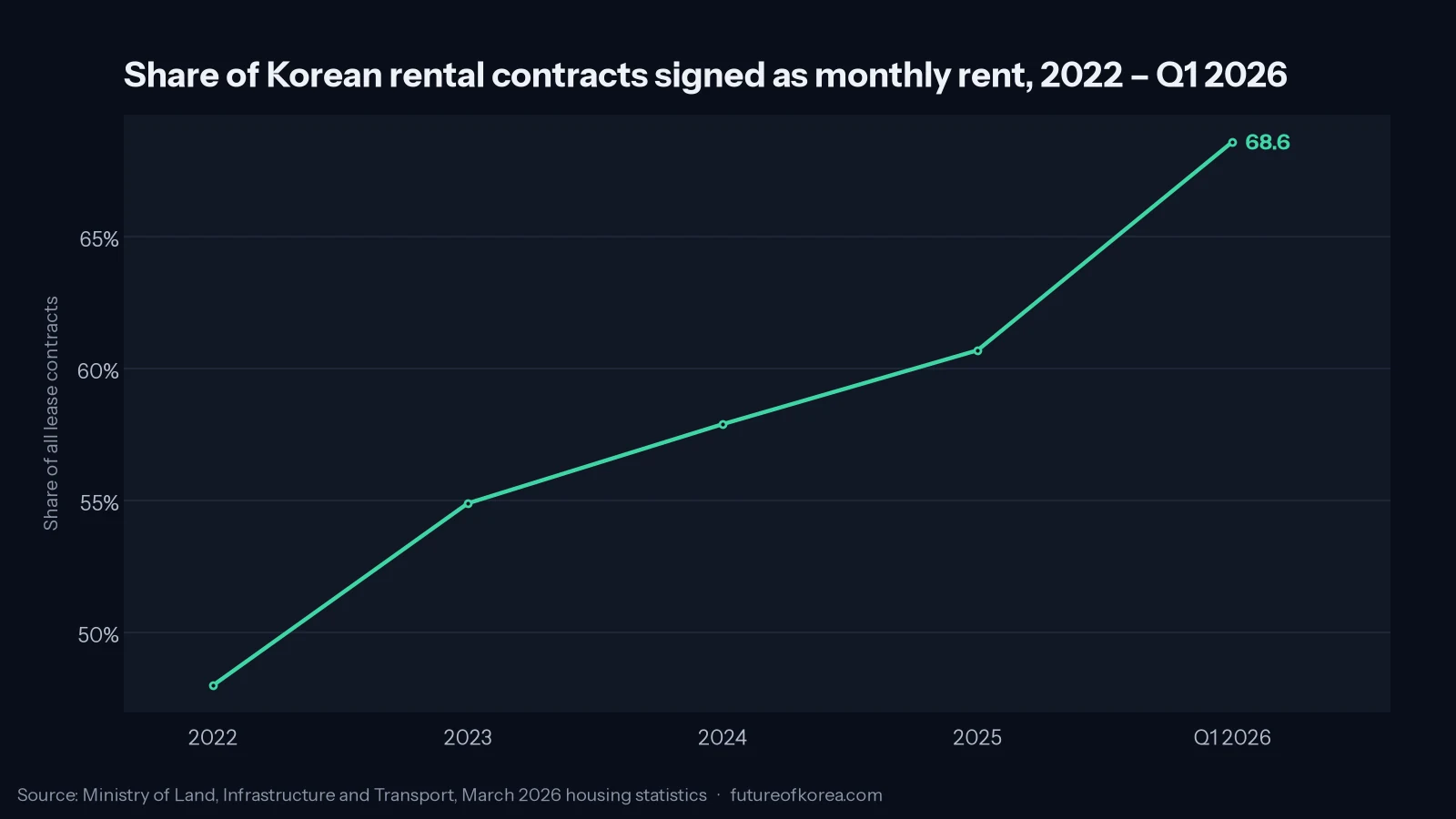
Korea will hold your jeonse deposit for you — and lend it to builders
From November, a state guarantor rather than a landlord will hold the deposit on some Korean leases. HUG invests the money in housing project-finance loans and pays the landlord the return as monthly income.
Korea's flat tax for foreign workers is going to 21% — and the break-even moves ₩20m
The 2026 tax reform package raises the optional flat rate for foreign employees by two points and extends the scheme to 2029. The rate rise pushes the salary at which electing it pays from about ₩133 million to about ₩154 million.
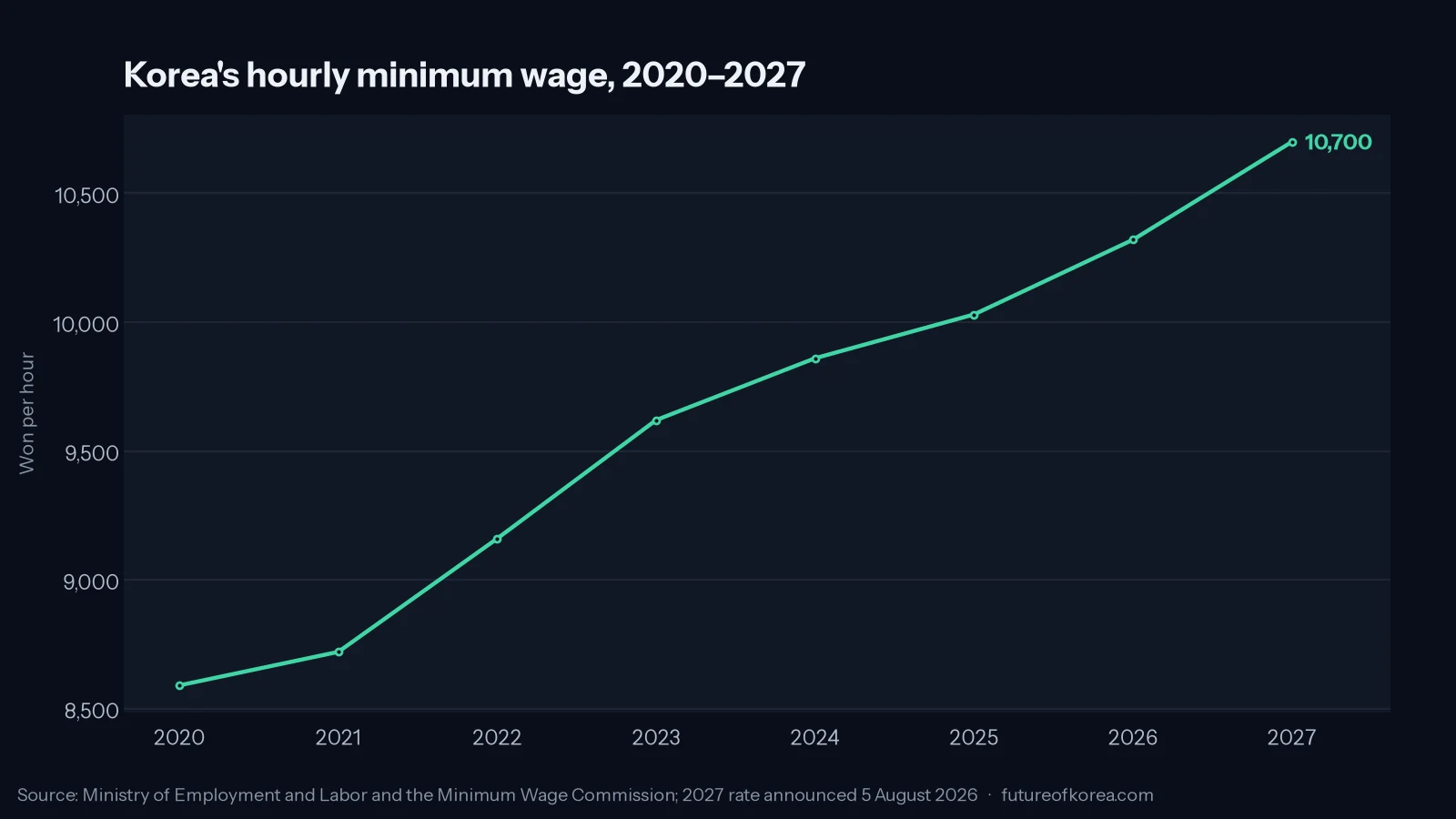
Korea's 2027 minimum wage is 10,700 won an hour. The number that actually binds is 12,840.
The Ministry of Employment and Labor finalised the 2027 minimum wage at 10,700 won an hour on 5 August. Anyone scheduled 15 hours a week or more is owed a fifth on top of that, which is why so many Korean part-time contracts stop at 14.