Who gets a Korean pension refund in 2026 — and who pays in for nothing
Eligibility for the National Pension lump-sum refund turns on your passport, not your contributions. Fifty countries are on the list. Seventeen of Korea's own treaty partners are not.
Photograph by Angelyn Sanjorjo on Pexels.
Fifty nationalities can take their Korean National Pension contributions home as a lump sum when they leave. British, Irish, Japanese, Chinese, Dutch and New Zealand nationals cannot, however long they paid in. Eligibility turns on the passport you hold and, for three visa types, on your stay status. It never turns on how much you contributed.
The sums got bigger in January. Korea’s pension contribution rate is 9.5% of standard monthly income in 2026, up from the 9% it had sat at since 1998, and employer and employee split it 4.75% each. Against the ceiling that applies from July 2026 — a standard monthly income of ₩6,590,000 — the most an employee can pay out of their own wages is ₩313,025 a month, matched by the employer. The floor is ₩410,000, which produces a bill of ₩19,475.
Three doors, and you only need one
The National Pension Service pays a lump-sum refund to a departing foreigner in exactly three circumstances, and they are alternatives rather than conditions.
The first is a social security agreement between Korea and your country that covers the refund. The second is reciprocity: your country grants Korean nationals a benefit corresponding to Korea’s lump sum, so Korea returns the favour. The third has nothing to do with nationality at all — insured periods worked on an E-8 seasonal worker visa, an E-9 non-professional employment visa or an H-2 work-and-visit visa qualify for a refund whoever holds them.
That third door is why the great majority of Korea’s migrant manufacturing and agricultural workforce gets its money back and most white-collar foreign professionals do not.
| Route | Countries | Condition |
|---|---|---|
| Social security agreement | 24 | None beyond the agreement |
| Reciprocity, any insured period | 17 | None |
| Reciprocity, one year or more | 8 | 12 months of contributions |
| Reciprocity, six months or more | 1 | 6 months of contributions |
| E-8, E-9 or H-2 visa | Any | Applies to the insured period on that visa |
NPS list dated 15 June 2026.
The 24 agreement countries are Germany, the United States, Canada, the Czech Republic, Hungary, Australia, France, Belgium, Bulgaria, Poland, Slovakia, Romania, Austria, India, Türkiye, Switzerland, Brazil, Peru, Luxembourg, Slovenia, Croatia, Uruguay, the Philippines and Argentina. The reciprocity group runs from Ghana and Sri Lanka to Hong Kong, Malaysia, Indonesia, Kazakhstan and Kenya, with Thailand, Laos and Bhutan needing a year of contributions and Belize six months.
An agreement with Korea is not an agreement about refunds
This is where most advice goes wrong, including advice given in good faith by employers.
NPS lists 41 social security agreement partners — 40 countries plus Quebec, which contracts separately from Canada. Only 24 of those agreements reach the lump-sum refund. The other 17 are the U.K., Ireland, Japan, China, the Netherlands, Italy, Spain, Sweden, Denmark, Finland, Norway, New Zealand, Chile, Mongolia, Uzbekistan, Vietnam and Quebec.
Those agreements do something genuinely useful. They let you add your Korean insured months to your home-country record so that neither period is orphaned, and they stop you paying into two systems at once on a short posting. What they do not do is hand back cash at the airport.
Work through the nationalities that dominate English-language teaching in Korea and the split is stark. Americans, Canadians and Australians are covered by agreement. Britons, Irish and New Zealanders are not. South Africans never enter the scheme in the first place, which is a different answer to the same question and, on a short stay, a better one.
Some passports never join at all
Coverage is decided before the refund question arises, and it is decided by nationality as well as visa. NPS grades 134 countries into three categories, on a list last revised on 1 February 2025.
Category A — 76 countries, including most of Europe, the Americas, Japan and China — are covered both as workplace subscribers and as individually insured persons. Category B, 37 countries including Vietnam, Mongolia, Thailand, Indonesia, Cambodia and Sri Lanka, are covered only through an employer; the same national working freelance is not enrolled. Category C is 22 countries whose nationals are excluded outright: South Africa, Nepal, Myanmar, Bangladesh, Pakistan, Singapore, Malaysia, Saudi Arabia, Belarus, Brunei, Kazakhstan, Ethiopia, Armenia, Fiji, Georgia, Nigeria, Iran and others. Their pension systems do not compulsorily cover Koreans, so Korea does not cover them.
Malaysia and Kazakhstan appear on both the exclusion list and the refund list, which looks like a contradiction and is not. Malaysians were compulsorily enrolled as workplace subscribers between August 1998 and September 2014, Kazakhstanis until October 2020. Those historic months still exist, and they are still refundable.
Visa status is the second filter. Diplomats, tourists, short-term visitors, D-2 students, D-3 and D-4 trainees, religious workers on D-6, F-1 family visitors, F-3 dependants and G-1 holders are outside the scheme. Almost every working status is inside it, including some people do not expect: D-10 job seekers and H-1 working-holiday visitors are both compulsorily enrolled.
What the money is worth, and the clock on it
A refund is the contributions actually paid — yours and your employer’s — plus interest at the three-year time-deposit rate for each month between payment and entitlement. It is not indexed to wages and it carries no employer top-up beyond the 4.75% already paid, so it behaves like a savings account, not like the pension it would otherwise have bought.
The deadline is five years from the date entitlement arises, which for most people is departure. After that the claim is extinguished, though it can be revived within ten years of turning 60, or by survivors within five years of a death.
Departing through Incheon, you can collect in cash the same day. File at any NPS branch within a month of your flight, then visit the airport centre in Terminal 1 — regardless of which terminal you fly from — and collect from a Woori Bank booth after immigration. Payment comes in one of 16 foreign currencies. Korean won is not among them.
If you are staying, the arithmetic runs the other way. Ten years of contributions buys an old-age pension payable anywhere in the world, and the 2026 rate increase buys a larger one. That trade — a few million won now against an indexed income from 65 — is the actual decision, and it is worth making deliberately rather than at a departure gate. The same logic applies to the other compulsory deduction on your payslip: what foreign residents pay for Korean health insurance is money that buys nothing back at all. And if the plan is to stay long enough for the pension to matter, the 2026 visa overhaul changed which routes get you there.
Figures current as of 16 August 2026, sourced to the National Pension Service pages and documents listed below. Contribution rates and the standard monthly income ceiling change every year; the refund country list changes without notice. Check both before acting.
Useful links & tools
Official portals and primary data sources for this topic. Opens in a new tab.
- NPS — Foreigners and Lump-sum Refund — The country list, the document checklist and the Incheon airport cash procedure, in English and dated
- NPS — Contributions — The current rate and the standard monthly income ceiling and floor, which change every July
- Eligibility by Country (PDF) — Whether your nationality is covered as a workplace subscriber, an individual subscriber, or not at all
- Eligibility by Stay Status (PDF) — Visa-by-visa table of who is enrolled — check it before assuming a short-stay status is exempt
- NPS Center for International Affairs — The office that handles agreement questions and overseas claims when a branch cannot
Frequently asked questions
Can I get my Korean pension money back when I leave Korea?
Only if you hold one of three tickets. Your country has a social security agreement with Korea that covers lump-sum refunds; or your country pays Korean nationals an equivalent benefit, which Korea reciprocates; or you worked on an E-8, E-9 or H-2 visa, which qualifies regardless of nationality. Fifty countries appear on the National Pension Service list published on 15 June 2026. If yours is not one of them and you were not on one of those three visas, there is no lump sum — your contributions stay in the scheme and become a pension entitlement at 65.
Why can Americans and Canadians claim a refund but Britons cannot?
Because a social security agreement and a lump-sum refund agreement are not the same instrument. Korea lists 41 contracting countries and jurisdictions, but only 24 of those agreements cover the refund. The U.K., Ireland, Japan, China, the Netherlands, Italy, Spain, Sweden, Denmark, Finland, Norway, New Zealand, Chile, Mongolia, Uzbekistan, Vietnam and Quebec have agreements that do something else — they let you combine insured periods in both countries so you qualify for a pension, rather than handing the cash back on departure.
How much do I pay into the Korean National Pension in 2026?
The rate is 9.5% of your standard monthly income. If you are employed, your employer pays 4.75% and you pay 4.75%, deducted at source. If you are an individually insured person, you pay the whole 9.5% yourself. Standard monthly income is capped at ₩6,590,000 and floored at ₩410,000 for the year running from July 2026 to June 2027, so the most an employee can pay from their own pay is ₩313,025 a month.
How long do I have to claim a lump-sum refund after leaving Korea?
Five years from the date entitlement arises — normally your departure. Miss that window and the claim is extinguished. It is not gone forever: you may re-apply within 10 years of reaching age 60, and surviving family may claim within five years of your death. Applying from abroad requires notarised documents attested by a Korean consulate, or an apostille certificate if your country is party to the Apostille Convention.
Sources & further reading
Every figure in the key takeaways is numbered to the source it was read from. Sources marked primary are the statistics office, central bank, exchange, regulator or filing itself.
- 1Contributionsprimary — National Pension Service · verified 2026-08-16
- 2Foreigners and Lump-sum Refundprimary — National Pension Service, list dated 15 June 2026 · verified 2026-08-16
- 3Eligibility by Country (134 countries, as of 1 February 2025)primary — National Pension Service · verified 2026-08-16
- 4Guide to the National Pension for Foreignersprimary — National Pension Service · verified 2026-08-16
- 5Eligibility by Stay Status (as of 1 April 2024)primary — National Pension Service · verified 2026-08-16
Read next
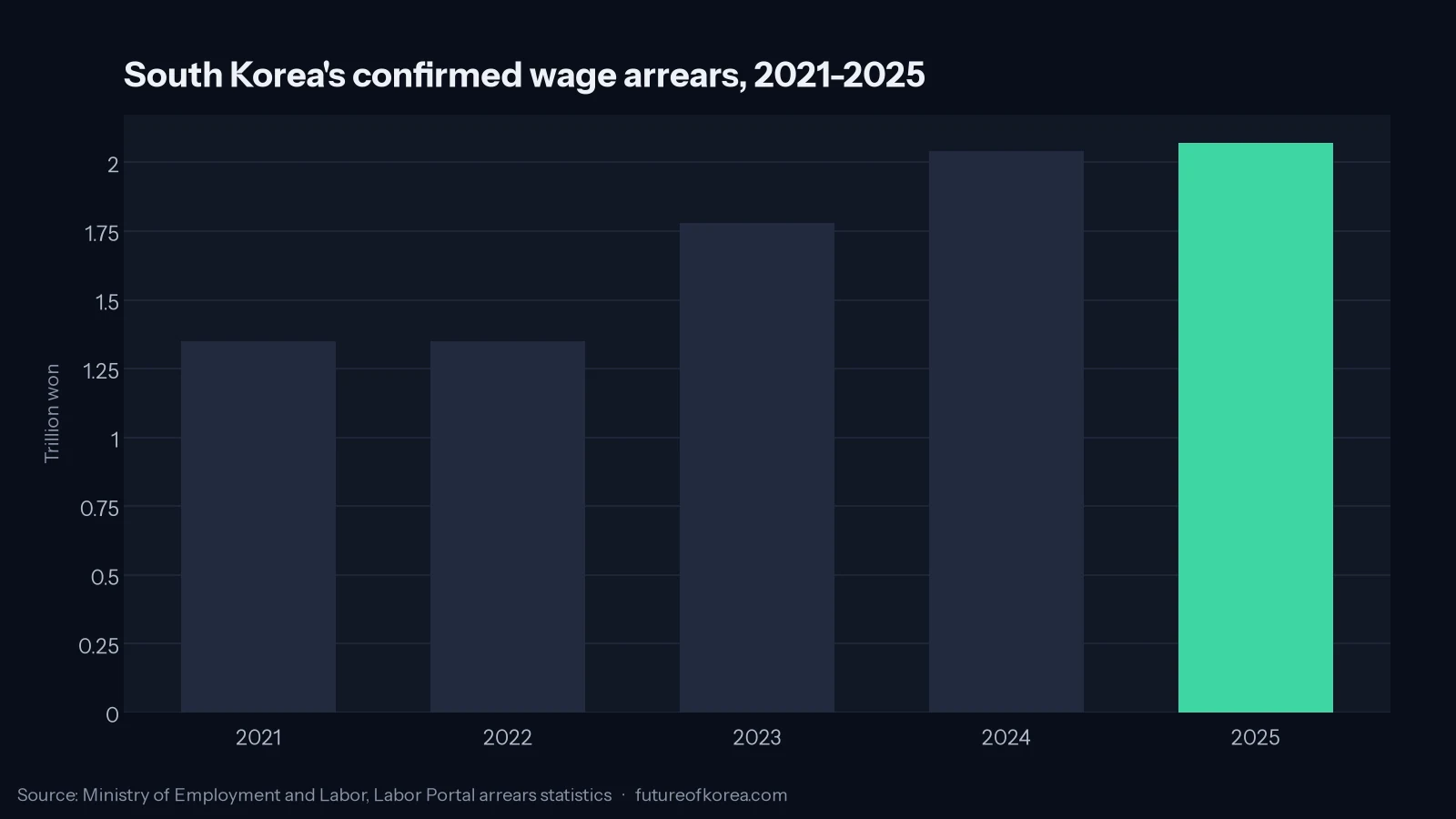
Unpaid severance is 45% of Korea's wage arrears — and the penalty rises this month
Almost half of everything Korean employers failed to pay their workers this year was severance. Here is why the money is missing, what the law says you are owed, and what changes on 18 September.
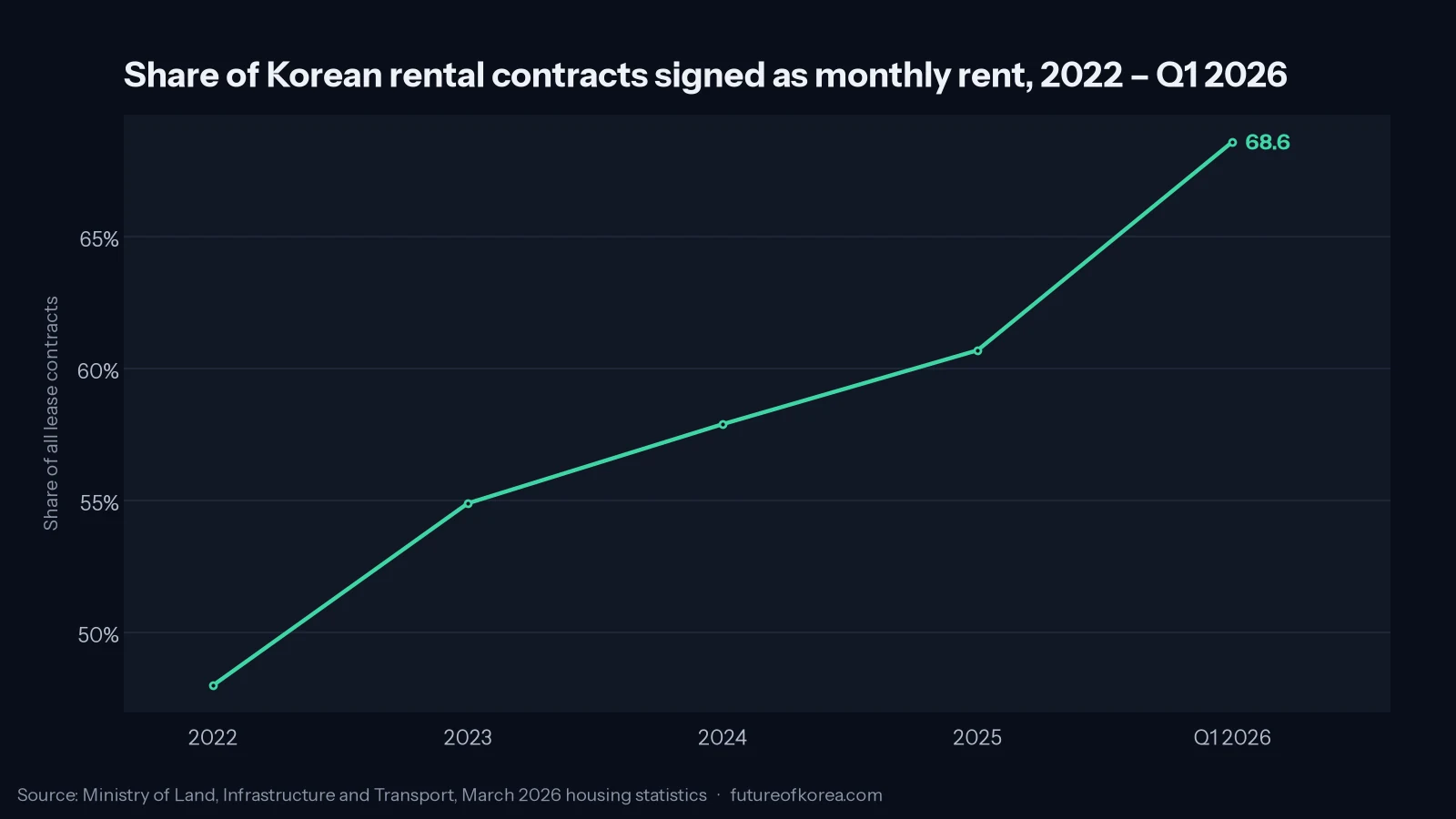
Korea will hold your jeonse deposit for you — and lend it to builders
From November, a state guarantor rather than a landlord will hold the deposit on some Korean leases. HUG invests the money in housing project-finance loans and pays the landlord the return as monthly income.
Korea's flat tax for foreign workers is going to 21% — and the break-even moves ₩20m
The 2026 tax reform package raises the optional flat rate for foreign employees by two points and extends the scheme to 2029. The rate rise pushes the salary at which electing it pays from about ₩133 million to about ₩154 million.