Korea will hold your jeonse deposit for you — and lend it to builders
From November, a state guarantor rather than a landlord will hold the deposit on some Korean leases. HUG invests the money in housing project-finance loans and pays the landlord the return as monthly income.
From November, a tenant in Korea will be able to sign a jeonse lease without ever handing the deposit to the landlord. The Ministry of Land, Infrastructure and Transport said on 20 August that the state guarantor HUG will hold the money instead, invest it in housing construction loans, and pay the landlord the return each month in place of rent.
The scheme is called the jeonse-and-monthly-rent safe trust, and it is the most interesting thing the government has done to the rental market in years — partly because of what it fixes, and partly because of where the money goes.
Why the ministry is inventing a new kind of lease
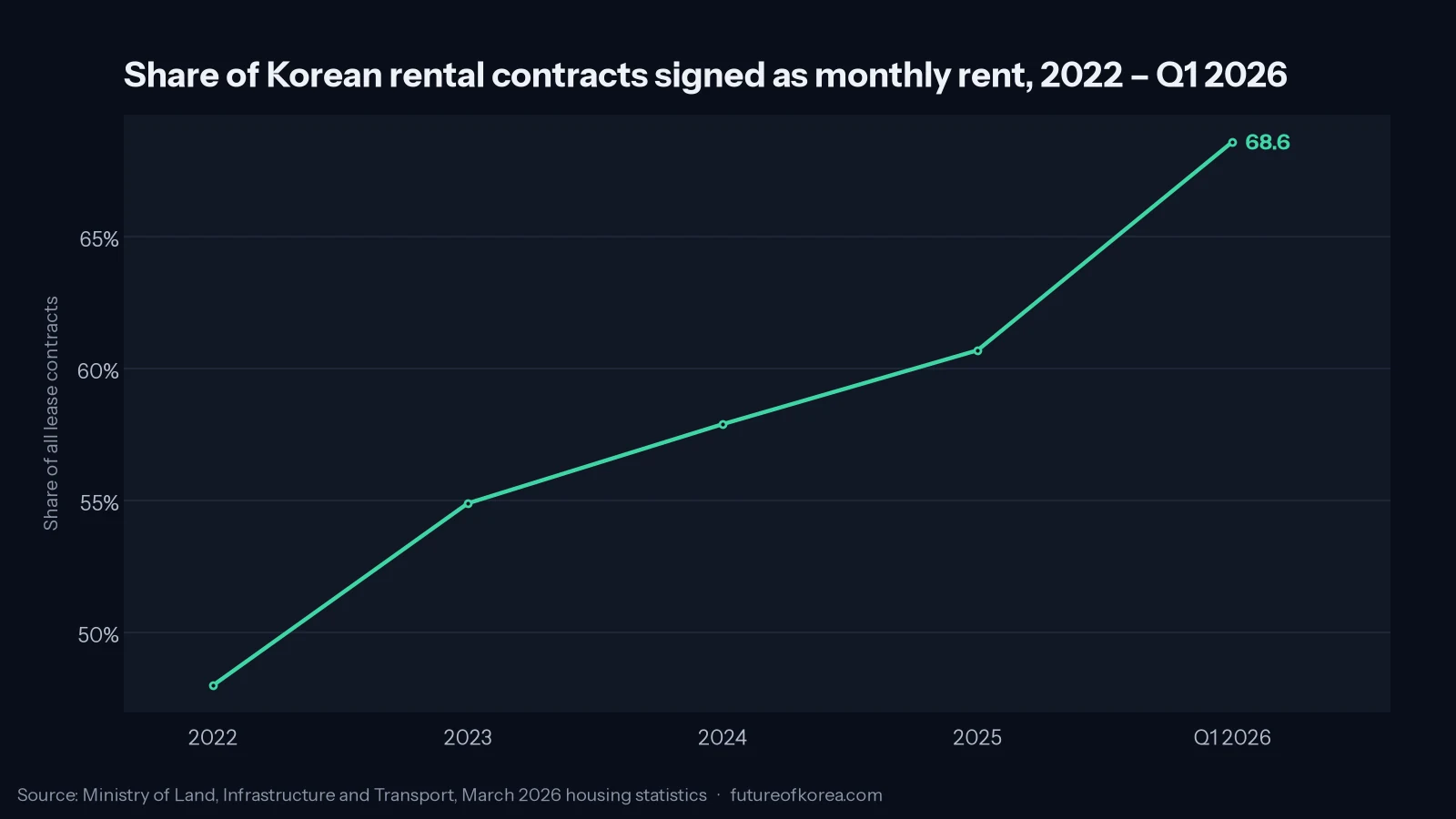
Jeonse is disappearing, and the numbers are not subtle. Monthly-rent contracts made up 68.6% of all rental deals nationwide in the first quarter of 2026, up 7.9 percentage points from 60.7% a year earlier. The same share was 48.0% in 2022. In Seoul it reached 70.5%, and for the first time since the series began, more than half of Seoul apartment leases — 50.8% — were signed as monthly rent rather than jeonse.
In March alone, 192,913 monthly-rent contracts were registered, up 36.3% year on year, while jeonse contracts fell 11.0% to 86,775.
The ministry’s own framing of the problem is a mismatch. Tenants still want jeonse, because paying interest on a loan is cheaper than paying rent. Landlords no longer want to hold other people’s money after the fraud wave of 2022–24, and would rather collect a monthly cheque. Neither side can get what it wants from the other, so the government is proposing to stand between them.
What the three-way contract actually does
HUG, the landlord and the tenant sign together. The tenant pays the jeonse sum into an account HUG designates. HUG pays the landlord a contracted monthly return. At the end of the lease, HUG — not the landlord — returns the deposit.
Because HUG holds the money, the tenant does not need a deposit-return guarantee or a jeonse-loan guarantee, which the ministry puts at roughly ₩340,000 a year in saved fees. Landlords who are registered rental businesses are released from their obligation to carry deposit-return insurance.
Here is the ministry’s own worked example, on a home valued at ₩300m with a jeonse figure of ₩200m.
| Today’s monthly-rent lease | Under the safe trust | |
|---|---|---|
| Tenant pays up front | ₩10m deposit | ₩200m, placed with HUG |
| Tenant pays monthly | ₩740,000 rent | ~₩530,000 loan interest, at 3.97% |
| Guarantee fees | ~₩340,000 a year | none |
| Landlord receives | ₩740,000, arrears risk carried | ₩730,000 contracted, paid by HUG |
| Who holds the deposit | the landlord | HUG |
There is an additional sweetener aimed squarely at the capital’s older landlords. A Seoul homeowner who joins the scheme and moves to a provincial region can draw a reverse mortgage on top: for a couple aged 65 and 55 with a ₩300m home on a lifetime fixed plan, the ministry calculates about ₩470,000 a month, taking the total to roughly ₩1.2m.
Where the money actually goes
This is the part worth slowing down for. The deposit is not sitting in escrow earning nothing.
HUG pools the deposits into a housing supply activation fund, which lends to residential construction sites through HUG-guaranteed project-finance loans. The target yield is in the 4% range, and that yield is what pays the landlord. So the tenant’s deposit becomes construction credit, and the landlord’s “rent” is a slice of a PF lending margin.
Read the programme that way and it stops looking purely like tenant protection. It is also a funding mechanism: the 13 August housing supply plan needs capital to reach building sites, and Korean households happen to be sitting on an enormous, idle, privately held pool of exactly that — jeonse deposits. The safe trust routes it.
HUG has been the counterparty in a housing crisis before
Recent enough to matter. HUG’s jeonse deposit-return guarantee claims ran to ₩4.49tn across 20,941 cases in 2024, the peak of the fraud and negative-equity wave, and the corporation subrogated ₩3.99tn to tenants that year. It posted a net loss of more than ₩2.5tn.
The recovery since has been fast. Claims fell to ₩1.24tn in 2025, and to ₩269.3bn in January–April 2026, down 53.1% year on year, as rising jeonse prices eased negative equity and a 2023 rule change cut the maximum eligible jeonse-to-value ratio from 100% to 90%. Recovery on bad debt improved from 29.7% in 2024 to 84.8% in 2025, and reached 156% in the first four months of 2026 — the first time since 2015 that HUG recovered more than it paid out in a period. It returned to profit in 2025, at ₩1,574.9bn.
So the institution about to hold strangers’ deposits and lend them to builders has had a repaired balance sheet for about one year. That is not an argument against the scheme. It is the reason to read the September notice closely.
Who can use it, and when
No income or asset test. Homes valued at ₩2bn or less to start, with checks for building-code violations and for a jeonse figure out of line with market value. Deposit-secured monthly leases can convert too, if the combined deposit and rent translate into a reasonable jeonse equivalent. The custody period tracks the lease — a two-year jeonse means a two-year deposit — and extends on renewal.
Separately, LH will supply about 500 of its purchased rental homes through the same body this year, aimed at young non-homeowners.
Applications open in October, three-way contracts and deposits follow in November, move-ins from December. For a country where the standard tenant-protection advice has been to file a move-in report, get a fixed-date stamp and buy a guarantee, a lease where none of that is necessary would be a real change. Whether it stays voluntary and small, or becomes the way the state finances housing, is the question the pilot will answer.
Figures current as of 28 August 2026, sourced to the ministries, corporations and outlets listed below.
Useful links & tools
Official portals and primary data sources for this topic. Opens in a new tab.
- HUG — Korea Housing & Urban Guarantee Corporation — Where the September programme notice and the application forms will be published
- HUG Ansim Jeonse Portal — HUG's tenant-facing portal for deposit-return guarantees and rental-market checks
- MOLIT statistics portal (Tonggye Nuri) — Monthly housing statistics, including jeonse and monthly-rent transaction counts
- Policy Briefing — the ministry's announcement — The full Korean-language explanation, including the ministry's ten-question Q&A
Frequently asked questions
What is the jeonse-and-monthly-rent safe trust?
It is a three-way lease contract between a tenant, a landlord and the Korea Housing & Urban Guarantee Corporation, announced by the Ministry of Land, Infrastructure and Transport on 20 August 2026. The tenant pays the lump-sum jeonse deposit to HUG rather than to the landlord. HUG invests the money and pays the landlord a monthly return in place of rent, then returns the deposit to the tenant when the lease ends. Participation is voluntary for both sides.
Is the deposit safe if HUG's investments lose money?
The ministry says yes. Deposits are pooled into a housing supply fund that lends to construction sites through HUG-guaranteed project-finance loans, a structure it describes as minimising loss of principal, and it states that the tenant’s deposit is repaid in full and the landlord’s monthly payment continues even if the fund takes losses. That promise is a HUG obligation, so it is worth reading alongside HUG’s own balance sheet rather than on its own.
Can foreign residents in Korea apply?
The announcement sets no income, asset or nationality condition — it says anyone who wants to take part may apply, subject to checks on the building and on whether the jeonse figure is excessive relative to market value. But raising the lump sum usually means a Housing and Urban Fund Buttimmok loan or a bank loan, and those carry their own eligibility rules. The programme notice due in late September is where that gets settled.
When does it start and how do I apply?
HUG publishes the recruitment notice in late September 2026, takes applications in October, signs three-way contracts and receives deposits from November, and supports phased move-ins from December. Applications go through the HUG website and its branch offices. Landlords may apply first and have HUG find a tenant, or a landlord and tenant may agree a jeonse figure and apply together.
Sources & further reading
Every figure in the key takeaways is numbered to the source it was read from. Sources marked primary are the statistics office, central bank, exchange, regulator or filing itself.
- 1월세 부담 낮추고 임대 수익은 보장…'전월세 안심신탁' 출시primary — Ministry of Land, Infrastructure and Transport / Policy Briefing, 20 August 2026 · verified 2026-08-28
- 2국토교통 통계누리 — 주택 통계primary — Ministry of Land, Infrastructure and Transport · verified 2026-08-28
- 3'전세의 나라' 옛말…월세 비중 4년 만에 48%→69% — Seoul Economic Daily, May 2026, reporting MOLIT March 2026 housing statistics · verified 2026-08-28
- 4HUG 올해 전세보증금 보증사고, 작년보다 절반으로 감소 — Tax & Finance Newspaper, May 2026, reporting HUG figures · verified 2026-08-28
- 5HUG — Korea Housing & Urban Guarantee Corporationprimary — Korea Housing & Urban Guarantee Corporation · verified 2026-08-28
- 6Korea to Launch Deposit-Trust Program Blending Jeonse and Monthly Rent — Seoul Economic Daily (English edition), August 2026 · verified 2026-08-28
Read next
Unpaid severance is 45% of Korea's wage arrears — and the penalty rises this month
Almost half of everything Korean employers failed to pay their workers this year was severance. Here is why the money is missing, what the law says you are owed, and what changes on 18 September.
Korea's flat tax for foreign workers is going to 21% — and the break-even moves ₩20m
The 2026 tax reform package raises the optional flat rate for foreign employees by two points and extends the scheme to 2029. The rate rise pushes the salary at which electing it pays from about ₩133 million to about ₩154 million.
Korea's 2027 minimum wage is 10,700 won an hour. The number that actually binds is 12,840.
The Ministry of Employment and Labor finalised the 2027 minimum wage at 10,700 won an hour on 5 August. Anyone scheduled 15 hours a week or more is owed a fifth on top of that, which is why so many Korean part-time contracts stop at 14.