Korean companies cancelled ₩43.1tn of their own shares in five months — and bought only ₩20tn
A law that took effect on 6 March 2026 turned the treasury share from a control device into a countdown. Companies have until September 2027 to empty the vault, and the Korea Exchange numbers show them doing it faster than they are refilling it.
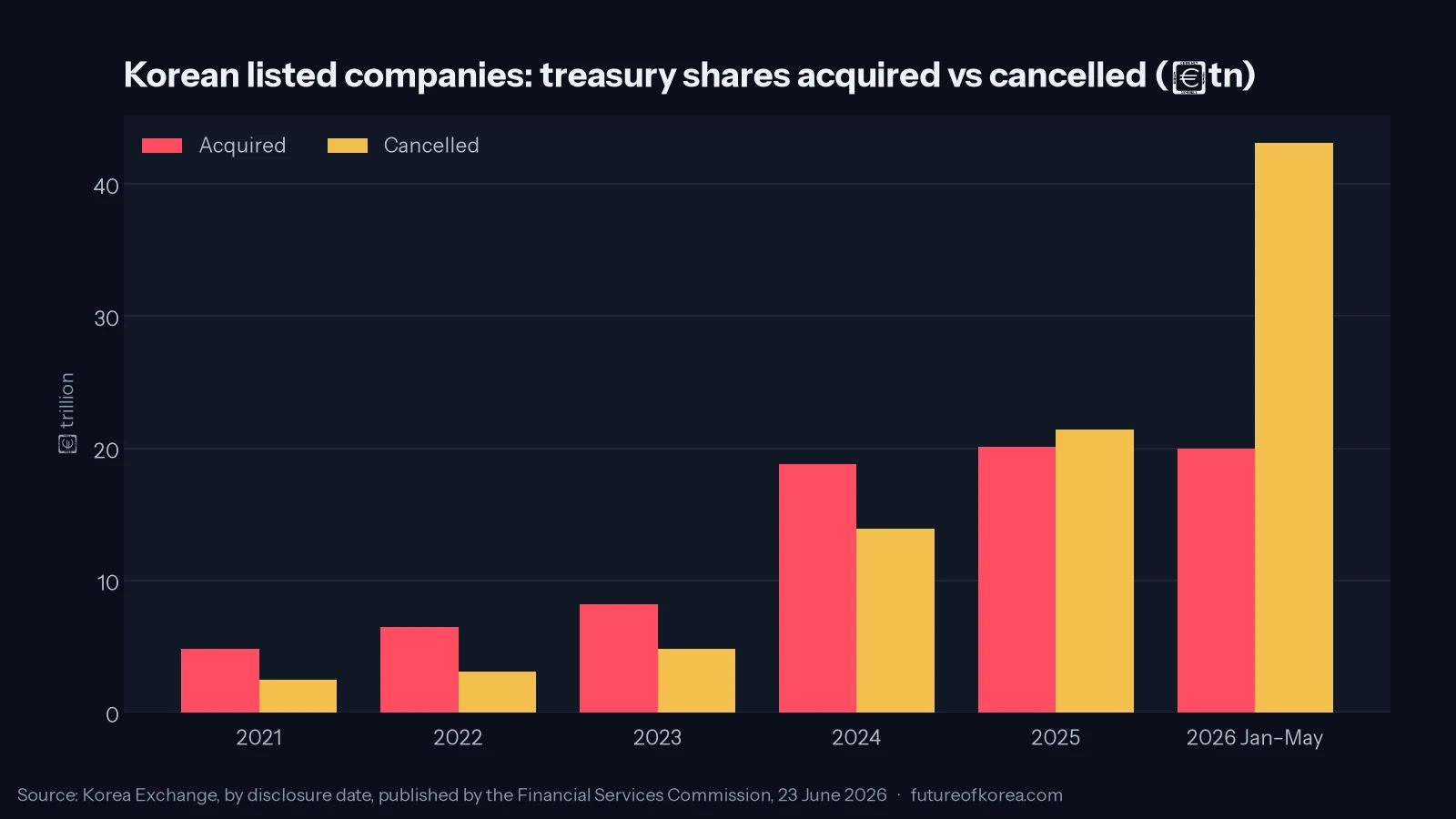
Korean listed companies cancelled ₩43.1tn of their own shares between 1 January and 31 May 2026. Over the same five months they bought ₩20.0tn. That is the first time the burning has run at more than twice the buying, and it is not a change of corporate heart. It is a deadline.
The third amendment to the Commercial Act passed the National Assembly on 25 February 2026 and took effect on 6 March. It makes cancellation the default outcome of a buyback. A company that acquires its own shares must now cancel them within a year of acquisition. Blocks already sitting on balance sheets on 6 March get an extra six months — eighteen months in total, which expires in the first week of September 2027.
Almost everything else in the amendment exists to stop companies routing around that one sentence.
A treasury share is now legally nothing
Korean company law spent decades arguing over what a treasury share actually is: an asset the company owns, or a share that has effectively ceased to exist. The amendment picks the second answer and writes it into the statute. Treasury shares carry no voting rights, no preemptive rights and no claim on cash or stock dividends.
What follows from that reads like an inventory of the things people were doing with them.
A company can no longer issue bonds convertible into, or redeemable with, its own treasury shares. It cannot create a pledge over them. In a merger or a corporate split it cannot allocate the newly issued shares to its own treasury block. A trustee holding shares under a buyback trust may not dispose of them during the trust period and must return them to the company as soon as the trust ends. Selling quietly into the open market to whoever happens to be bidding is gone entirely: a permitted disposal now has to go to every shareholder in proportion to their holding, or to a named third party under one of the statutory exceptions.
The Financial Services Commission wrote the market-side half of this into the Capital Markets Act enforcement decree, approved by the State Council on 23 June and in force from 30 June. That decree deleted the exchangeable-bond provisions rather than restricting them, and the FSC was unusually direct about why: bonds exchangeable into treasury shares had been issued to parties friendly to the controlling shareholder in situations where the company had no real financing need, and worked in practice as a management-rights defence.
Buying used to outrun burning. It doesn’t now.
The five-and-a-half-year series the FSC published in June is the clearest single picture available of what Korean treasury shares were for.
| Period | Acquired (₩tn) | Cancelled (₩tn) |
|---|---|---|
| 2021 | 4.8 | 2.5 |
| 2022 | 6.5 | 3.1 |
| 2023 | 8.2 | 4.8 |
| 2024 | 18.8 | 13.9 |
| 2025 | 20.1 | 21.4 |
| 2026, 1 Jan–31 May | 20.0 | 43.1 |
Through 2024 every year added to the pile. Companies acquired ₩58.4tn of their own stock between 2021 and 2025 and cancelled ₩45.7tn of it, so about ₩12.7tn stayed put — and that is only the flow over five years, sitting on top of blocks accumulated across the decades before. 2025 was the first year cancellations edged in front, and only by ₩1.3tn.
Five months of 2026 reversed the whole period. Fold them in and the running totals invert: ₩78.4tn acquired since the start of 2021 against ₩88.8tn cancelled.
The run rate says it more bluntly. Cancellations averaged ₩1.78tn a month through 2025. Across January to May 2026 they averaged ₩8.62tn.
The largest single one came in August
SK hynix’s board met on 19 August 2026 and approved a ₩40tn buyback, every share of which is to be cancelled. At the previous day’s close of ₩1,662,000 that works out at roughly 24.07 million shares, about 3.3% of the 730,492,365 shares outstanding. Purchases began on 20 August and run for around three months. No Korean listed company has announced a larger cancellation.
The company presented it as pulling an existing commitment forward rather than making a new one. In November 2024 it had promised to return up to half of cumulative free cash flow over 2025–27; the August board resolution changed “within 50%” to “50% or more” and said dividends would continue alongside the cancellations. Net cash stood at about ₩69tn at the end of the second quarter.
Notice what this is not. SK hynix is not clearing an inherited block ahead of the September 2027 cut-off. It is buying fresh stock and destroying it inside the one-year window the new law allows for new acquisitions. The transitional deadline governs the stockpile; the one-year default governs everything bought from here.
What cancellation does not do
It does not return cash to shareholders. The cash leaves at the point of purchase. Cancelling afterwards shrinks the denominator, so earnings per share, book value per share and dividend per share all rise without a further won moving. For anyone modelling Korean equities that is a live variable rather than a footnote — it bears on how index providers and their weights read the market, and on what the National Pension Service’s enlarged domestic allocation is actually buying into, since the float is contracting while the buyer is scaling up.
Nor is the exception route narrow. A company may still hold and dispose of treasury shares for employee and executive compensation, or for stated business purposes such as introducing new technology or improving its financial structure, provided its articles of incorporation permit it. The catch is procedural: shareholders must approve a holding and disposal plan, signed or sealed by every director, and re-approve it each year. The June decree then extended the disclosure obligation for those plans from companies holding 1% or more of their shares in treasury to every listed company holding any at all, and required them to report execution against the plan rather than only the plan itself.
This is the third of three amendments in eighteen months, and it is the one with teeth. The first, in 2025, gave directors a fiduciary duty running to shareholders rather than only to the company. The second mandated cumulative voting for director elections and widened the separate election of audit committee members. Those changed who sits on boards and what they owe. This one changes the capital structure directly, on a clock, whether or not a board wants it to — and law firms advising on it have been careful to point out that the sanction for missing the deadline attaches to the directors personally.
For foreign investors who have spent years discounting Korean equities for exactly this — a share class that could be revived at the controlling family’s convenience — the interesting number is not ₩43.1tn. It is what the balance sheets look like in September 2027, once the vault is supposed to be empty and every remaining block has a name, a purpose and a shareholder vote behind it. The 2026 market itself has already priced some of this. The audit of who actually complied has not happened yet.
Figures current as of 31 August 2026. Acquisition and cancellation totals are Korea Exchange data by disclosure date, published by the Financial Services Commission on 23 June 2026; the 2026 column covers 1 January to 31 May 2026 only. Statutory dates are as promulgated. Nothing here is investment advice — see the disclaimer.
Useful links & tools
Official portals and primary data sources for this topic. Opens in a new tab.
- Financial Services Commission press releases — Where the March and June 2026 treasury-share releases were published, including the Korea Exchange acquisition and cancellation table used here.
- DART — Financial Supervisory Service electronic disclosure — Individual buyback, disposal and cancellation filings, plus the treasury-share holdings table now required in every listed company's business report.
- KIND — Korea Exchange listed company disclosure — Treasury-share status by company and the value-up disclosure page, both maintained by the exchange rather than the regulator.
- Korea Law Information Center — The consolidated text of the Commercial Act, including the amended treasury-share articles and the addenda that set the transitional deadline.
- Korea Exchange market data portal — Shares outstanding, market capitalisation and daily investor-type flows — the denominators that move when a cancellation settles.
Frequently asked questions
When must Korean companies cancel their treasury shares?
Shares acquired after the law took effect must be cancelled within one year of the acquisition date. Shares already on the balance sheet on 6 March 2026 get an extra six months, so the total window is eighteen months from that date and the deadline falls in the first week of September 2027. A company can hold beyond those windows only if its articles of incorporation allow it and shareholders approve a holding and disposal plan, which has to be re-approved at every annual general meeting.
Can a Korean company still buy back its own stock?
Yes. Buybacks are unaffected — Korean listed companies acquired ₩20.0tn of their own shares in the first five months of 2026, roughly the same pace as 2025’s full-year ₩20.1tn. What changed is what happens next. The default outcome of a buyback is now cancellation within a year rather than an indefinite stay on the balance sheet, which is why the cancellation line has pulled so far ahead of the acquisition line.
Why did Korea ban exchangeable bonds backed by treasury shares?
Because they were a way around the cancellation obligation and, before that, a control device. The Financial Services Commission said in its 23 June 2026 release that such bonds had been issued to parties friendly to the controlling shareholder in situations where the company had no pressing need to raise money, effectively functioning as a management-rights defence. The enforcement decree deleted the provisions governing them outright rather than restricting them.
Does cancelling treasury shares return cash to shareholders?
Not by itself. The cash leaves the company at the point of purchase, not at the point of cancellation. Cancelling the shares afterwards shrinks the share count, so earnings per share, book value per share and dividend per share all rise mechanically without any further outlay. The practical difference from holding the shares is that the block can never be revived, sold to a friendly third party, or voted back into existence through a merger or split.
Sources & further reading
Every figure in the key takeaways is numbered to the source it was read from. Sources marked primary are the statistics office, central bank, exchange, regulator or filing itself.
- 1자기주식 보유·처분 공시 강화해 기업가치 제고 뒷받침한다! — 자본시장법 시행령 개정안 국무회의 의결 (6.23)primary — Financial Services Commission, June 2026 · verified 2026-08-31
- 23차 상법 개정 취지에 맞추어 자기주식 보유·처분 공시 강화 — 자본시장법 시행령 및 하위규정 입법예고primary — Financial Services Commission, March 2026 · verified 2026-08-31
- 3Third Amendment to Korean Commercial Code on Mandatory Treasury Share Cancellation — Kim & Chang, April 2026 · verified 2026-08-31
- 4SK하이닉스, 주주환원 새 역사 쓴다…40조 자사주 취득·소각 '역대급' — Money Today, August 2026 · verified 2026-08-31
- 5Electronic disclosure system — listed company treasury share acquisition, disposal and cancellation filingsprimary — Financial Supervisory Service (DART) · verified 2026-08-31
Read next
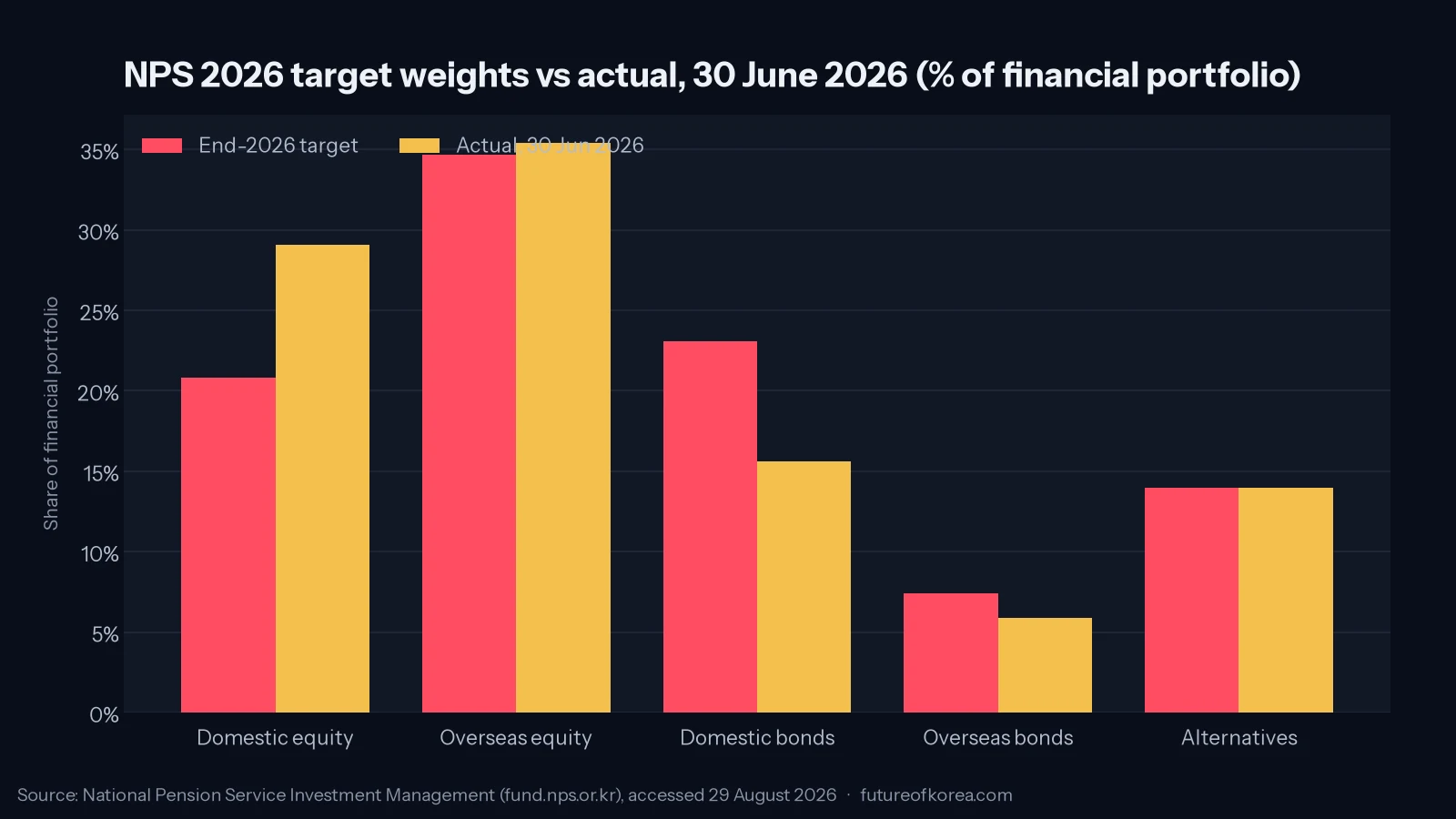
The National Pension Service raised its Korea target to 20.8%. It was already holding 29.1%.
On 28 May the National Pension Service raised its 2026 target weight in Korean shares from 14.9% to 20.8%. Five weeks later the fund held 29.1%. The gap, and what the fund is quietly underweight, matter more than the headline.
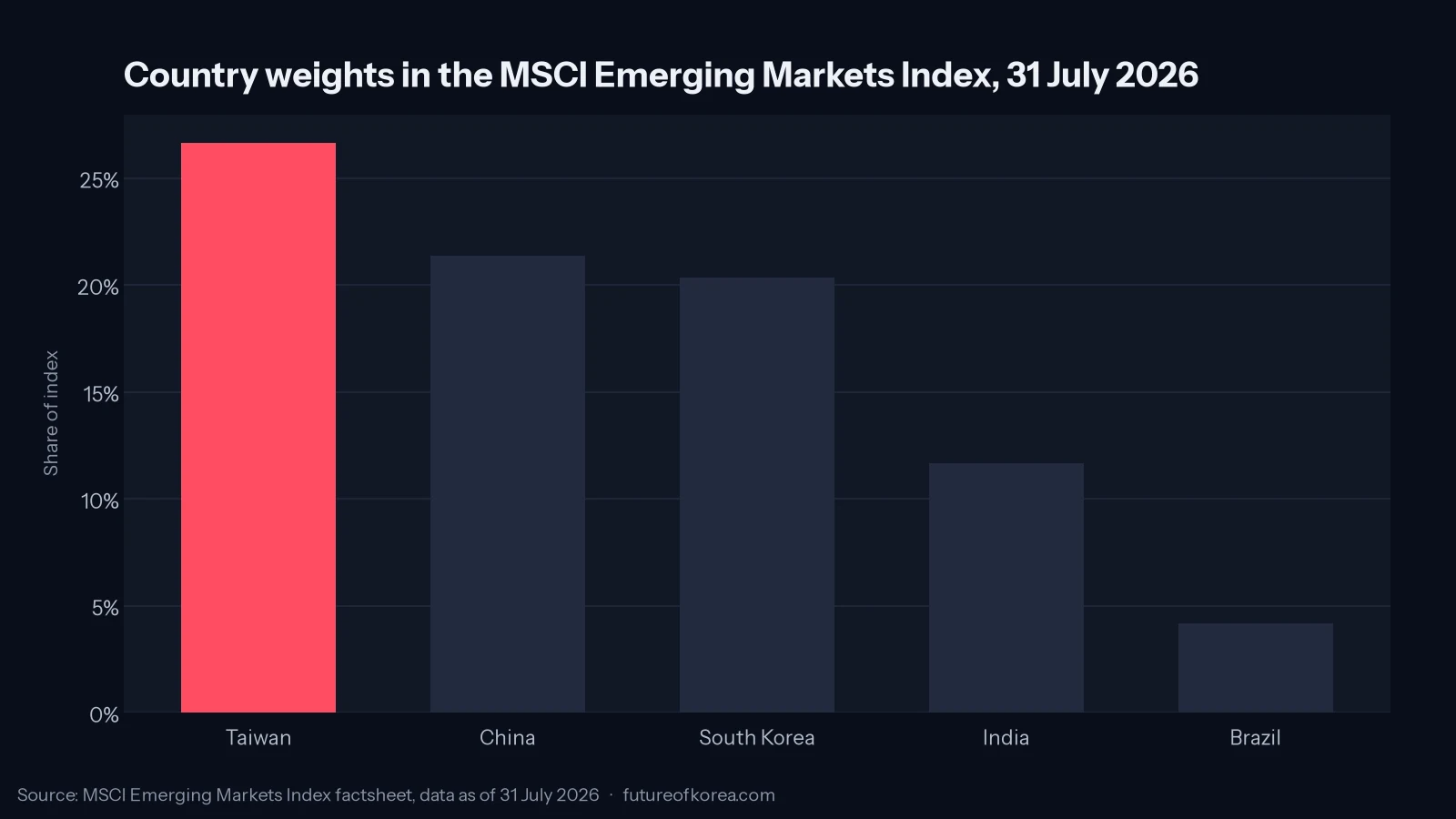
FTSE calls Korea a developed market. MSCI still calls it emerging.
Two index providers look at the same exchange and reach opposite conclusions. The disagreement is about the won, and the arithmetic of an upgrade is less flattering than the campaign for one suggests.
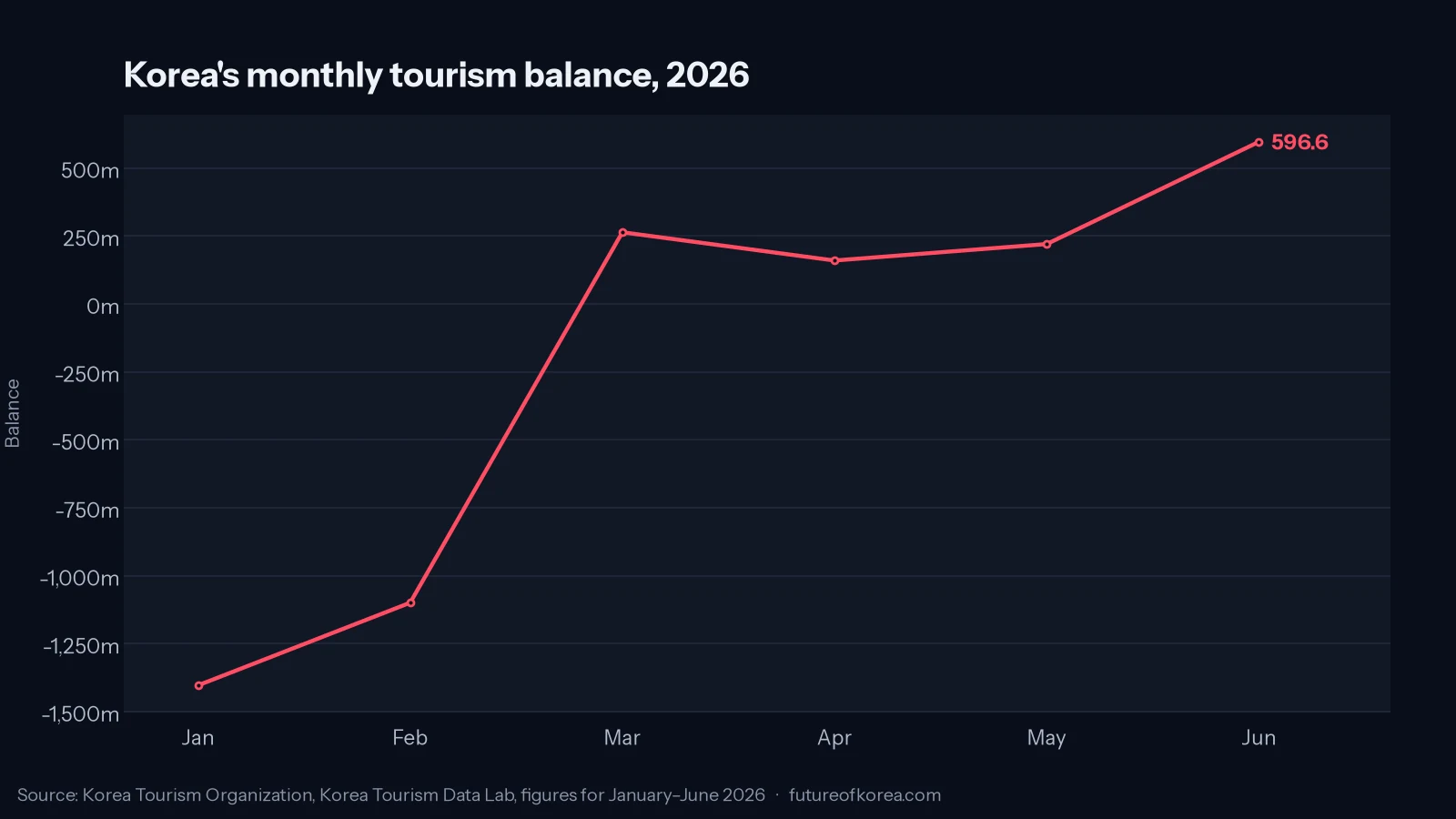
Korea's tourism balance turned positive in March. Duty-free sales are still down 60%.
Four consecutive surplus months put Korea within reach of its first annual tourism surplus since 2000. Half of it is foreigners spending more. The other half is Koreans priced out of flying abroad.