FTSE calls Korea a developed market. MSCI still calls it emerging.
Two index providers look at the same exchange and reach opposite conclusions. The disagreement is about the won, and the arithmetic of an upgrade is less flattering than the campaign for one suggests.
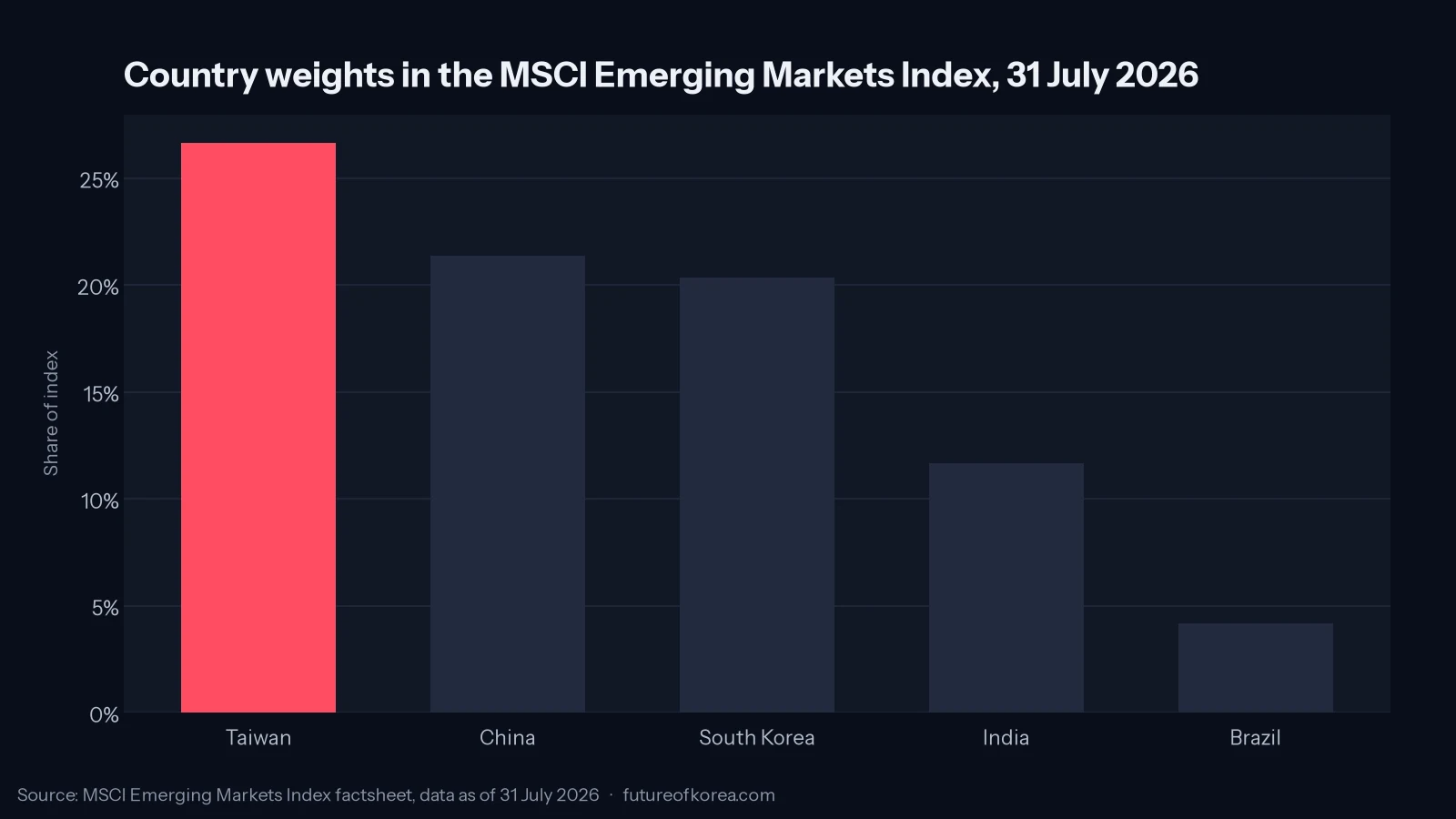
Buy an index fund tracking MSCI World and you own no Korean shares at all. Buy one tracking FTSE Developed and you own plenty. Two of the largest index providers in finance look at the same exchange, the same currency and the same settlement plumbing, and file Korea in opposite drawers.
MSCI settled the question again on 23 June 2026. Korea stays emerging.
The objection is the currency, and it always has been
MSCI consulted global investors on promoting Korea from 2008 to 2014, then stopped. This year’s review did not reopen the consultation; it recorded that MSCI is monitoring Korea’s reform programme, which is the polite form of not yet.
The specific complaints are worth reading closely, because none of them is about the size, depth or quality of the Korean equity market. The won is not deliverable offshore. Onshore liquidity during Korea’s extended foreign exchange trading hours is, in MSCI’s assessment, still too thin to let an index replicator execute at spreads comparable to a developed-market currency during its own daytime. Omnibus accounts and in-kind transfers exist on paper but are barely used. The compliance regime reinstated when the short-selling ban was lifted has left operational burdens on foreign brokers. Pre-settlement funding requirements tie up capital.
Then the sentence that sets the calendar: a consultation can only begin once every issue has been addressed, the reforms have been fully implemented, and investors have had ample time to evaluate whether the changes hold. Three conditions, and Korea has not cleared the first.
FTSE has the same complaints and a different answer
FTSE Russell’s classification table, dated 7 April 2026, lists South Korea among developed markets alongside Japan, Australia and the United Kingdom. That same document spends four paragraphs on unresolved Korean problems.
Its “short sales permitted” criterion is still rated Restricted, more than a year after the ban was lifted at the end of March 2025 and the Naked Short-Selling Detection System went live. Brokers are pre-funding settlement and committing capital more than once against the same exposure during index rebalances. Securities on the Investment Alert and Investment Risk lists create inconsistent funding obligations across portfolios; large caps have been exempted, actively traded mid caps have not. The Korea Exchange has said it is reviewing the market-warning framework and has changed nothing yet.
So the two providers agree on the diagnosis almost line by line. They differ on what to do about it, and the reason is inertia rather than judgement. A market already inside the developed bucket has to be actively demoted to leave it. A market outside has to be actively promoted to enter. Korea sits on the comfortable side of that asymmetry with FTSE and the uncomfortable side with MSCI.
| Provider and asset class | Korea’s classification | As of |
|---|---|---|
| MSCI, equities | Emerging | 23 June 2026 review |
| FTSE Russell, equities | Developed | 7 April 2026 table |
| FTSE Russell, fixed income | Developed (WGBI-DM) | Phase-in April–November 2026 |
The arithmetic that decides whether an upgrade is good news
Korean officials have chased the MSCI upgrade for the better part of two decades, and the campaign is usually framed as a hunt for foreign inflows. The framing deserves more scrutiny than it gets.
Reclassification would cut Korea’s index weight by a factor of about 7.7 — from a fifth of the emerging markets index to a fortieth of the developed one. Every passive fund benchmarked to emerging markets would sell its Korean holdings outright. Every passive fund benchmarked to developed markets would buy a small new position. The net flow is positive only if the money tracking developed-market indices exceeds the money tracking emerging-market indices by more than that multiple.
That is a real threshold, not a rhetorical one. Anyone arguing an upgrade guarantees inflows is asserting a ratio above 7.7 to 1 without saying so.
What reclassification would reliably change is the buyer. Korea would move from a pool dominated by dedicated emerging-market allocators, who trade the country as a macro and memory-cycle position, to one dominated by global core equity money that mostly does not think about country weights at all. At about 2.6%, Korea would rank fifth among the 23 developed markets, ahead of France and behind Canada — a permanent, unglamorous slot in the world’s largest passive pools rather than a rotation trade. For anyone weighing the practical routes into Korean equities from abroad, that shift in ownership base matters more than the one-off flow.
Two companies are most of the country
Samsung Electronics was 7.20% of the entire MSCI Emerging Markets Index on 31 July 2026. SK hynix was 5.57%. Samsung’s preferred line added 0.90%. Together, three securities issued by two companies made up 13.67% of a 1,178-stock index spanning 24 countries — and about two-thirds of Korea’s whole country weight.
An index provider grading Korea is therefore grading a memory-chip position with a stock market attached. That concentration cuts in both directions. It is why Korea’s weight has held up through a decade of no reclassification, and it is why the weight would move violently if the semiconductor cycle that now dominates Korea’s export accounts turned. Neither MSCI nor FTSE adjusts a country’s classification for that. Investors do.
The bonds already crossed the line
While the equity argument stalls, Korea’s government debt has quietly been admitted to a developed-market benchmark.
FTSE Russell classifies Korea as developed in fixed income and is adding local-currency, fixed-rate Korean government bonds with original tenors of 30 years or less to the World Government Bond Index, including its developed-markets variant. As of January 2026 profiles, 63 bonds with $641.3 billion of par value were projected to qualify, at 2.05% of the index by market value. Inclusion runs in eight equal monthly tranches, starting with April 2026 profiles and finishing with November 2026.
By December, then, Korea’s sovereign bonds sit fully inside a developed-market index while its shares remain outside MSCI’s. That is not a contradiction anyone designed. It is what happens when four separate classification committees apply four separate rulebooks to one country.
Korea’s tax treatment of foreign shareholders has moved faster than its index status; the 2026 change to the securities transaction tax took effect without a parliamentary vote while the classification question sat still. Reform of the plumbing is slower work, and MSCI has said plainly that it will not start counting until the work is finished.
Figures current as of 25 August 2026, sourced to the index providers and data portals listed below.
Useful links & tools
Official portals and primary data sources for this topic. Opens in a new tab.
- MSCI Market Classification — The framework itself, the annual review results and the Global Market Accessibility Review that grades each criterion country by country
- FTSE Russell country classification — Where the March interim and September annual equity classification announcements are published, along with the fixed income reviews
- Korea Exchange — Market statistics, the Investment Alert and Investment Risk designations, and the disclosure rules that index providers keep flagging
- Ministry of Economy and Finance (English) — The ministry that owns the foreign exchange and capital market reform agenda MSCI is grading
- Bank of Korea ECOS — Foreign exchange turnover and trading-hour series, for checking whether overnight won liquidity is actually deepening
Frequently asked questions
Is South Korea a developed market or an emerging market?
Both, depending on whose index you hold. MSCI classifies Korea as an emerging market, so a fund tracking MSCI World holds no Korean shares. FTSE Russell’s country classification table dated 7 April 2026 lists South Korea under Developed, so a FTSE Developed tracker does hold them. FTSE also treats Korea as developed in its fixed income indices. The World Bank separately classifies Korea as a high-income economy, but that measures national income, not how easily a foreign institution can trade there.
Why does MSCI still classify Korea as an emerging market?
Almost entirely because of the currency. In its June 2026 review MSCI said the won is not deliverable offshore, and that onshore liquidity during Korea’s extended foreign exchange trading hours is still too thin to support execution at developed-market standards. It also cited limited take-up of omnibus accounts and in-kind transfers, compliance burdens introduced when the short-selling ban was lifted, and pre-settlement funding requirements. Market size and company quality have never been the obstacle.
Would an MSCI upgrade push Korean share prices up?
Not automatically. Korea is 20.33% of the MSCI Emerging Markets Index but would be about 2.6% of MSCI World, a fall of roughly seven and a half times in index weight. Passive money benchmarked to emerging markets would have to sell; passive money benchmarked to developed markets would buy. The net flow is positive only if developed-market tracking assets exceed emerging-market tracking assets by more than that multiple, which is an empirical question rather than a certainty.
When could Korea actually be reclassified by MSCI?
Not before 2028 on any realistic path. MSCI requires that every identified issue be resolved, that reforms be fully implemented, and that investors have had time to judge whether the changes hold. Only then can a consultation open. Greece shows the pace: MSCI launched its consultation on 26 January 2026, announced the decision on 31 March 2026, and will implement at the May 2027 index review. Korea has not reached the consultation stage.
Sources & further reading
Every figure in the key takeaways is numbered to the source it was read from. Sources marked primary are the statistics office, central bank, exchange, regulator or filing itself.
- 1MSCI Announces the Results of the MSCI 2026 Market Classification Reviewprimary — MSCI Inc., 23 June 2026 · verified 2026-08-29
- 2Index Factsheet — MSCI Emerging Markets Index (USD)primary — MSCI Inc., data as of 31 July 2026 · verified 2026-08-25
- 3Index Factsheet — MSCI World Index (USD)primary — MSCI Inc., data as of 31 July 2026 · verified 2026-08-25
- 4FTSE Equity Country Classification — March 2026 Interim Announcementprimary — FTSE Russell, published 7 April 2026 · verified 2026-08-25
- 5Reminder: Upcoming Inclusion of South Korea in FTSE World Government Bond Indexprimary — FTSE Russell, 16 January 2026 · verified 2026-08-25
Read next
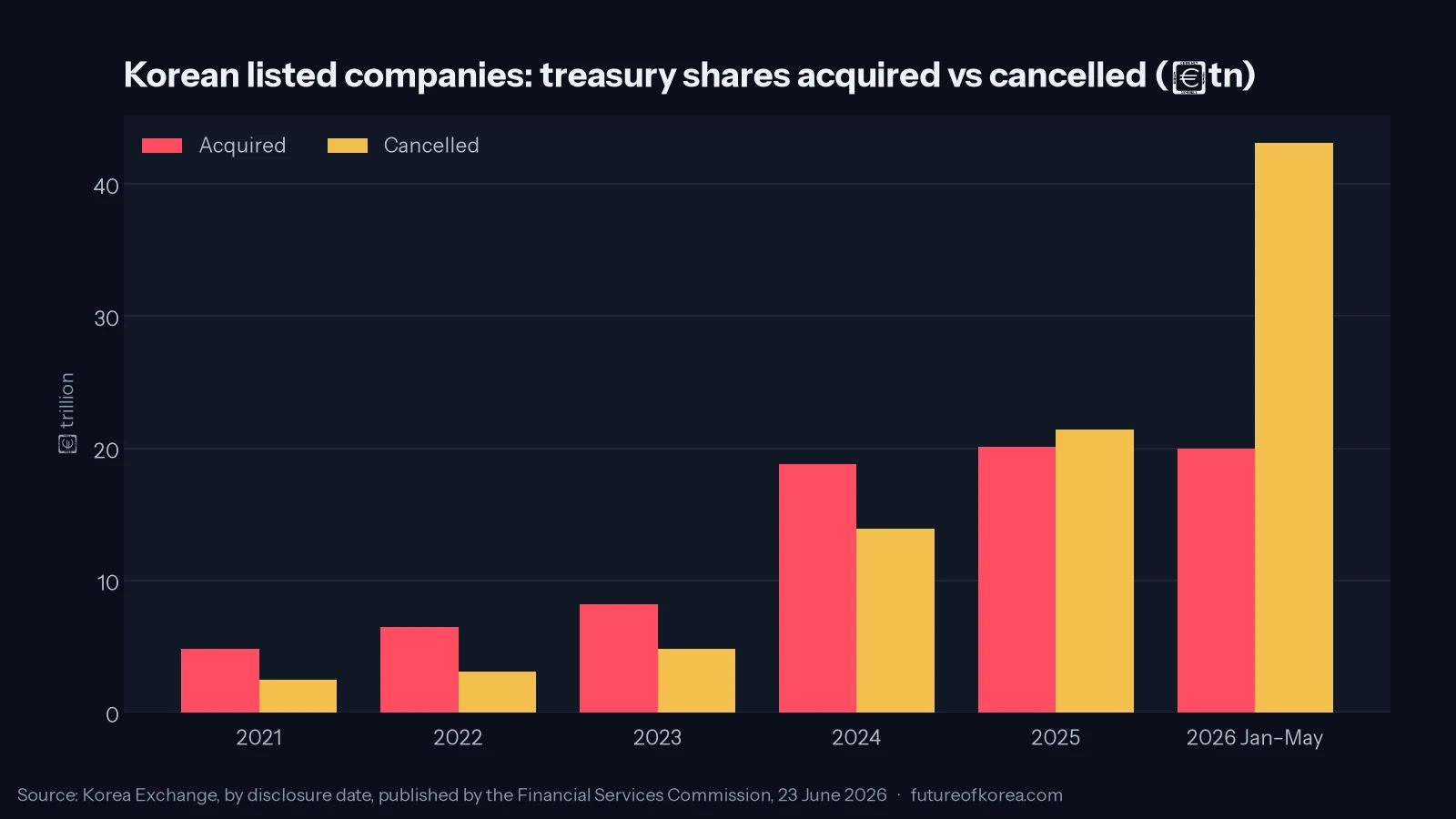
Korean companies cancelled ₩43.1tn of their own shares in five months — and bought only ₩20tn
A law that took effect on 6 March 2026 turned the treasury share from a control device into a countdown. Companies have until September 2027 to empty the vault, and the Korea Exchange numbers show them doing it faster than they are refilling it.
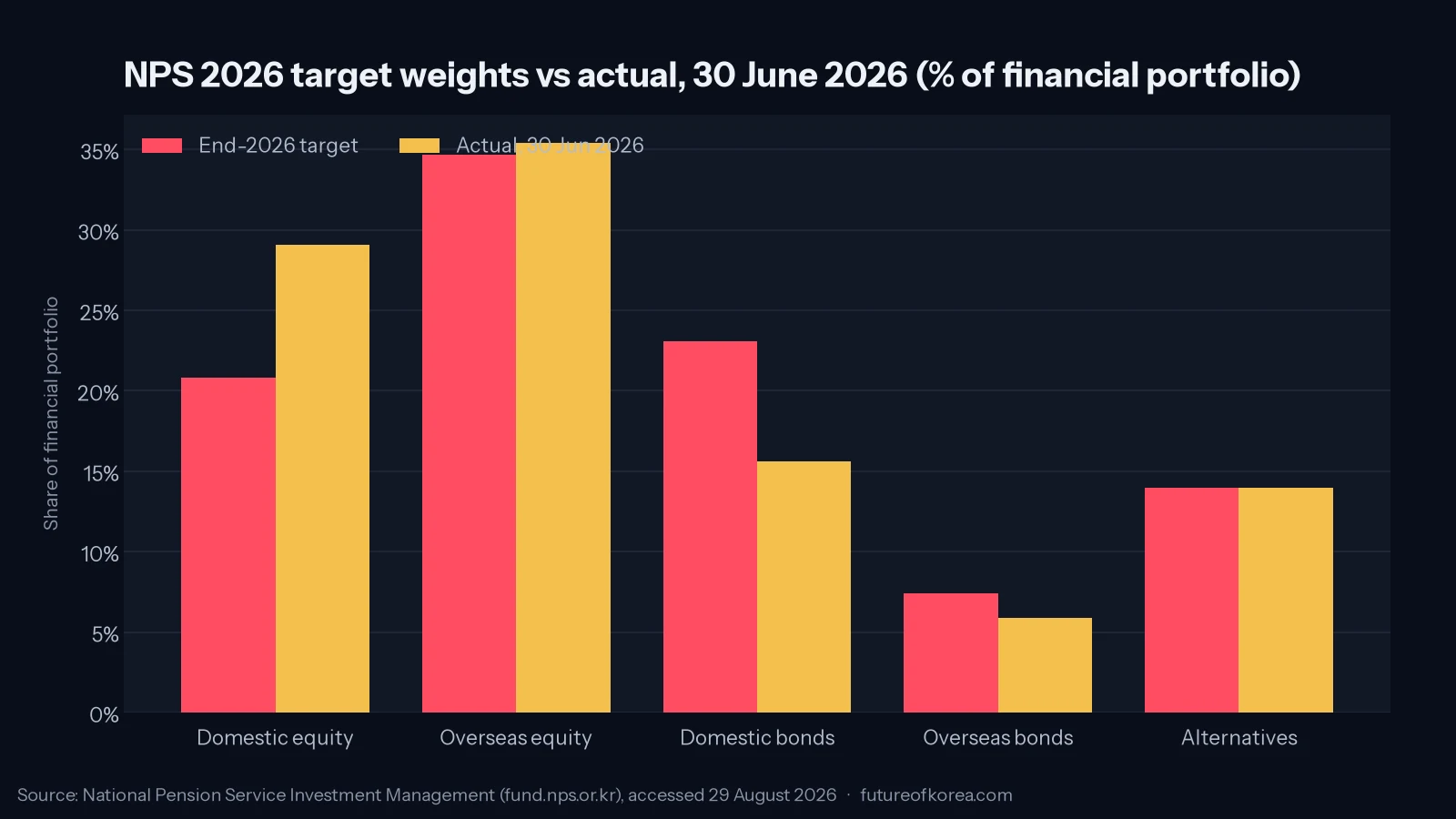
The National Pension Service raised its Korea target to 20.8%. It was already holding 29.1%.
On 28 May the National Pension Service raised its 2026 target weight in Korean shares from 14.9% to 20.8%. Five weeks later the fund held 29.1%. The gap, and what the fund is quietly underweight, matter more than the headline.
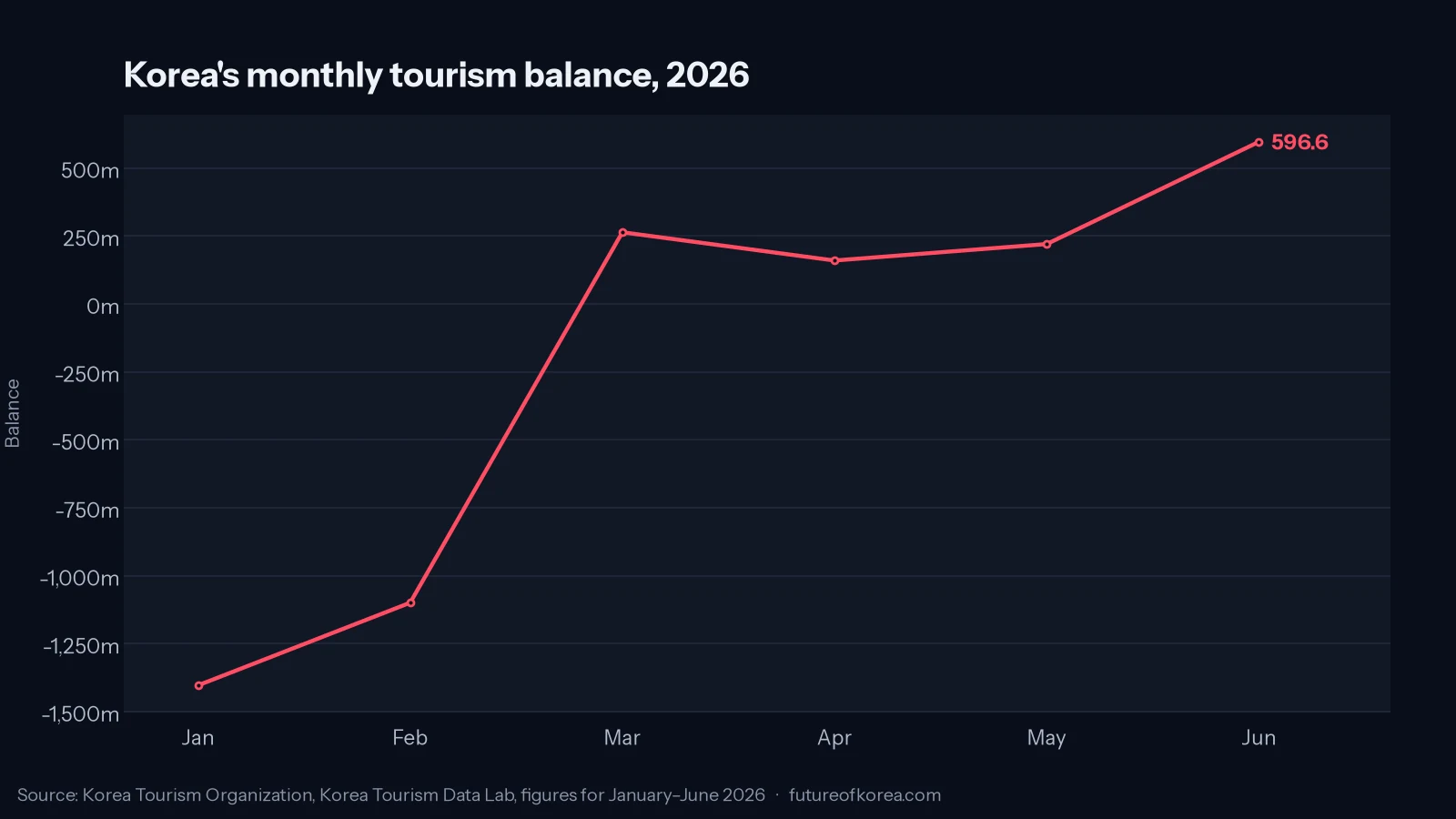
Korea's tourism balance turned positive in March. Duty-free sales are still down 60%.
Four consecutive surplus months put Korea within reach of its first annual tourism surplus since 2000. Half of it is foreigners spending more. The other half is Koreans priced out of flying abroad.