Korea's tourism balance turned positive in March. Duty-free sales are still down 60%.
Four consecutive surplus months put Korea within reach of its first annual tourism surplus since 2000. Half of it is foreigners spending more. The other half is Koreans priced out of flying abroad.
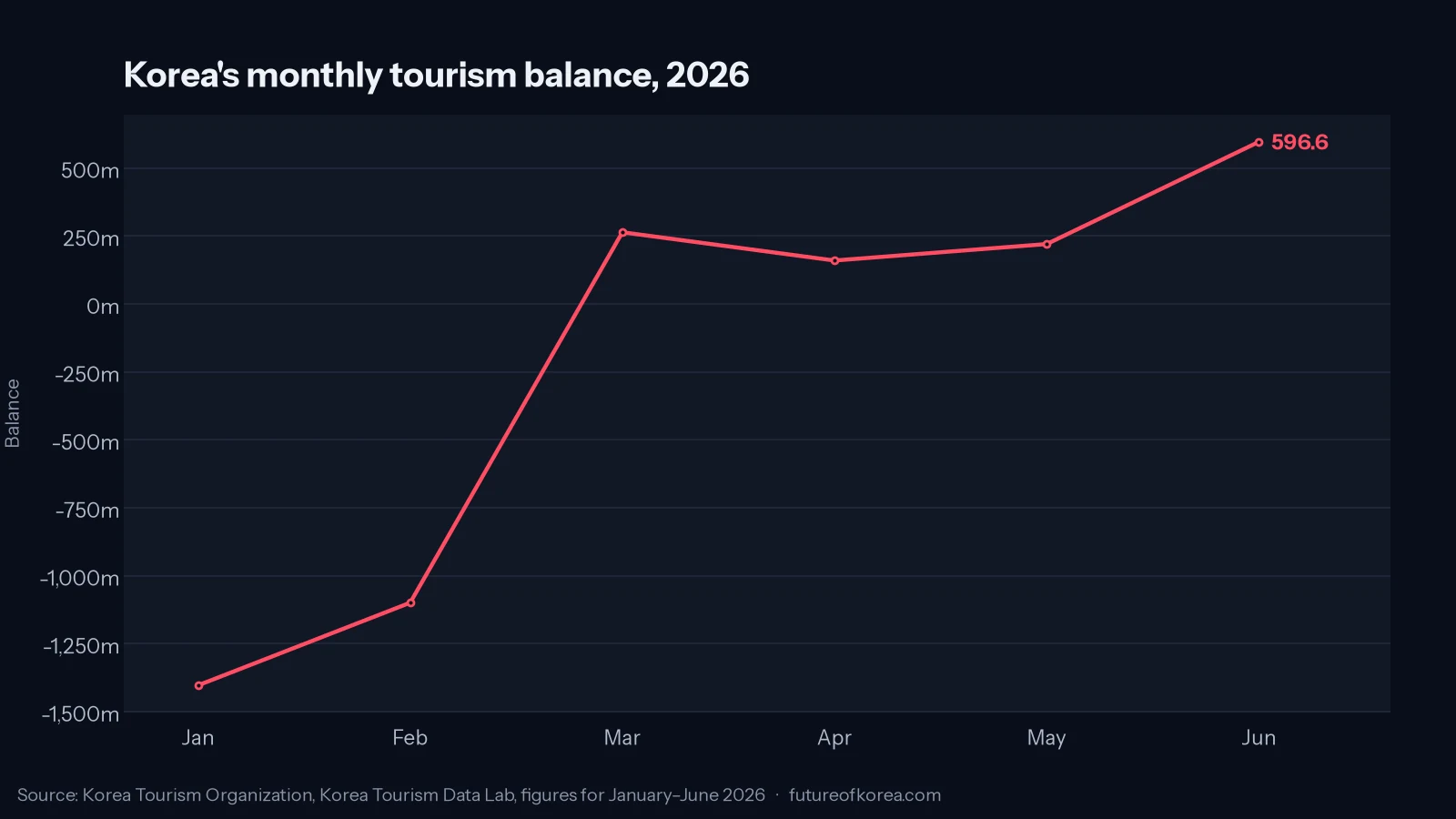
Korea’s tourism balance ran a $596.66 million surplus in June, its fourth consecutive positive month and the biggest single month since October 2008. The country has not closed a full year in tourism surplus since 2000. It is now close enough that the arithmetic is worth checking — and the money is not coming from where it used to.
Duty-free sales to foreign visitors in the first half were $3.37 billion. In the first half of 2019 they were $8.37 billion.
The receipts are up, but the deficit closed from both ends
Ten point seven one million foreign visitors arrived between January and June, 21.3% more than a year earlier and 26.9% more than the same stretch of 2019. That is the largest half-year on record. Tourism receipts came to $13.61 billion, up 36.4% year on year and 31.6% above 2019.
That is the half of the story everyone reports. The other half is quieter and does at least as much work.
Korean nationals spent $14.87 billion abroad in the first half — down 3.5% from a year earlier, even though 2.7% more of them left the country. Spending per outbound traveller fell 6.0%, from $1,057.6 to $993.7. Then the traveller count itself turned: down 2.1% year on year in May, down 10.0% in June.
The won explains both directions at once. It averaged ₩1,483.9 to the dollar over the six months, which made Korea cheaper to visit in every currency that matters and made everywhere else more expensive to reach from Seoul. The same exchange rate that has been holding the won weak through a record export year is what turned the travel account around. In won terms, outbound spending was actually 32.9% higher than 2019 — Koreans are paying more and getting less trip for it.
Where they still go is telling. Japan took 5.675 million Korean visitors in the half, 37.9% of all outbound travel, against 25.7% in the first half of 2019. The United States (−40.8% versus 2019), Thailand (−35.3%), the Philippines (−40.5%) and Hong Kong (−38.7%) have not recovered at all. Short flights survived the exchange rate. Long ones did not.
Duty free lost, medicine won
The composition of foreign spending has changed more than the total.
| Measure, H1 2026 | vs H1 2019 |
|---|---|
| Duty-free sales, $3.37bn | −59.8% |
| Duty-free customers | −30.9% |
| Duty-free spend per customer | −41.8% |
| Foreign medical spending, ₩1.1931tn | ×6.6 |
| Spending per visitor, $1,270.4 | +3.7% |
Both halves of the duty-free number fell. Fewer people walked in, and the ones who did bought less. That is what the collapse of the group-tour bulk-buying model looks like in a statistic: the tour bus, the fixed shopping stop, the resale margin, all of it thinner than it was seven years ago.
Medical tourism took its place, and then some. Foreign medical spending of ₩1.1931 trillion is 6.6 times the 2019 figure and 59% up on last year. A patient stays longer than a shopper and spends more per day, which is why spending per visitor cleared the 2019 mark at all — a mark it had to clear against a real drag, because cruise arrivals quadrupled to 481,000 and cruise passengers famously spend a few hours ashore and very little while they are there.
Entry points shifted too. Arrivals through regional airports were 42.2% above 2019, roughly double the 21.4% growth at the capital-region airports, and regional ports were up 63.8%. Taiwan grew fastest of the top ten source markets at 33.4%, behind China’s 3.212 million and Japan’s 1.95 million in absolute terms. This is not the Myeongdong-and-Incheon pattern that carried the last inbound boom, and it is not the one the retail duty-free business was built for.
The second half is an exchange-rate bet
Every element of this reverses if the won strengthens. Inbound demand loses its discount, outbound demand gets its purchasing power back, and the two lines that converged in June — outbound travellers outnumbered inbound by 2.6 to 1 in January and were nearly level by June — start diverging again.
That is not a hedged forecast. It is what the data says drove the change. Arrivals rose because Korea got cheaper, not because a new attraction opened; outbound fell because flying got expensive, not because Koreans lost interest in Japan. Jang Soo-cheong, who heads Yanolja Research, put the point directly in the report that first ran the annual-surplus arithmetic: the direction of the exchange rate in the second half is the variable that decides it.
There is a slower change underneath, and it is the more durable one. A tourism sector earning from medical treatment, regional entry and longer stays is less exposed to a single currency move than one earning from duty-free volume, because a knee replacement is not an impulse purchase and a two-week stay is not repriced by a 3% currency move. Korea has spent a decade trying to move inbound tourism up that curve, mostly through the cultural export machine that shows up in the entertainment agencies’ quarterly filings. The 2026 numbers are the first half-year where the shift shows in the receipts rather than in the strategy documents.
Whether it shows up in the annual balance is a different question, and it will be settled by the dollar.
Figures current as of 22 August 2026, sourced to the Korea Tourism Organization, the Bank of Korea and the outlets and research publications listed below.
Useful links & tools
Official portals and primary data sources for this topic. Opens in a new tab.
- Korea Tourism Data Lab — The Korea Tourism Organization's own portal — monthly arrivals, tourism receipts and payments, and the balance series charted above
- Bank of Korea — press releases — Where the monthly balance of payments release lands, including the travel account line, in English
- Tourism Knowledge and Information System — MCST's statistics system — arrivals by nationality, purpose and entry point, plus the visitor survey
- Yanolja Research — Publishes the half-year inbound and outbound analysis that first flagged the annual surplus arithmetic
- Visit Korea — K-ETA rules, entry requirements and the tax refund system, in English, for anyone planning a trip
Frequently asked questions
When did Korea last run an annual tourism surplus?
In 2000. Every year since then has closed in deficit, and the three most recent were among the widest ever: $10.38 billion in 2023, $10.21 billion in 2024 and $10.76 billion in 2025. The first half of 2026 still ran a cumulative deficit of $1.26 billion, so a full-year surplus requires the second half to clear that gap — roughly $210 million a month against the $310 million monthly average recorded between March and June.
Why do the Bank of Korea and the Korea Tourism Organization report different numbers?
They measure different things. The Bank of Korea’s travel account sits inside the balance of payments and follows international statistical conventions on what counts as a travel credit or debit; it showed a $440 million surplus in June and $50 million in May, so a two-month streak. The Korea Tourism Organization’s tourism balance, published through Korea Tourism Data Lab, compares tourism receipts against tourism payments on its own basis and shows four consecutive surplus months from March. Both are official. Neither is wrong — cite the period and the compiler alongside the figure.
Is the weak won the main reason for the tourism surplus?
It is the reason both sides moved at once. The won averaged ₩1,483.9 to the dollar in the first half of 2026, which cut the dollar price of a trip to Korea and raised the won price of a trip anywhere else. Inbound receipts rose 36.4% while outbound spending fell 3.5%. Korean outbound traveller numbers turned negative in May and fell 10.0% year on year in June. A meaningful won recovery would work against both halves of the trade simultaneously.
What replaced duty-free shopping in foreign visitors' spending?
Medical treatment, mainly. Foreign medical spending hit ₩1.1931 trillion in the first half, 6.6 times the same period of 2019 and 59% above last year, while duty-free sales fell 59.8% against 2019. Duty-free customer numbers dropped 30.9% and spending per customer dropped 41.8%, so both the traffic and the basket shrank. Per-visitor spending overall still came in at $1,270.4, which is 3.7% above the 2019 figure of $1,225.5.
Sources & further reading
Every figure in the key takeaways is numbered to the source it was read from. Sources marked primary are the statistics office, central bank, exchange, regulator or filing itself.
- 1Korea Tourism Data Lab — monthly tourism receipts, payments and balanceprimary — Korea Tourism Organization · verified 2026-08-22
- 2Balance of Payments press releases, including June 2026 (preliminary), released 6 August 2026primary — Bank of Korea · verified 2026-08-22
- 3[보도자료] 2026년 상반기 방한 관광객 규모·1인당 지출액 동반 상승 — Yanolja Research, 10 August 2026 · verified 2026-08-22
- 4의료관광이 이끈 인바운드 호황…관광수지 반전 기대 커졌다 — The Korea Economic Daily, 7 August 2026 · verified 2026-08-22
- 5Korea's Tourism Balance Nears First Annual Surplus in 26 Years — Seoul Economic Daily, 7 August 2026 · verified 2026-08-22
- 6“한국 여행에 지갑 연 외국인들”…6월 관광수지 4개월째 흑자 — Digital Times, 9 August 2026, reporting Korea Tourism Data Lab figures · verified 2026-08-22
Read next
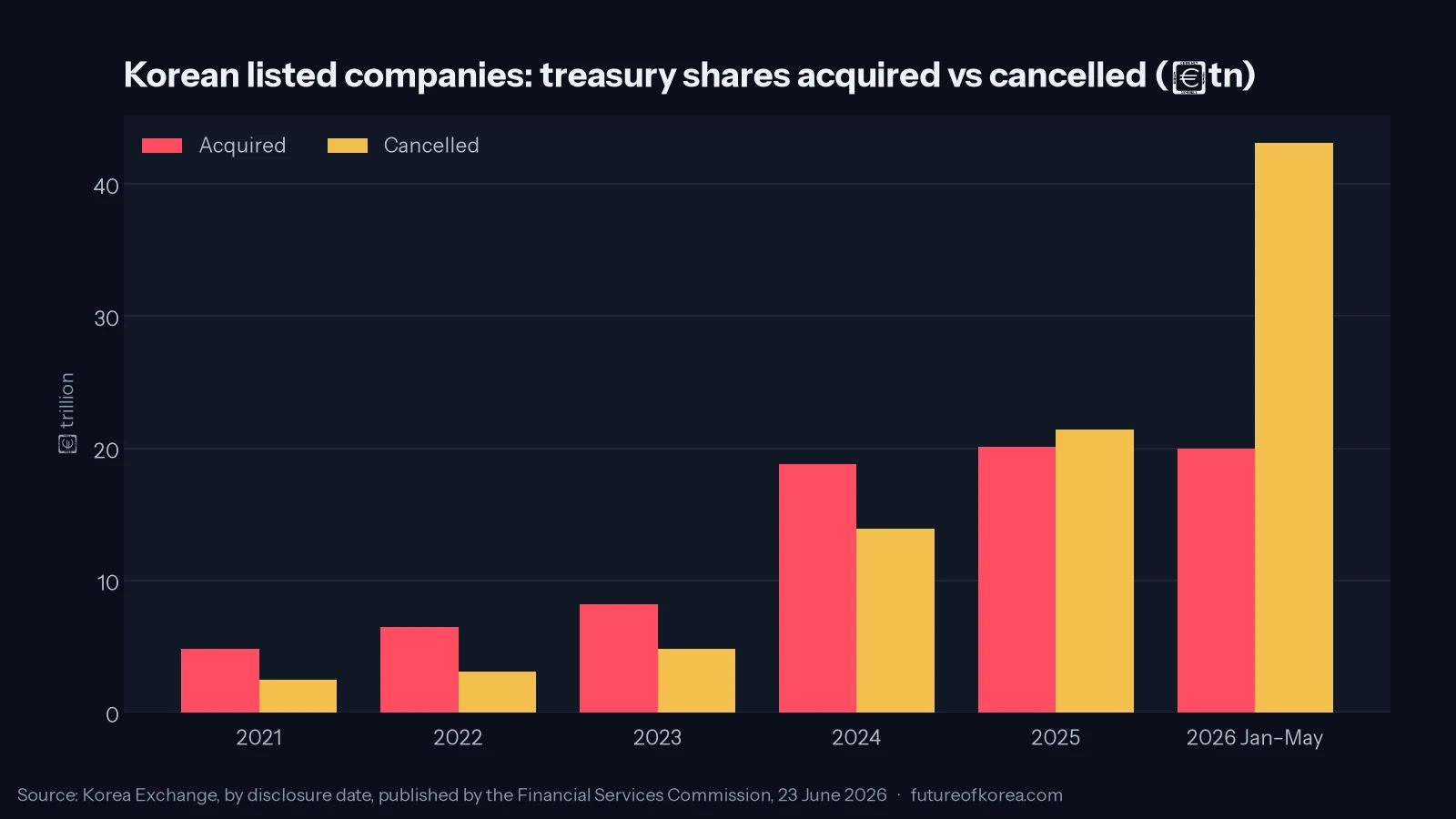
Korean companies cancelled ₩43.1tn of their own shares in five months — and bought only ₩20tn
A law that took effect on 6 March 2026 turned the treasury share from a control device into a countdown. Companies have until September 2027 to empty the vault, and the Korea Exchange numbers show them doing it faster than they are refilling it.
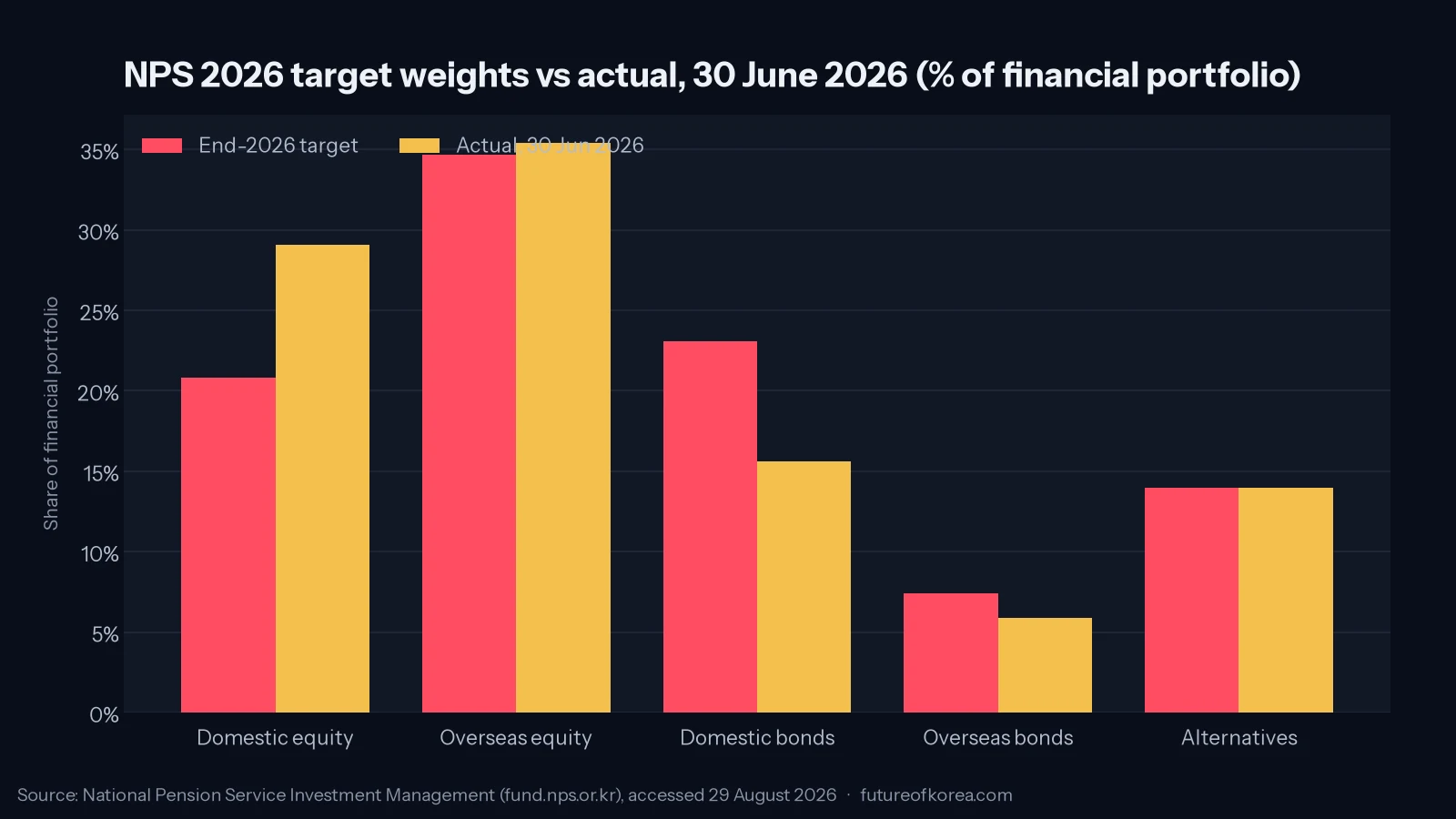
The National Pension Service raised its Korea target to 20.8%. It was already holding 29.1%.
On 28 May the National Pension Service raised its 2026 target weight in Korean shares from 14.9% to 20.8%. Five weeks later the fund held 29.1%. The gap, and what the fund is quietly underweight, matter more than the headline.
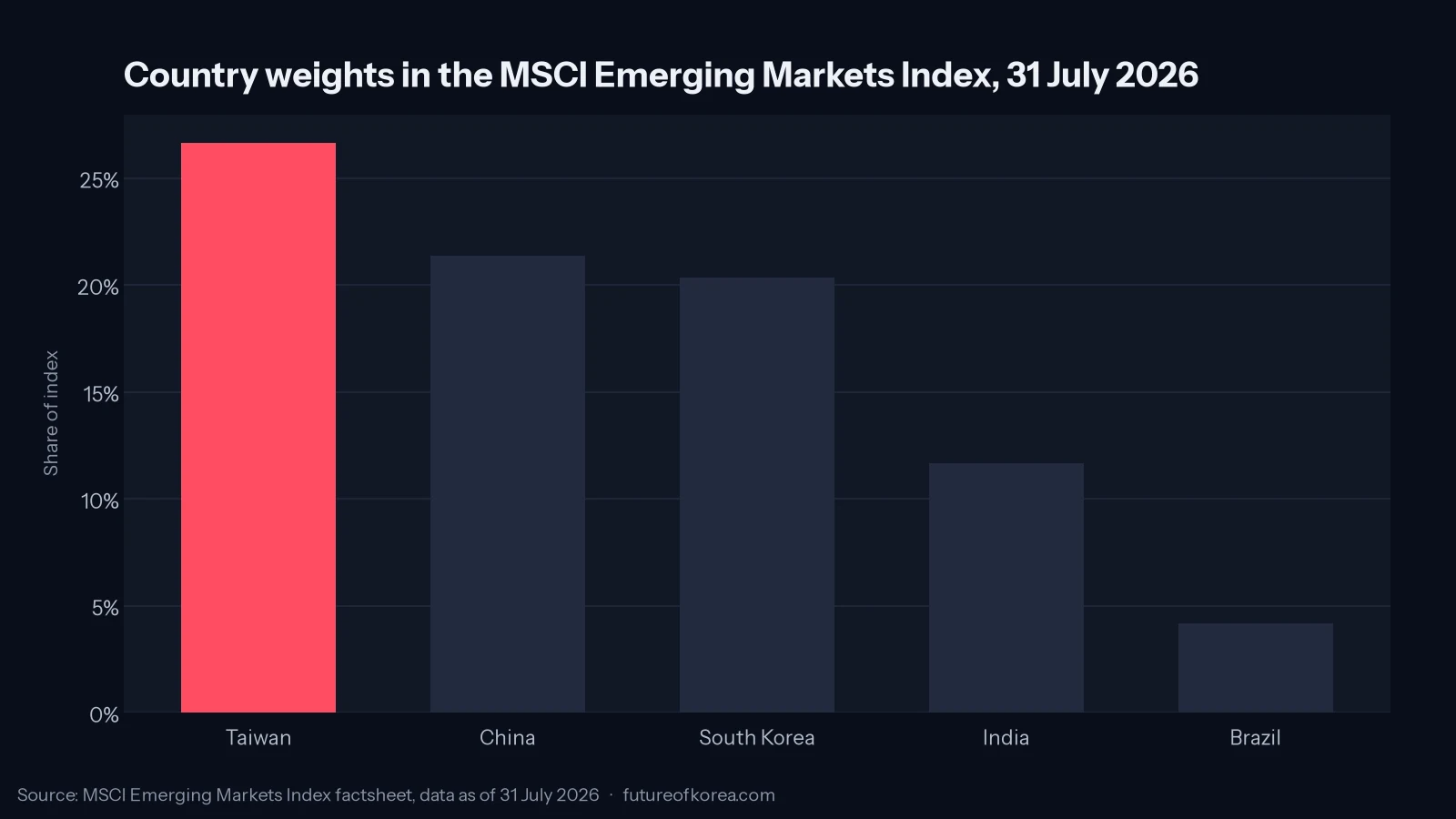
FTSE calls Korea a developed market. MSCI still calls it emerging.
Two index providers look at the same exchange and reach opposite conclusions. The disagreement is about the won, and the arithmetic of an upgrade is less flattering than the campaign for one suggests.