The National Pension Service raised its Korea target to 20.8%. It was already holding 29.1%.
On 28 May the National Pension Service raised its 2026 target weight in Korean shares from 14.9% to 20.8%. Five weeks later the fund held 29.1%. The gap, and what the fund is quietly underweight, matter more than the headline.
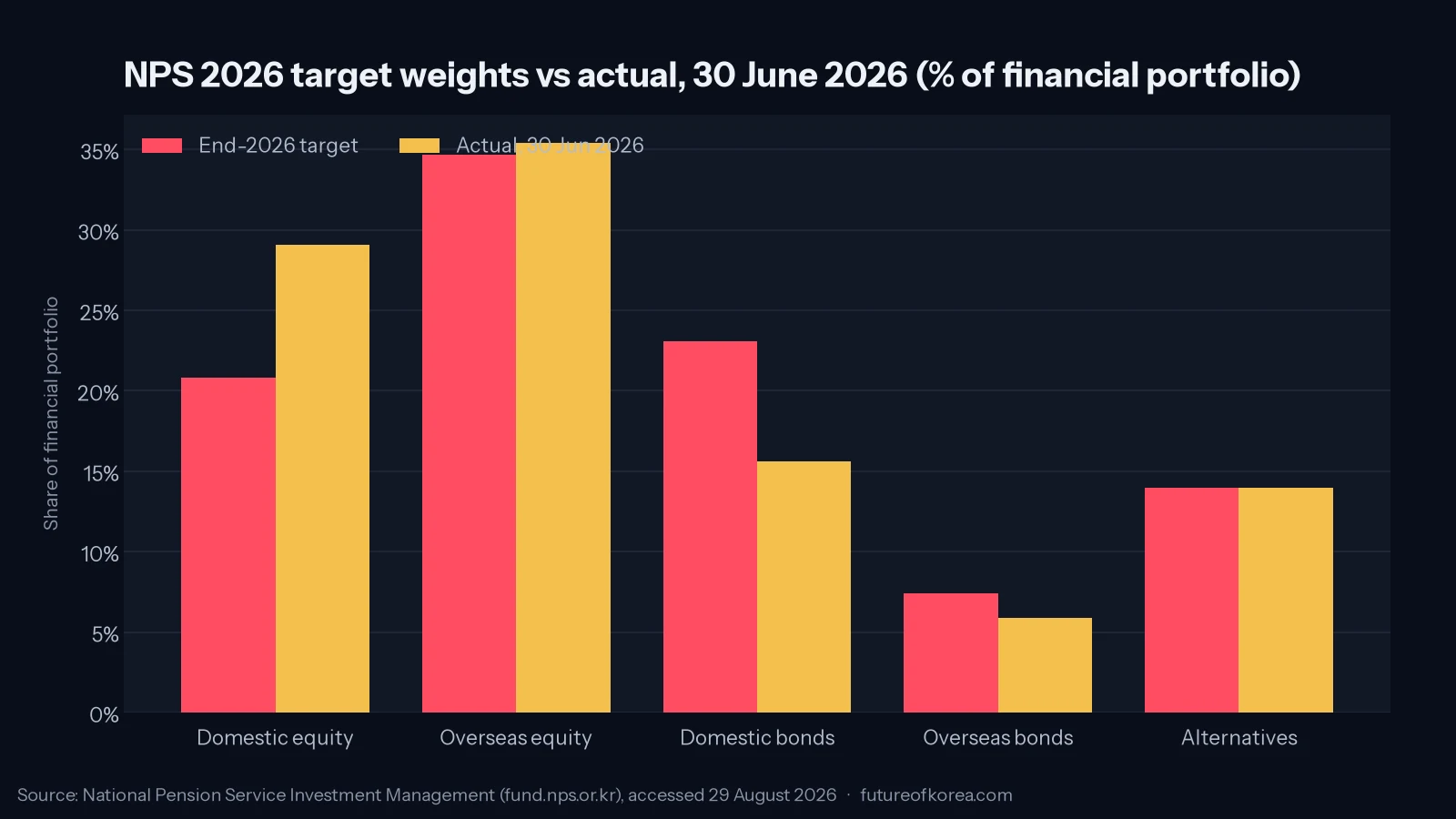
On 28 May the National Pension Service’s Fund Management Committee raised the fund’s 2026 target weight in Korean equities from 14.9% to 20.8%. Five weeks later, at the end of June, the fund actually held 29.1% — ₩543.2tn of shares, some 8.3 percentage points and roughly ₩155tn above the target it had just been handed.
The committee did not miss. It was overtaken.
Prices did what no allocator would have dared
NPS’s domestic equity book returned 107.37% in the first half of 2026, money-weighted and provisional, against a benchmark of 102.91%. Over the same six months its domestic bond book lost 3.00%. When one sleeve of a portfolio roughly doubles and another falls, the weights move on their own. No trader has to do anything.
That is the whole explanation for the 29.1%. The fund’s managers did not decide to make a ₩155tn bet on Korea. The bet was made for them by the first half of a market that peaked at 9,385.59 on 19 June before giving most of it back.
The drift was also permitted. At its first meeting of the year, on 26 January, the committee suspended rebalancing when the strategic asset allocation band was breached, citing volatility in the domestic market. So through the entire run-up, the mechanism that would normally have trimmed the position was switched off.
Why raise the target rather than sell the stock
The Ministry of Health and Welfare’s own language for the change was 현실화 — making the target realistic. Two reasons were given: the possibility of structural change in the Korean equity market following the amendment of the Commercial Act, and the plain fact that the actual weight had already expanded far beyond plan.
The alternative was to sell roughly ₩155tn of Korean shares into a market that had just fallen hard. The committee said mitigating that market impact was part of the decision, and it went further than the headline number suggests. It temporarily widened the strategic allocation band around domestic equities, cut the maximum size the fund may rebalance in a single day, and set the new target to take effect only from the end of June, when the January suspension lapsed.
Then it declined to publish the widened band.
The number nobody will disclose
The committee’s stated reason for withholding the tolerance range is the fair conduct of fund management and the stability of financial markets. That is a defensible position rather than an evasive one. A band is a trigger, and a market that knows the level at which the largest domestic institution becomes a forced seller will trade in front of it.
It also means that nobody outside Jeonju can say whether 29.1% sits inside the tolerance or outside it. Every estimate of “how much NPS has to sell” published this summer is a reconstruction from a target the committee published and a band it did not. Treat the resulting figures accordingly.
| Asset class | End-2025 target | End-2026 target | Actual, 30 Jun 2026 | H1 2026 return |
|---|---|---|---|---|
| Domestic equity | 14.9% | 20.8% | 29.1% | +107.37% |
| Overseas equity | 35.9% | 34.7% | 35.4% | +17.81% |
| Domestic bonds | 26.5% | 23.1% | 15.6% | −3.00% |
| Overseas bonds | 8.0% | 7.4% | 5.9% | +9.22% |
| Alternatives | 14.7% | 14.0% | 14.0% | +9.60% |
Target weights for bonds include short-term cash, so the actual figure above combines domestic bonds (15.4%) with the 0.2% held in short-term instruments. Returns are money-weighted, in won, and provisional for 2026.
The interesting deviation is on the bond side
Read the table down rather than across and a second gap appears, one that has attracted almost no attention. Against a 23.1% target, the fund held 15.6% in domestic bonds and cash at the end of June. That is 7.5 points short — roughly ₩140tn — and it is the largest underweight in the portfolio.
Rebalancing works in both directions. A fund closing an equity overweight by redirecting contributions has to put that money somewhere, and the plan says Korean government bonds. NPS is therefore set up as a structural buyer of KTBs precisely as the Bank of Korea sits at 3% with its own projections pointing higher — which is to say, into rising yields and the −3.00% the sleeve has already delivered this year.
That is the trade that will move Korean rates over the next several quarters, and it is far less discussed than the equity overhang.
The June photograph is already out of date
Everything above is a 30 June snapshot, published with the fund’s customary two-month lag. Korean equities have fallen substantially since. That matters mechanically: a drawdown in the overweight asset shrinks both the numerator and the denominator, so the gap to target closes without a single share changing hands.
Which supplies an uncomfortable answer to a question asked repeatedly in July. If NPS was the buyer of last resort that many retail investors expected, the arithmetic of its own allocation plan argues otherwise — the fund entered the summer needing less Korean equity, not more. The next portfolio update, covering the third quarter, will show how much of the overhang the market resolved on the fund’s behalf.
One number is worth keeping in view behind all of this. Since 1988 the fund has taken in ₩956.9tn of contributions and earned ₩1,370.8tn in investment income, against ₩448.3tn paid out in benefits. Investment returns have now contributed more to Korea’s pension reserve than every won of contributions ever collected — which is why a decision about a target weight is not a technical matter, and why the committee took five months to make it. If you are weighing your own exposure to this market, the mechanics of buying Korean equities from abroad are a separate question, and the disclaimer applies.
Figures current as of 29 August 2026, sourced to the data portals and releases listed below. Portfolio and performance figures are as at 30 June 2026 and are provisional.
Useful links & tools
Official portals and primary data sources for this topic. Opens in a new tab.
- NPS Investment Management — fund status and portfolio — The fund's own monthly portfolio table: total assets and the weight of each asset class. Updated with a lag of roughly two months.
- NPS Investment Management — performance by asset class — Returns and excess returns against benchmark for each sleeve, in won and in dollars. Where the 107.37% figure comes from.
- NPS Investment Management — asset allocation policy — The annual fund management plan, including the year-end target portfolio table used in this article.
- NPS Investment Management (English) — English-language mirror of the fund pages, useful if you do not read Korean. Thinner and updated less often than the Korean site.
- Korea Exchange — market data portal — Daily index levels and investor-type net buying, including the pension and insurance category that captures most NPS domestic flow.
Frequently asked questions
Does the National Pension Service have to sell Korean shares to get back to 20.8%?
Not mechanically, and not on any published schedule. NPS rebalances partly by directing net new contributions away from the overweight asset class rather than by selling it, and the committee explicitly cut the maximum daily rebalancing size in May 2026 to reduce market impact. The tolerance band around the target was also widened and deliberately not published, so no outside party can calculate a required sale figure. The ₩155tn gap is the distance from target, not an order ticket.
Why did the committee raise the target instead of selling down the position?
The Ministry of Health and Welfare described the change as bringing the target into line with reality. It cited two reasons: the possibility of structural change in the Korean equity market following the amendment of the Commercial Act, and the fact that the actual weight had already expanded well beyond plan. Selling roughly ₩155tn of Korean shares into a market that had just fallen sharply would have been the alternative, and the committee said mitigating that market impact was part of the decision.
How did NPS end up so far above its own target in the first place?
Prices, not purchases. The fund’s domestic equity portfolio returned 107.37% in the first half of 2026 on a money-weighted basis, against a benchmark of 102.91%, while its domestic bond portfolio lost 3.00%. When one sleeve of a portfolio roughly doubles and another falls, weights move without a single trade. The committee had also suspended rebalancing in January 2026 when the strategic allocation band was breached, so the drift was allowed to run.
Is the fund's foreign portfolio still larger than its Korean one?
Yes, but by less than at any recent point. At 30 June 2026 overseas equities were ₩661.1tn, or 35.4% of the financial portfolio, against ₩543.2tn and 29.1% in domestic equities. Add overseas bonds at 5.9% and the offshore book is roughly 41% of the fund. The mid-term plan approved in May keeps the overseas equity target near 35% through 2027, so the recent convergence reflects Korean prices rising faster, not a strategic retreat from abroad.
Sources & further reading
Every figure in the key takeaways is numbered to the source it was read from. Sources marked primary are the statistics office, central bank, exchange, regulator or filing itself.
- 1운용현황 개요 — fund status and portfolio composition, 30 June 2026primary — National Pension Service Investment Management · verified 2026-08-29
- 2자산군별 성과 — performance by asset class, provisional to June 2026primary — National Pension Service Investment Management · verified 2026-08-29
- 3자산배분 — 2026 fund management plan target portfolioprimary — National Pension Service Investment Management · verified 2026-08-29
- 4국민연금, 올해 국내주식 목표비중 14.9%→20.8%로 상향primary — Ministry of Health and Welfare via Korea Policy Briefing, May 2026 · verified 2026-08-29
- 5해외 주식 — overseas equity portfolio compositionprimary — National Pension Service Investment Management · verified 2026-08-29
Read next
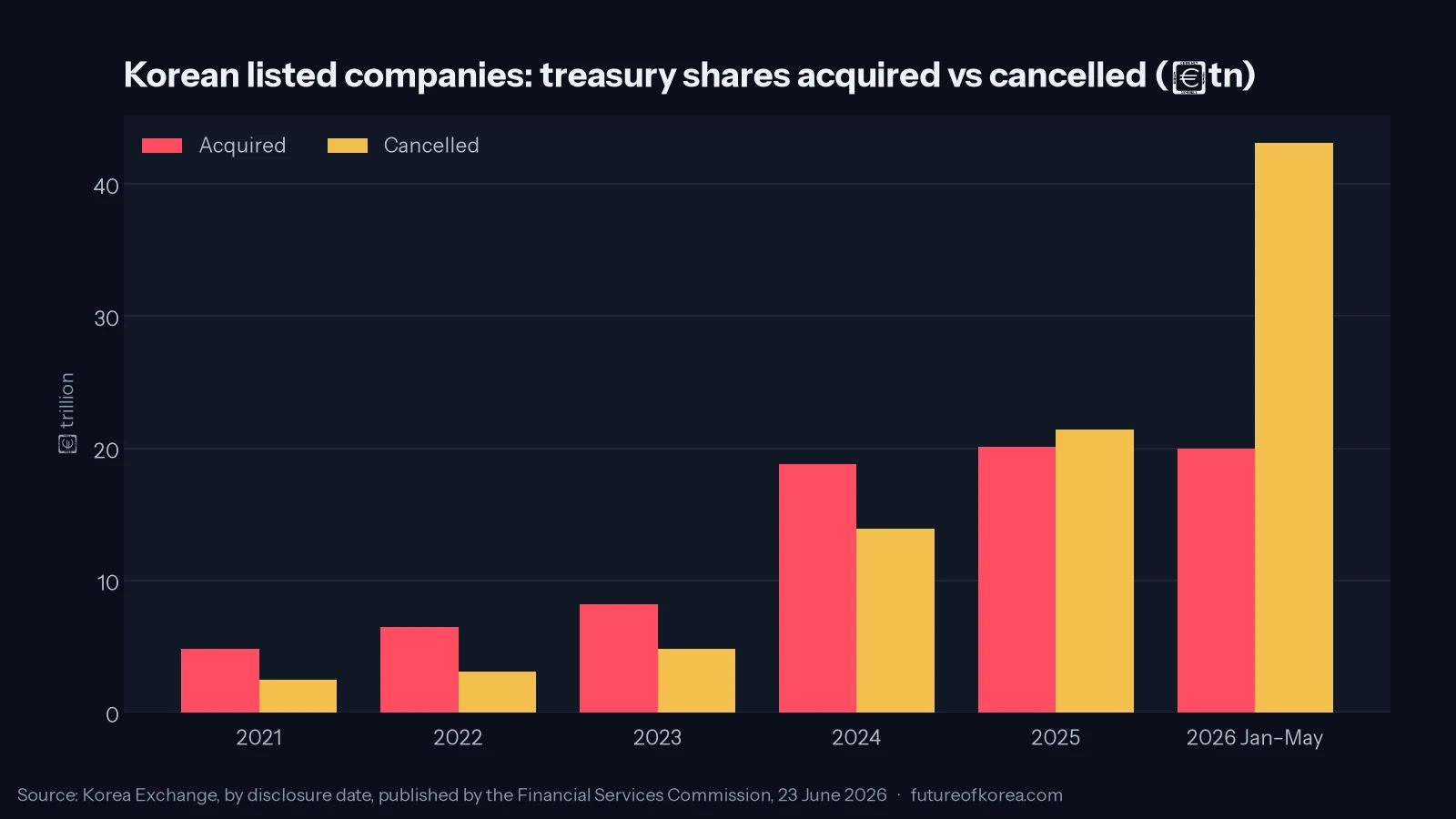
Korean companies cancelled ₩43.1tn of their own shares in five months — and bought only ₩20tn
A law that took effect on 6 March 2026 turned the treasury share from a control device into a countdown. Companies have until September 2027 to empty the vault, and the Korea Exchange numbers show them doing it faster than they are refilling it.
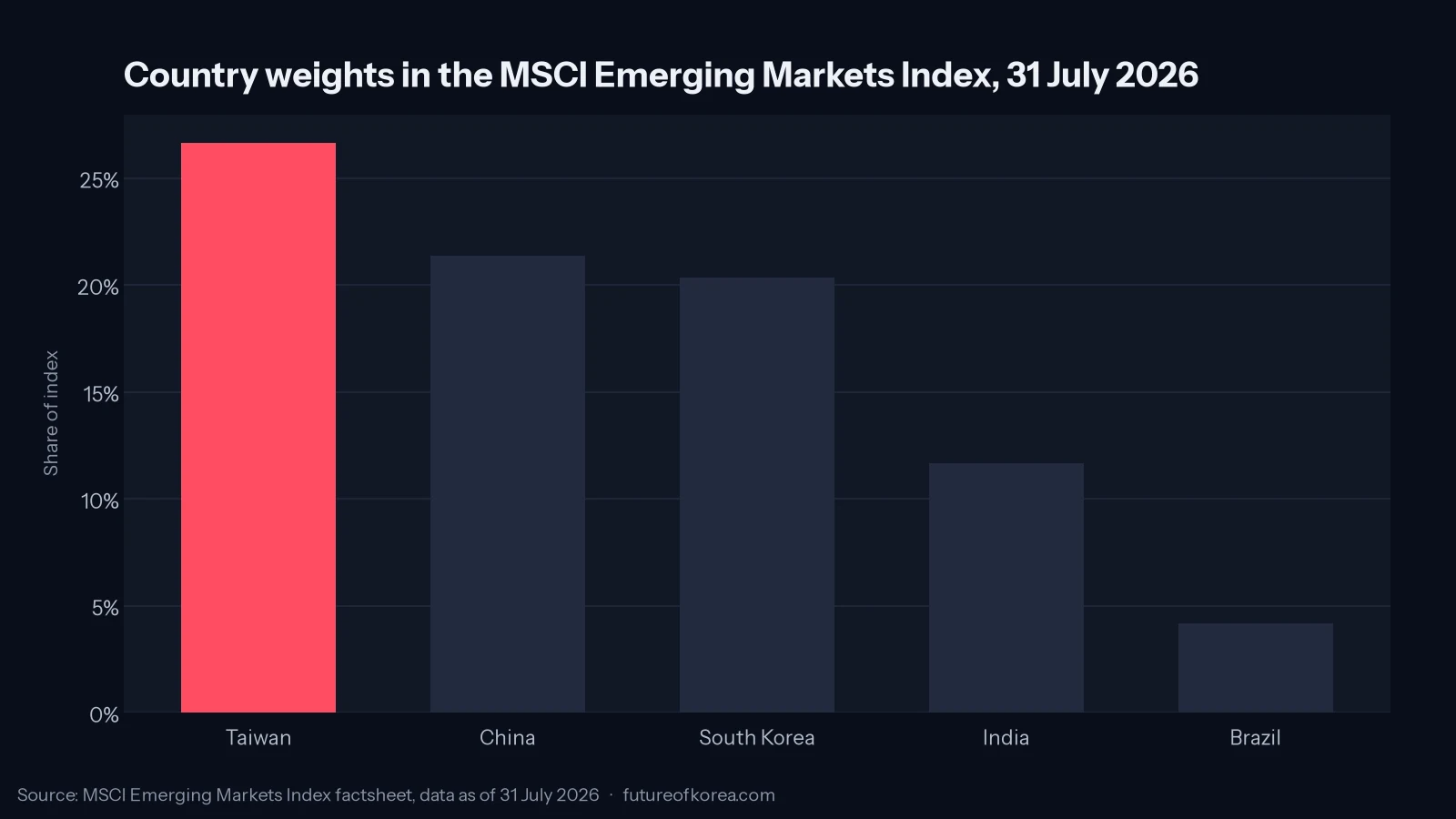
FTSE calls Korea a developed market. MSCI still calls it emerging.
Two index providers look at the same exchange and reach opposite conclusions. The disagreement is about the won, and the arithmetic of an upgrade is less flattering than the campaign for one suggests.
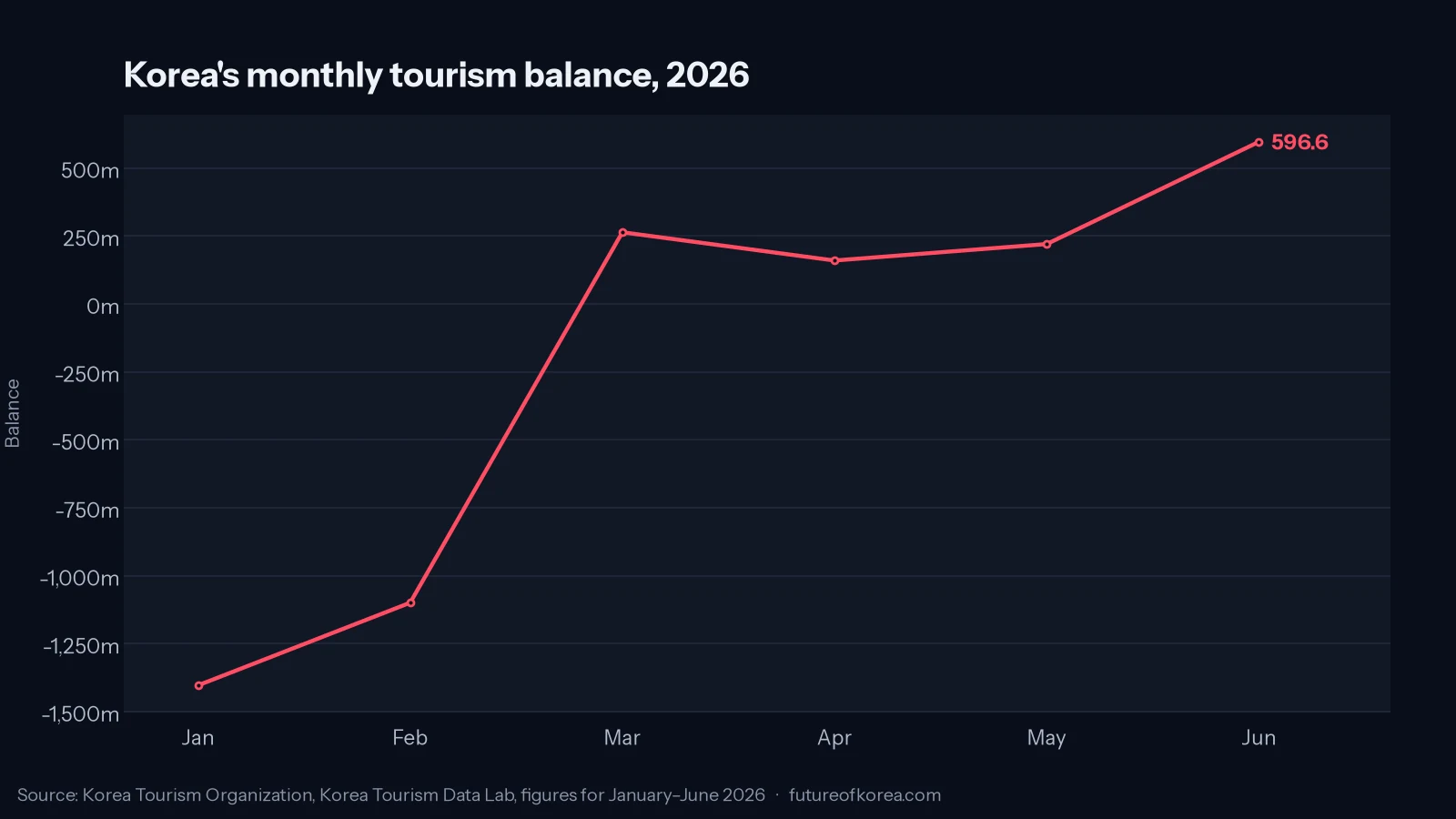
Korea's tourism balance turned positive in March. Duty-free sales are still down 60%.
Four consecutive surplus months put Korea within reach of its first annual tourism surplus since 2000. Half of it is foreigners spending more. The other half is Koreans priced out of flying abroad.