Korea's core inflation hit 3.4%. A phone bill from last August did most of it.
Consumer prices rose 3.1% in August and core inflation rose 3.4%, the sharpest one-month acceleration of the year. Strip out a single expenditure group and the same data show inflation falling.
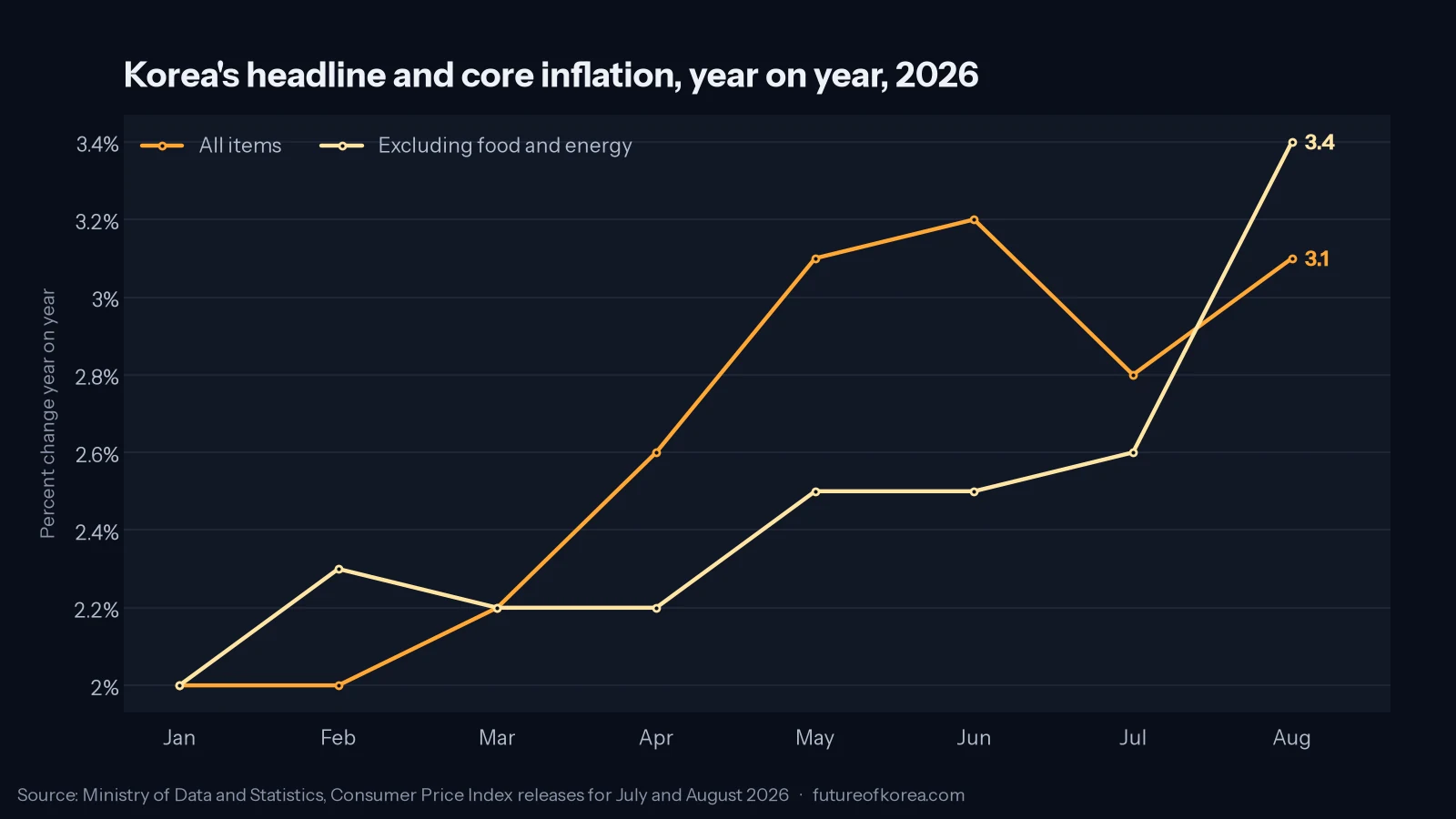
Korean consumer prices rose 3.1% in the year to August 2026, and the core index — the one that strips out food and energy — rose 3.4%. Core has not outrun headline by that margin at any point this year. The single biggest reason is that SK Telecom halved its customers’ phone bills in August 2025.
The mobile discount that became an inflation print
After a data breach exposed subscriber data in April 2025, SK Telecom gave every eligible customer a 50% discount on their August 2025 bill, part of a compensation package the company put at ₩500bn covering roughly 24 million users on its own network and on MVNOs riding it.
The statistics office recorded that faithfully. The communication expenditure group fell 13.3% in a single month, taking its index from 101.35 in July 2025 to 87.87 in August.
Twelve months later, the discount is gone and the comparison is against that hole. Communication printed 102.48 in August 2026 — up 16.6% year on year, against 0.7% a month earlier.
Strip it out and inflation is falling
Rebuild the index without communication and both months change character. Excluding that group, prices rose 2.9% in the year to July and 2.6% in the year to August — a deceleration, not the acceleration the published figures show.
| Measure | July 2026 | August 2026 |
|---|---|---|
| All items, year on year | 2.8% | 3.1% |
| Excluding food and energy | 2.6% | 3.4% |
| Communication group | +0.7% | +16.6% |
| All items excluding communication | 2.9% | 2.6% |
The core measure moved further than headline for a mechanical reason. Communication is neither food nor energy, so it never leaves the core basket — and that basket is smaller than the full one, so the same 14.61-point jump lands with more force.
This unwinds. The discount applied to one billing month, and by July 2026 the communication index had returned to roughly where it was two years earlier. Assuming September 2025 was not similarly depressed, the September 2026 release should shed most of the distortion.
What is actually getting more expensive
The rest of the table is less dramatic and more useful. Transport rose 7.2% year on year, driven by petroleum, though it fell 0.1% on the month. Recreation and culture was up 4.9%, miscellaneous goods and services 4.4%, restaurants and hotels 2.8%.
Food and non-alcoholic beverages went the other way: the index read 128.27 against 128.96 a year earlier, a fall of 0.5%. Groceries in Korea are cheaper than they were last August, for the first time this year — which is not what most households will report, because the categories that grew fastest are the ones people pay monthly and notice.
Housing, water, electricity and gas rose 1.9%, and education 1.3%.
The Bank of Korea already decided
Governor and board had made their call before this print. On 27 August the Monetary Policy Board raised the base rate to 3.00%, its second consecutive quarter-point move, and published a six-month outlook in which sixteen of twenty-one dots sat above the new level. That decision rested on the composition of price pressure, on housing in the capital region and on household credit — not on an August CPI number nobody had yet seen. The full dot plot and what the board said about it is the better guide to where rates go next.
For borrowers the practical question is unchanged, and it is a question about the mortgage book rather than about August’s index. Korean households have been switching into floating-rate mortgages just as the tightening cycle began, which is the transmission channel that matters if the dots are right.
Anyone building a forecast off this month’s core reading is forecasting a telecoms apology.
Figures current as of 2 September 2026, sourced to the outlets and data portals listed below.
Useful links & tools
Official portals and primary data sources for this topic. Opens in a new tab.
- Consumer Price Survey — press releases — Where the monthly CPI release and its full expenditure-category table are published in English, usually on the second working day of the month
- KOSIS — Korean Statistical Information Service — The full CPI back series, including individual items and the weights used in the basket
- Economic Statistics System (ECOS) — The Bank of Korea's data portal — policy rate history, expected inflation surveys and market rates
- The Bank of Korea Base Rate — The dated record of every base rate decision, useful for checking what the rate was on any given day
Frequently asked questions
What was Korea's inflation rate in August 2026?
The consumer price index stood at 120.05 on a 2020=100 base, 3.1% higher than in August 2025 and 0.2% higher than in July 2026. The index excluding food and energy — the core measure — was 116.64, up 3.4% year on year and 0.2% on the month. Both figures come from the Ministry of Data and Statistics release published on 2 September 2026.
Why did Korean core inflation rise faster than headline inflation?
Because the distortion sits inside the core basket rather than outside it. SK Telecom gave every subscriber a 50% discount on their August 2025 bill after a data breach, which pushed the communication index down 13.3% in a single month. Communication is neither food nor energy, so it stays in the core measure, and the core basket is smaller than the full one — the same swing therefore counts for more, not less.
Will the August base effect disappear from Korea's inflation numbers?
The discount applied to one billing month, and the communication index had already returned to its normal level by July 2026, when it stood at 102.01 against 101.35 a year earlier. Unless the September 2025 reading was also depressed, the comparison should normalise in the September 2026 release, due in early October. That would mechanically subtract something close to half a percentage point from the headline rate.
Does this change what the Bank of Korea does next?
Probably not much on its own. The board raised the base rate to 3.00% on 27 August 2026 and published a six-month outlook in which 16 of 21 dots sat above that level, so the tightening case was made before this print landed. A central bank that hikes on a distorted core reading and then watches it unwind has a communication problem, which is a reason to discount the August number rather than act on it.
Sources & further reading
Every figure in the key takeaways is numbered to the source it was read from. Sources marked primary are the statistics office, central bank, exchange, regulator or filing itself.
- 1Consumer Price Index in August 2026primary — Ministry of Data and Statistics · verified 2026-09-02
- 2Consumer Price Index in July 2026primary — Ministry of Data and Statistics · verified 2026-09-02
- 3Monetary Policy Decisionsprimary — Bank of Korea · verified 2026-09-02
- 4SK Telecom Announces Accountability and Commitment Program — SK Telecom newsroom, July 2025 · verified 2026-09-02
- 5After massive breach, SK Telecom rolls out W1.2tr customer-first plan — The Korea Herald, July 2025 · verified 2026-09-02
Read next
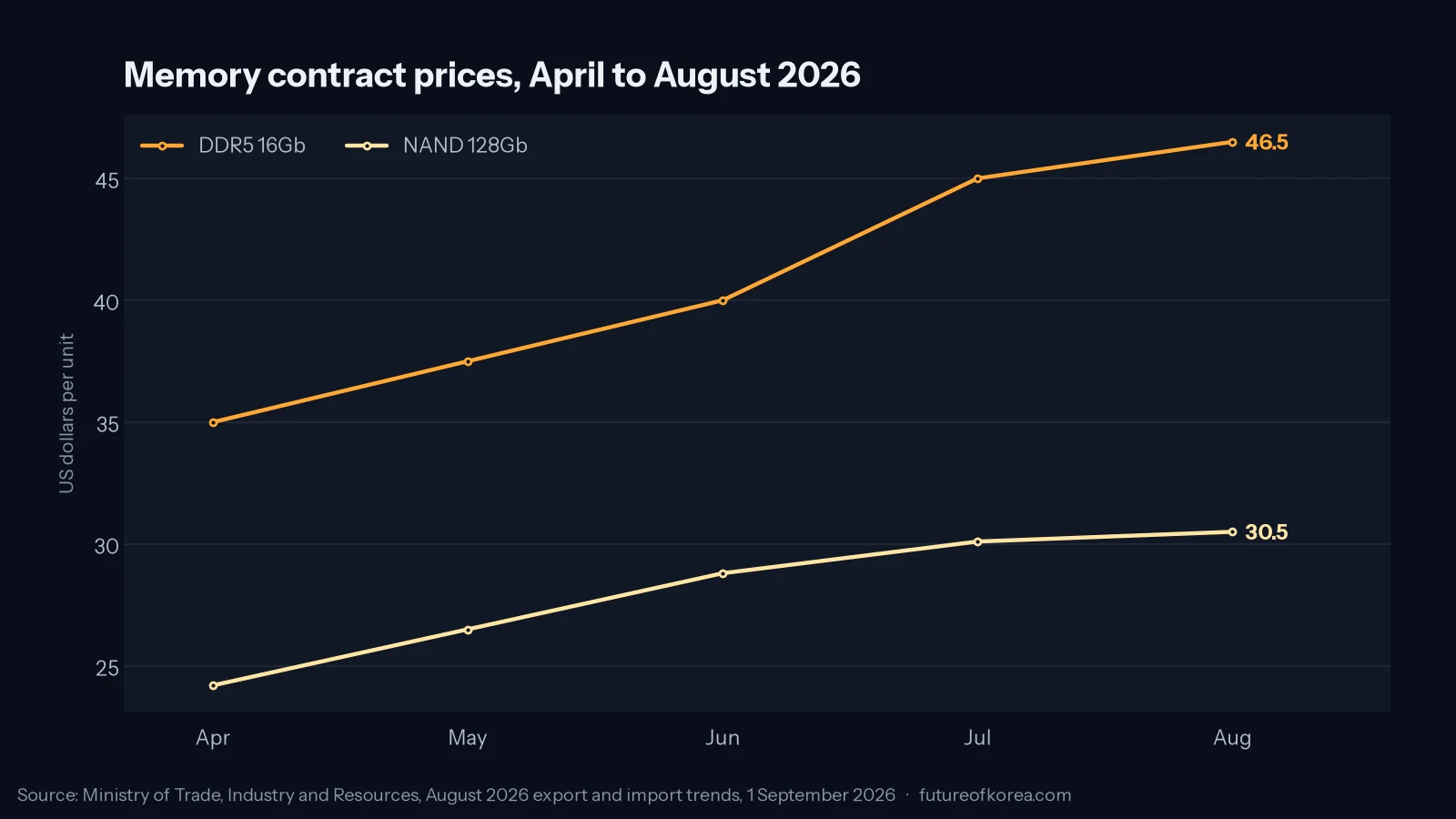
Korea's exports grew 68.7% in August. Strip out three product lines and they grew 2%.
August was Korea's third-biggest export month on record and produced a $34.75bn trade surplus. Almost the entire year-on-year gain came from three lines, and all three are priced rather than produced.
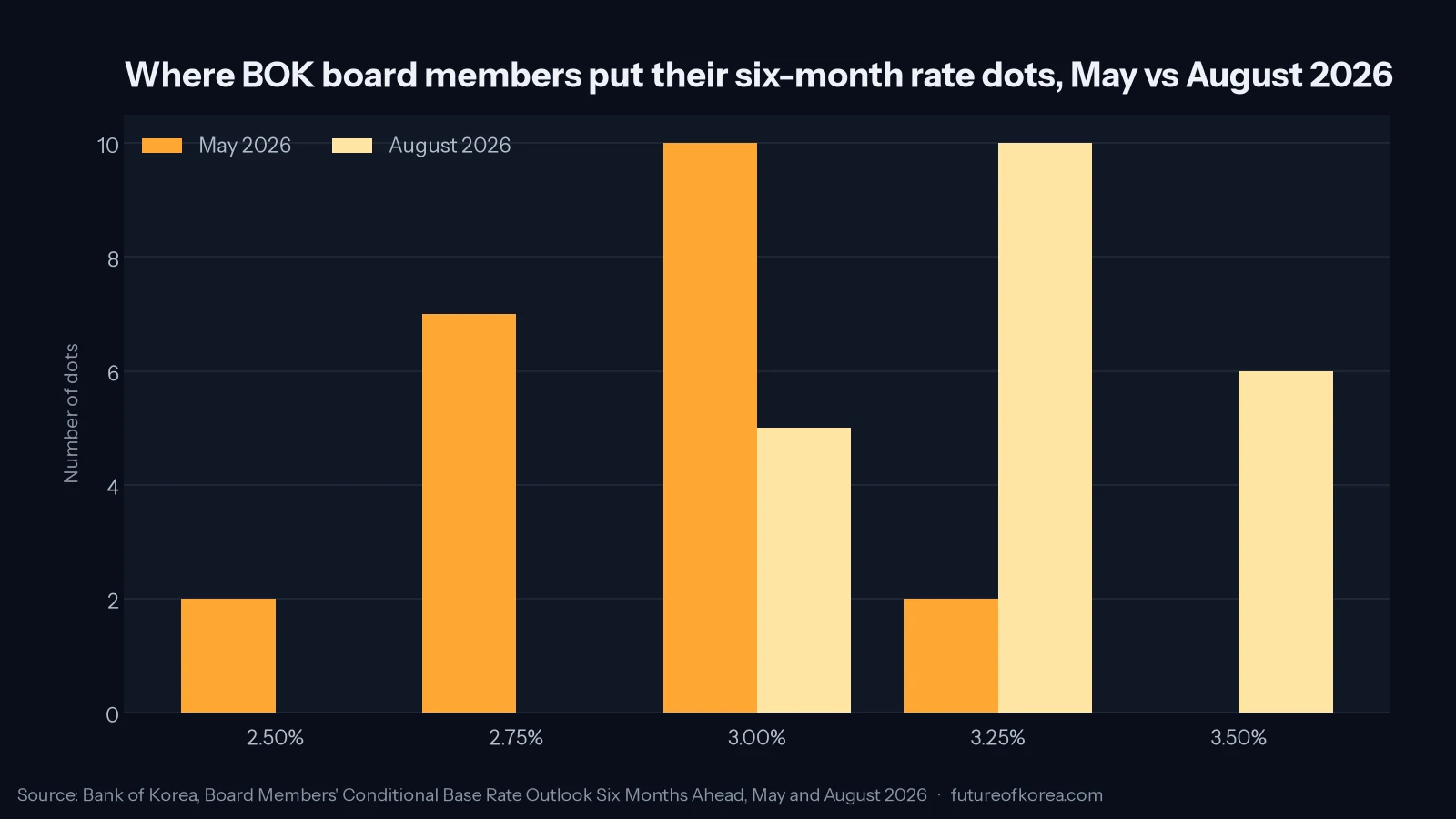
The Bank of Korea went to 3%. Its own dot plot says that is not the top.
A second consecutive quarter-point hike takes Korea's base rate to 3.00%. The more consequential release was the board's six-month rate outlook, which moved up almost as a bloc.
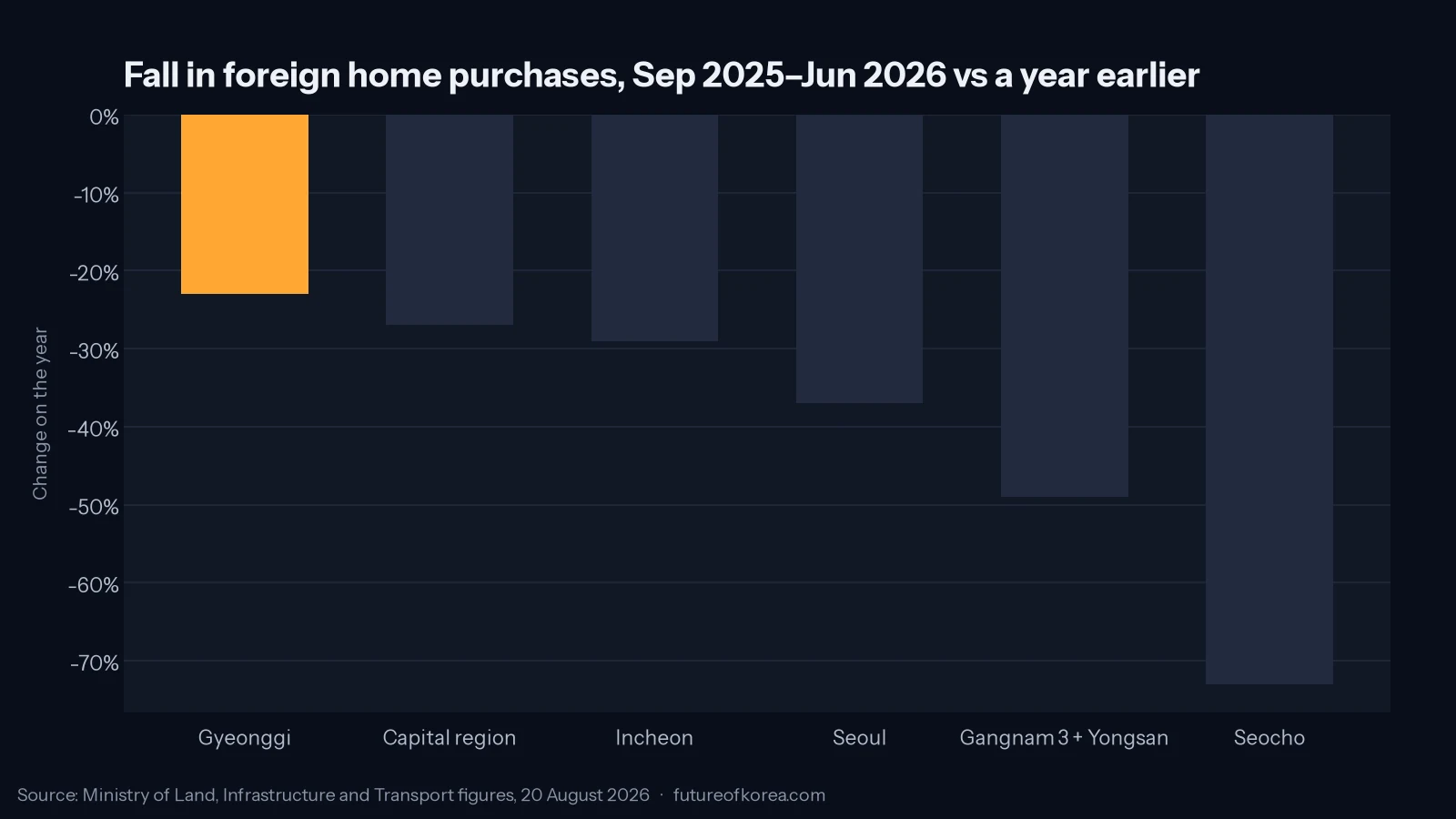
Korea extended its foreign home-buying permits. The buyers were never in Gangnam.
The Ministry of Land, Infrastructure and Transport kept its capital-region permit zone for another year and added 353 islands. The transaction data underneath shows a policy aimed at Gangnam catching a market in Bucheon.