Koreans are switching to floating-rate mortgages just as the Bank of Korea starts hiking
Korean borrowers spent the first half of 2026 abandoning fixed-rate mortgages for floating ones. The Bank of Korea spent July raising rates for the first time in more than three years.
Photograph by https://kaboompics.com/ on Pexels.
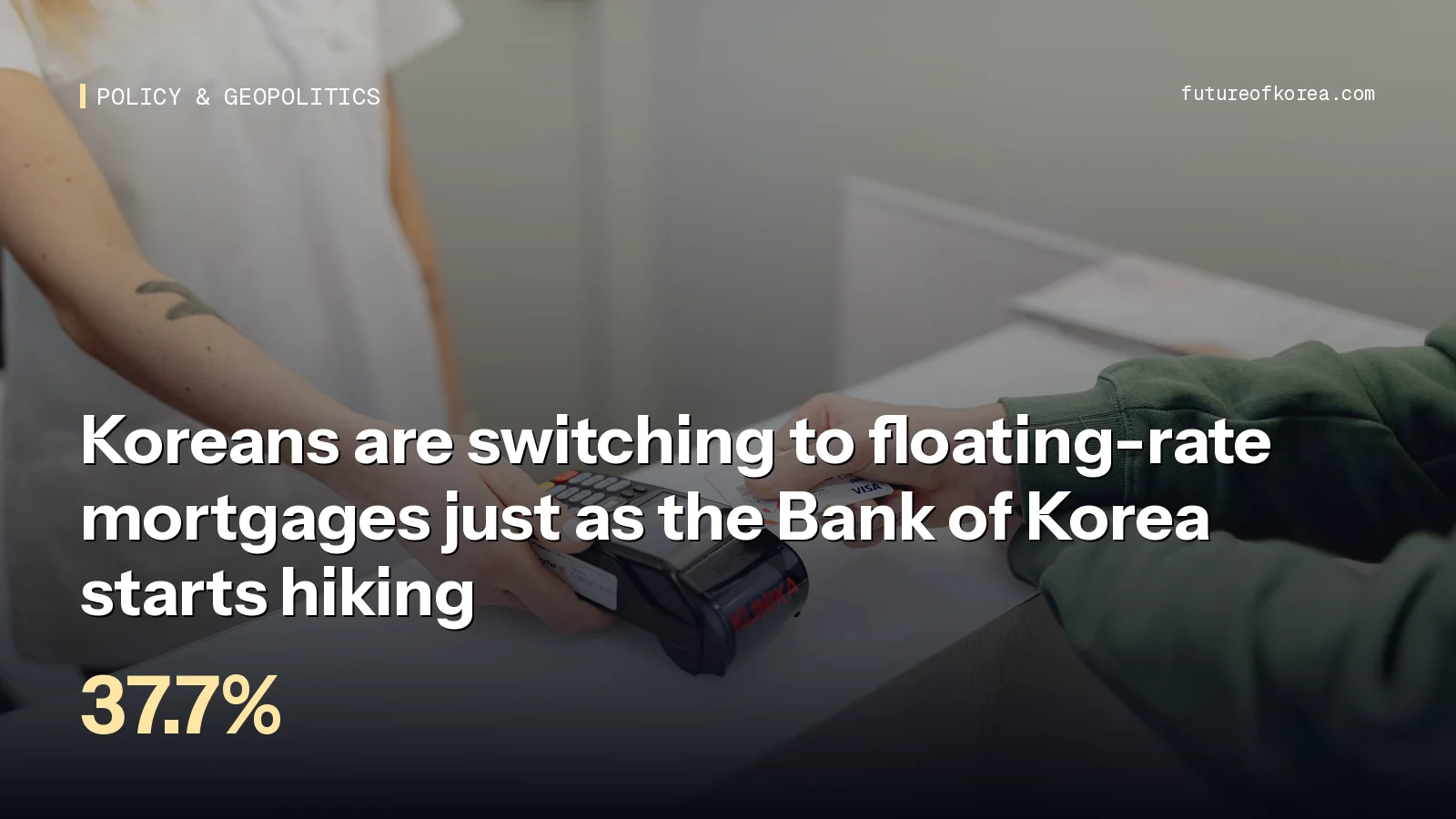
In November 2025, 90.2% of new mortgage lending at Korean banks carried a fixed rate. By June 2026 that share was 37.7%. Over the same stretch the Bank of Korea stopped cutting and started raising, lifting its base rate to 2.75% on 16 July. Korean borrowers moved to floating rates exactly as floating got expensive.
The switch is not irrational. It is a response to price. In June, banks charged an average 4.53% on new fixed-rate mortgages and 4.27% on variable ones — a 26 basis point discount for accepting the risk that rates climb. On a ₩400 million loan that is a little over ₩1 million a year, banked at signing. The saving is certain. The risk is not.
Why the cheaper option was the floating one
Fixed mortgage pricing in Korea keys off bank bond yields, and bond yields move on where the market thinks the base rate is going. Variable pricing keys off short-term funding benchmarks that only move once the base rate actually moves.
Those two clocks ran out of sync for most of a year. The bond market repriced through late 2025, as it became clear the easing cycle was over. The base rate itself sat still until July. In between, a borrower walking into a branch was choosing between a fixed rate that had already absorbed the coming hikes and a variable rate that had not yet felt them.
Almost all of them took the variable rate.
One caveat is easy to miss and cuts the wrong way. The Bank of Korea files policy mortgages such as Bogeumjari loans inside the fixed-rate bucket. Strip those out and the share of genuinely market-priced fixed lending is lower still.
The stock is safer than the flow
None of this means Korea’s mortgage book is about to reprice en masse. On an outstanding-balance basis, 63.1% of bank mortgage debt was still fixed-rate at the end of June. Anyone who borrowed during the cheap years is insulated for as long as their fixed period runs.
The exposure sits in this year’s cohort — households who took a floating loan in the first half of 2026 and will meet the July hike, and anything that follows it, at their next six- or twelve-month reset. They are the marginal borrowers, and marginal borrowers are usually the stretched ones.
Here is what they signed up to.
| New lending, deposit banks, June 2026 | Average rate |
|---|---|
| Mortgage — variable rate | 4.27% |
| Mortgage — all | 4.36% |
| Mortgage — fixed rate | 4.53% |
| Jeonse deposit loans | 4.07% |
| General unsecured loans | 5.72% |
| All new household lending | 4.50% |
The base against which this happens is large and still growing. Household credit — the Bank of Korea’s broadest measure — stood at ₩1,993.1 trillion at the end of March, up ₩14.0 trillion on the quarter and rising for an eighth consecutive quarter. Mortgages make up ₩1,178.6 trillion of it. The pace of increase has now slowed for three quarters running, which is the one genuinely reassuring line in the release.
There is a reading of all this that works in the central bank’s favour. A hike delivered into a book of fixed-rate loans does very little: the payments do not move, so household spending does not move, and the Board has to keep going to get any effect. A hike delivered into a book that is nearly two-thirds floating on new lending reaches the borrower within a year. Whatever else the shift to variable rates has done, it has made the policy rate a sharper instrument than it was in November — which is a reason to expect fewer hikes rather than more, and possibly why the Board felt able to signal further tightening without flinching.
What 27 August actually decides
The July decision was unanimous. All seven Monetary Policy Board members voted to raise, ending fourteen months without a move and reversing an easing cycle that began in October 2024 — the first increase since January 2023. The statement committed the Bank to a stance consistent with further hikes, which is unusually direct language for an institution that normally leaves itself more room.
Then inflation cooled. Consumer prices rose 2.8% year on year in July, down from 3.2% in June and the first sub-3% print in three months. Prices actually fell 0.2% on the month.
That makes the August meeting live rather than pre-cooked. A central bank that has just told the market it intends to keep tightening, and then watches its main justification soften, has to decide whether one month is a trend. The Board’s problem is that inflation was never the whole case: the July statement leaned as much on financial imbalances — Seoul house prices, household debt, leveraged positioning — as on the price index. Those have not cooled.
This is the same tension that ran through the won’s weakness during the first half of 2026, where the currency kept sliding despite a strong export account, and through Korea’s 2026 market crash, where margin debt turned a correction into something faster. A central bank raising rates into a highly indebted household sector is choosing which risk it would rather run.
For anyone borrowing now, the arithmetic that made floating attractive has begun to close. The 26 basis point gap in June was payment for taking rate risk at a moment when the central bank had told everyone it intended to raise rates. That is a narrow price for a known risk. Whether it stays narrow depends on what the Board does on 27 August, and on whether July’s softer inflation print turns out to be the start of something.
Figures current as of 15 August 2026. Base rate and the July policy statement from the Bank of Korea; July consumer prices from the Ministry of Economy and Finance; bank lending rates and fixed-rate shares from the Bank of Korea’s June 2026 weighted-average interest rate release; household credit from the Bank of Korea’s Q1 2026 release. Nothing here is investment or financial advice — see the disclaimer.
Useful links & tools
Official portals and primary data sources for this topic. Opens in a new tab.
- Bank of Korea — Monetary Policy Decisions — Every rate statement in English, published within hours of the decision
- Bank of Korea — Economic Statistics System (ECOS) — The base rate series, bank lending rates and household credit, downloadable
- Bank of Korea — Monetary Policy Board meeting dates — Check before assuming a decision date reported second-hand
- Financial Services Commission (English) — Monthly household lending releases and changes to mortgage lending rules
Frequently asked questions
Why are variable-rate mortgages cheaper than fixed ones in Korea right now?
Fixed mortgage rates in Korea are priced off bank bond yields, which move on where the market expects the base rate to go. Variable rates track short-term funding benchmarks, which only move after the Bank of Korea actually acts. Bond yields absorbed the expectation of rate rises through late 2025; the base rate itself did not move until July 2026. That timing gap left fixed-rate loans priced 26 basis points above variable ones in June.
Does a Bank of Korea base rate change hit my mortgage payment immediately?
Not immediately, and not at all if your loan is fixed for its full term. Variable-rate mortgages in Korea typically reset every six or twelve months against a reference rate such as COFIX, so a base rate rise in July shows up in monthly payments over the following two to four quarters. Loans written on a five-year fixed period reprice only when that period ends.
How much household debt does Korea actually carry?
Household credit — the Bank of Korea’s broadest measure, combining loans from all financial institutions with credit purchases — reached ₩1,993.1 trillion at the end of March 2026. Mortgage lending accounted for ₩1,178.6 trillion of that. The total has risen for eight consecutive quarters, though the quarterly pace of increase has slowed for three quarters running.
When does the Bank of Korea next decide on rates?
The Monetary Policy Board’s next scheduled rate-setting meeting falls on 27 August 2026. The Bank of Korea holds eight rate decisions a year; in 2026 they fall in January, February, April, May, July, August, October and November. Decisions are announced in the morning, Korea time, followed by a press conference with the governor.
Sources & further reading
Every figure in the key takeaways is numbered to the source it was read from. Sources marked primary are the statistics office, central bank, exchange, regulator or filing itself.
- 1Monetary Policy Decision, 16 July 2026primary — Bank of Korea · verified 2026-08-15
- 27월 소비자물가는 2.8% 상승 (July consumer prices rose 2.8%)primary — Ministry of Economy and Finance, August 2026 · verified 2026-08-15
- 36월 은행 가계대출 금리 두 달째 상승⋯고정형 주담대 비중 12년래 최저 — 이투데이 (etoday), 28 July 2026, reporting the Bank of Korea's '2026년 6월 금융기관 가중평균금리' release · verified 2026-08-29
- 4Household credit rises for 8th quarter in Q1 amid tighter lending regulations — The Korea Times, May 2026 · verified 2026-08-15
- 52026년 1/4분기 가계신용(잠정) 기자설명회primary — Bank of Korea · verified 2026-08-15
- 6예금은행 가중평균금리 — 대출금리(신규취급액 기준), 1996.01–2026.06primary — Bank of Korea series published via KOSIS, Statistics Korea — the monthly fixed-rate share, including November 2025 and June 2026 · verified 2026-08-20
Read next

Korea will charge 90% after your 300th outpatient visit. Last year that was 7,765 people.
The cabinet cut the excess-use threshold from 366 visits a year to 301 on 8 September. Fewer than eight thousand people crossed the old line — which is the clearest sign the rule is not really aimed at them.
Korea's exports grew 68.7% in August. Strip out three product lines and they grew 2%.
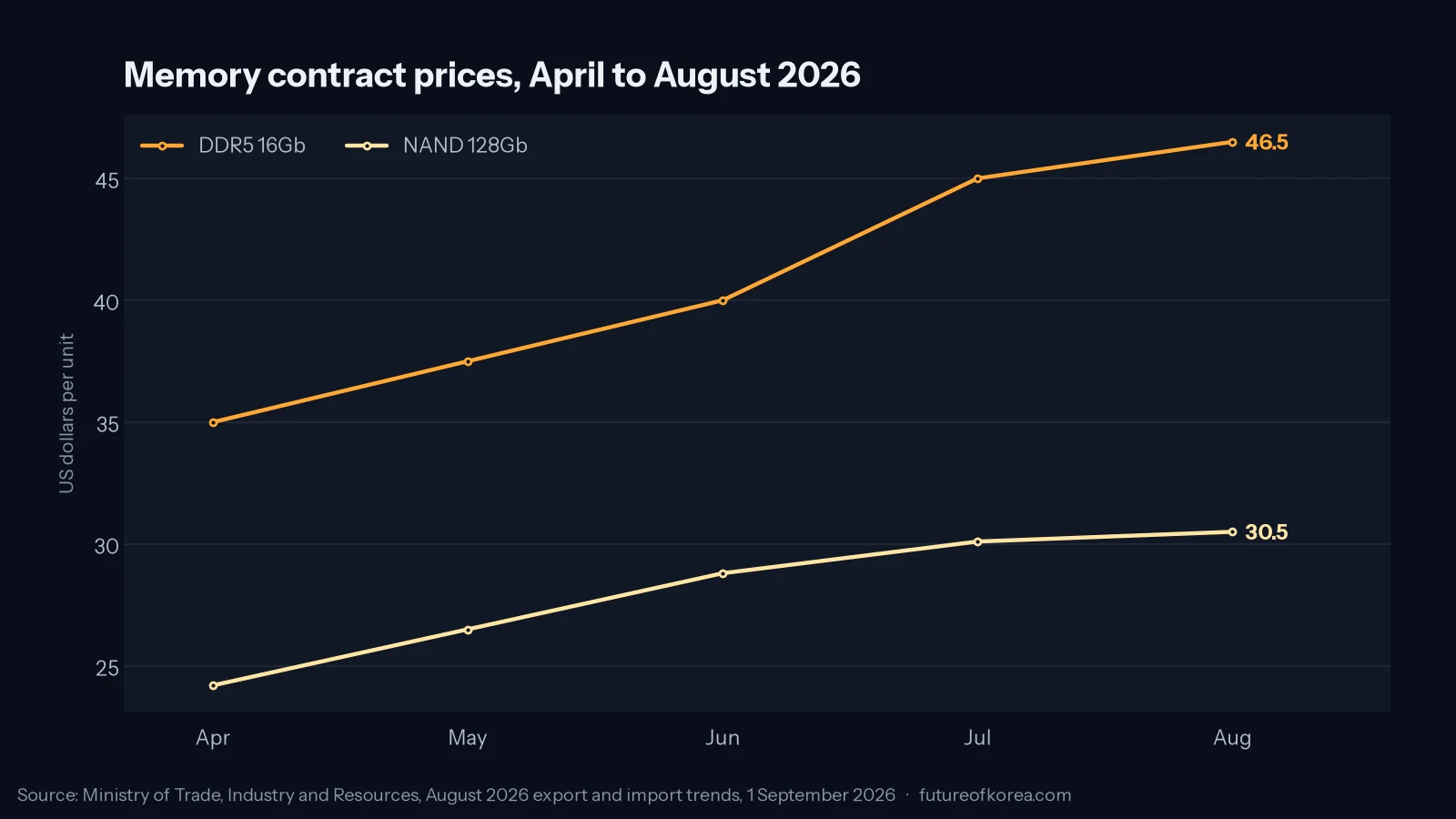
August was Korea's third-biggest export month on record and produced a $34.75bn trade surplus. Almost the entire year-on-year gain came from three lines, and all three are priced rather than produced.
Korea's core inflation hit 3.4%. A phone bill from last August did most of it.
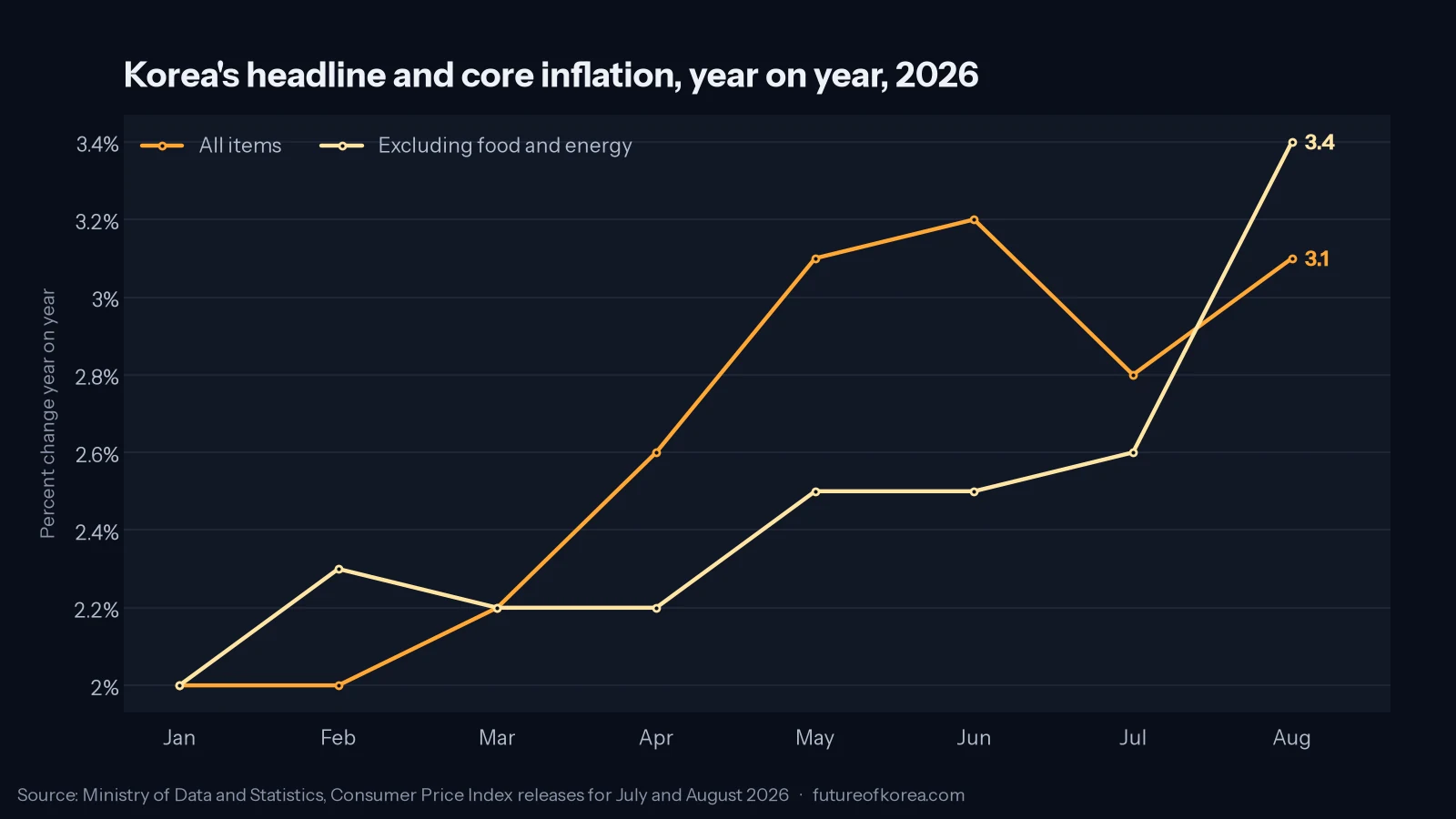
Consumer prices rose 3.1% in August and core inflation rose 3.4%, the sharpest one-month acceleration of the year. Strip out a single expenditure group and the same data show inflation falling.