The Bank of Korea went to 3%. Its own dot plot says that is not the top.
A second consecutive quarter-point hike takes Korea's base rate to 3.00%. The more consequential release was the board's six-month rate outlook, which moved up almost as a bloc.
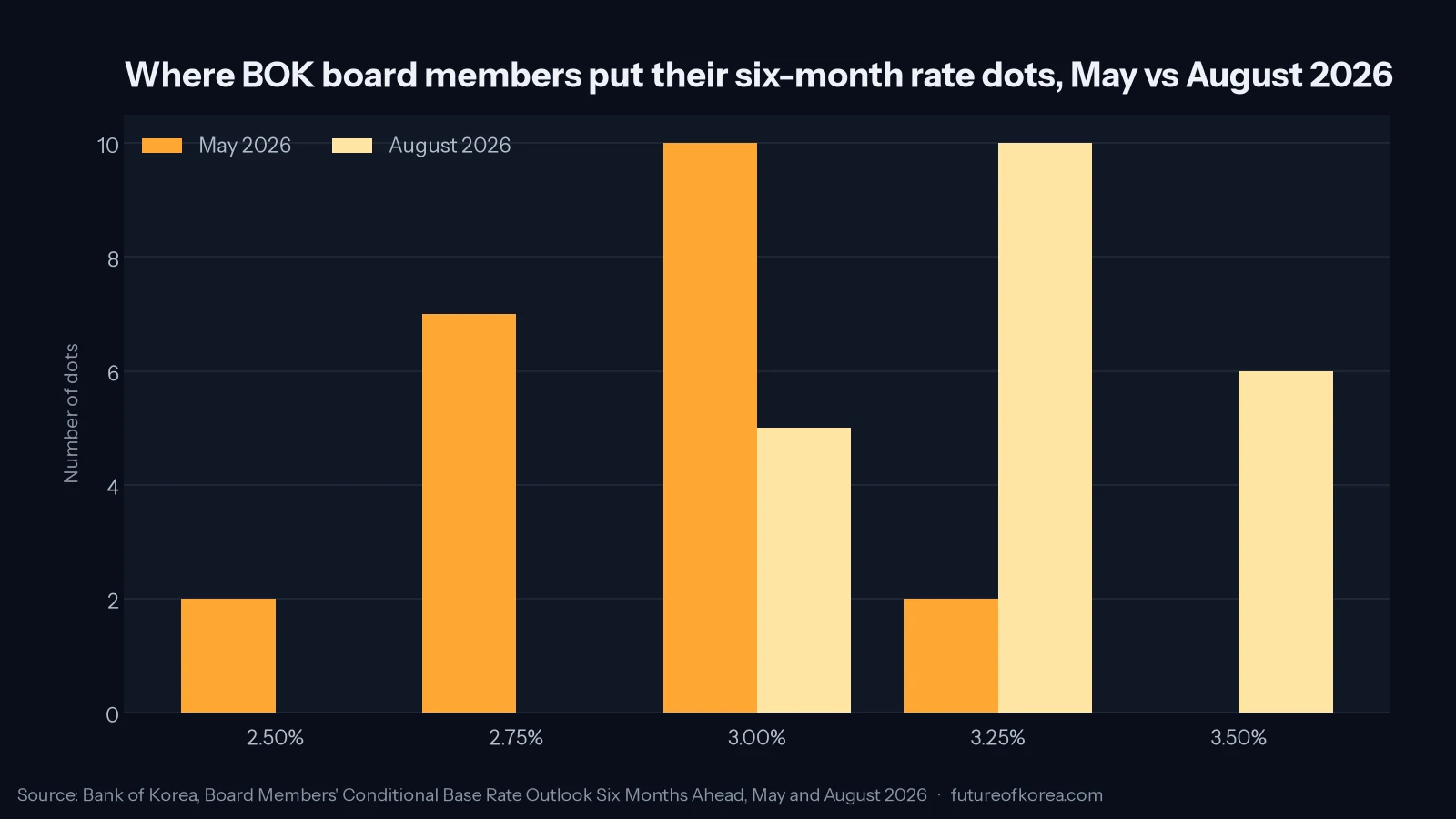
The Bank of Korea raised its base rate by a quarter point to 3.00% on 27 August 2026, its second increase in two months. The rate decision was widely expected. The document released beside it was not: in the board’s six-month rate outlook, 16 of 21 dots sat above 3.00%, and not one sat below.
That is the story. A hike that markets had already priced, accompanied by a distribution of forecasts that moved almost as a bloc.
Ten dots landed at 3.25% and six at 3.50%. Five stayed at the current rate. Three months earlier, in May, the same exercise put ten dots at 3.00%, seven at 2.75% and two each at 2.50% and 3.25% — a board that was still arguing about whether the easing cycle had ended. It is no longer arguing about that.
What the board actually said
The vote was 6–1. Governor Hyun Song Shin and five colleagues backed the increase; Hwang Kun-il wanted to hold at 2.75%. That makes the second dissent in as many meetings a fairly narrow objection rather than a split board, and it is consistent with the dots, where the five members sitting at 3.00% are still on the same side of the current rate as everyone else.
The statement gave three reasons, in order. Growth has run faster than forecast on strong exports and recovering domestic demand. Inflation is projected to stay above target “for a considerable period”. And financial stability — specifically, housing prices in the greater Seoul area and the pace of household debt growth — needs continued attention.
The word doing the work is preemptive. The board said it judged it important to stop price pressures broadening before they broaden, which is a different justification from the one a central bank offers when it is chasing an inflation print upward.
Why a falling inflation rate produced a rate hike
Headline inflation slowed to 2.8% in July, below 3% for the first time in three months. On its own that reads dovish. It was not, because of what sat underneath it.
Oil product prices were still up 15.5% year on year in July, but that was a sharp deceleration from June’s 24.7%, and oil’s contribution to headline inflation fell to 0.6 percentage point from 0.93. Almost all of the improvement in the headline number came from that one line. Meanwhile core inflation, which excludes food and energy, rose to 2.6% — the fastest since December 2023 — as personal services and durable goods prices firmed.
A headline figure falling because oil base effects are washing out, while the underlying measure climbs, is close to the textbook case for tightening. The BOK also nudged its 2026 core inflation forecast up to 2.5%, while leaving the headline forecast at 2.7%.
The mechanism running through all of this is the chip boom. Semiconductors are now roughly 47% of Korea’s exports, which is why an AI-memory upcycle shows up in the growth forecast, then in wages and services prices, and then in the policy rate. Korea’s monetary stance is now partly a derivative of HBM demand.
What 3.50% would mean
Six dots at 3.50% is the number worth sitting with. Base rate moves come in quarter-point steps, so a dot there implies two more increases inside six months — by roughly February 2027.
| Path | Dots | What it implies by early 2027 |
|---|---|---|
| Hold at 3.00% | 5 | The July and August moves were the whole cycle |
| 3.25% | 10 | One more hike; the modal view |
| 3.50% | 6 | Two more hikes; core inflation proves sticky |
Households carry the transmission. Korean borrowers have been shifting toward floating-rate mortgages precisely as the tightening began, so each quarter point reaches monthly payments faster than it would have two years ago. That is also why the statement’s financial-stability paragraph reads less like boilerplate than usual: the same rate that cools Seoul housing raises the debt-service burden of the people already in it.
For foreign investors the immediate question is the won, which has spent 2026 weak against a booming export account. A wider Korea–US rate differential in Korea’s favour is the classic support, and the board named “movements in global oil prices and the won” among the uncertainties around its own inflation path. Whether the currency responds this time is a separate argument, and one this site has taken up at length.
Two things decide the next move, and the board named both. Whether core inflation keeps broadening beyond oil, and whether the semiconductor upturn spills into domestic demand at the pace the 3.3% forecast assumes. If both hold, the ten dots at 3.25% are the floor rather than the destination.
Figures current as of 27 August 2026, sourced to the Bank of Korea and the outlets listed below.
Useful links & tools
Official portals and primary data sources for this topic. Opens in a new tab.
- Bank of Korea — Monetary Policy Decisions — The full English statement after every rate-setting meeting, plus the dissent record
- Bank of Korea — the Base Rate — Official history of the policy rate and how it transmits to market rates
- Bank of Korea — Monetary Policy Board minutes — Published two weeks after each meeting; where the dissent's reasoning actually appears
- Economic Statistics System (ECOS) — The rate series, bank lending rates, household credit and the won, in downloadable form
- Bank of Korea — rate-setting meeting dates — The published calendar, so you know when the next decision lands
Frequently asked questions
What is the Bank of Korea base rate now?
The base rate is 3.00%, set on 27 August 2026 when the Monetary Policy Board raised it by 0.25 percentage point from 2.75%. It is the rate the Bank of Korea applies to seven-day repurchase agreements with financial institutions, and it feeds through to the overnight call rate and from there to deposit and loan pricing. The board sets it eight times a year. This was the second increase in a row, following a hike in July 2026.
What is the Bank of Korea dot plot and how does it differ from the Fed's?
The BOK publishes a Board Members’ Conditional Base Rate Outlook Six Months Ahead, released alongside quarterly forecast rounds. Each of the seven board members submits three dots, giving 21 in total, and the horizon is six months rather than several years. The dots are conditional and anonymous, and unlike the Federal Reserve’s median-dot framing the BOK’s release is usually read as a distribution — where the mass sits and whether anyone has moved below the current rate.
Why is Korea raising rates when inflation is falling?
Headline inflation slowed to 2.8% in July 2026, but core inflation — which strips out food and energy — rose to 2.6%, its fastest reading since December 2023. The board’s concern is the composition, not the level: services and durable goods prices broadened, growth is running well above forecast on the semiconductor cycle, and the statement flagged housing prices in the greater Seoul area and accelerating household debt. A falling headline number driven by oil base effects does not settle any of that.
How high will Korean interest rates go in 2026 and 2027?
Nobody at the Bank of Korea has committed to a peak, and the dots are explicitly conditional forecasts rather than promises. What the August release shows is that ten of 21 dots point to 3.25% and six point to 3.50% within six months, so the board is at minimum entertaining one more quarter-point move and possibly two. The path depends on core inflation, the won, oil prices and how far the chip upturn spills into domestic demand.
Sources & further reading
Every figure in the key takeaways is numbered to the source it was read from. Sources marked primary are the statistics office, central bank, exchange, regulator or filing itself.
- 1Monetary Policy Decisions — Monetary Policy Board statement, 27 August 2026primary — Bank of Korea · verified 2026-08-27
- 2The Bank of Korea Base Rateprimary — Bank of Korea · verified 2026-08-27
- 3BOK raises key rate for 2nd consecutive session to 3%, revises up 2026 forecast to 3.3% — The Korea Herald / Yonhap, August 2026 · verified 2026-08-27
- 4BOK Board Members See Rate Rising as High as 3.50% — Seoul Economic Daily, August 2026 · verified 2026-08-27
- 5BOK Signals More Rate Hikes, Citing Inflation and Growth — Seoul Economic Daily, August 2026 · verified 2026-08-27
- 6Consumer prices up 2.8% in July; oil price hike slows — The Korea Times / Yonhap, August 2026 · verified 2026-08-27
Read next

Korea will charge 90% after your 300th outpatient visit. Last year that was 7,765 people.
The cabinet cut the excess-use threshold from 366 visits a year to 301 on 8 September. Fewer than eight thousand people crossed the old line — which is the clearest sign the rule is not really aimed at them.
Korea's exports grew 68.7% in August. Strip out three product lines and they grew 2%.
August was Korea's third-biggest export month on record and produced a $34.75bn trade surplus. Almost the entire year-on-year gain came from three lines, and all three are priced rather than produced.
Korea's core inflation hit 3.4%. A phone bill from last August did most of it.
Consumer prices rose 3.1% in August and core inflation rose 3.4%, the sharpest one-month acceleration of the year. Strip out a single expenditure group and the same data show inflation falling.