What foreign residents actually pay for Korean health insurance in 2026
The contribution rate went up in January for the first time in three years. For foreign residents who are not employed, the bill is a flat ₩158,630 a month — whatever their income.
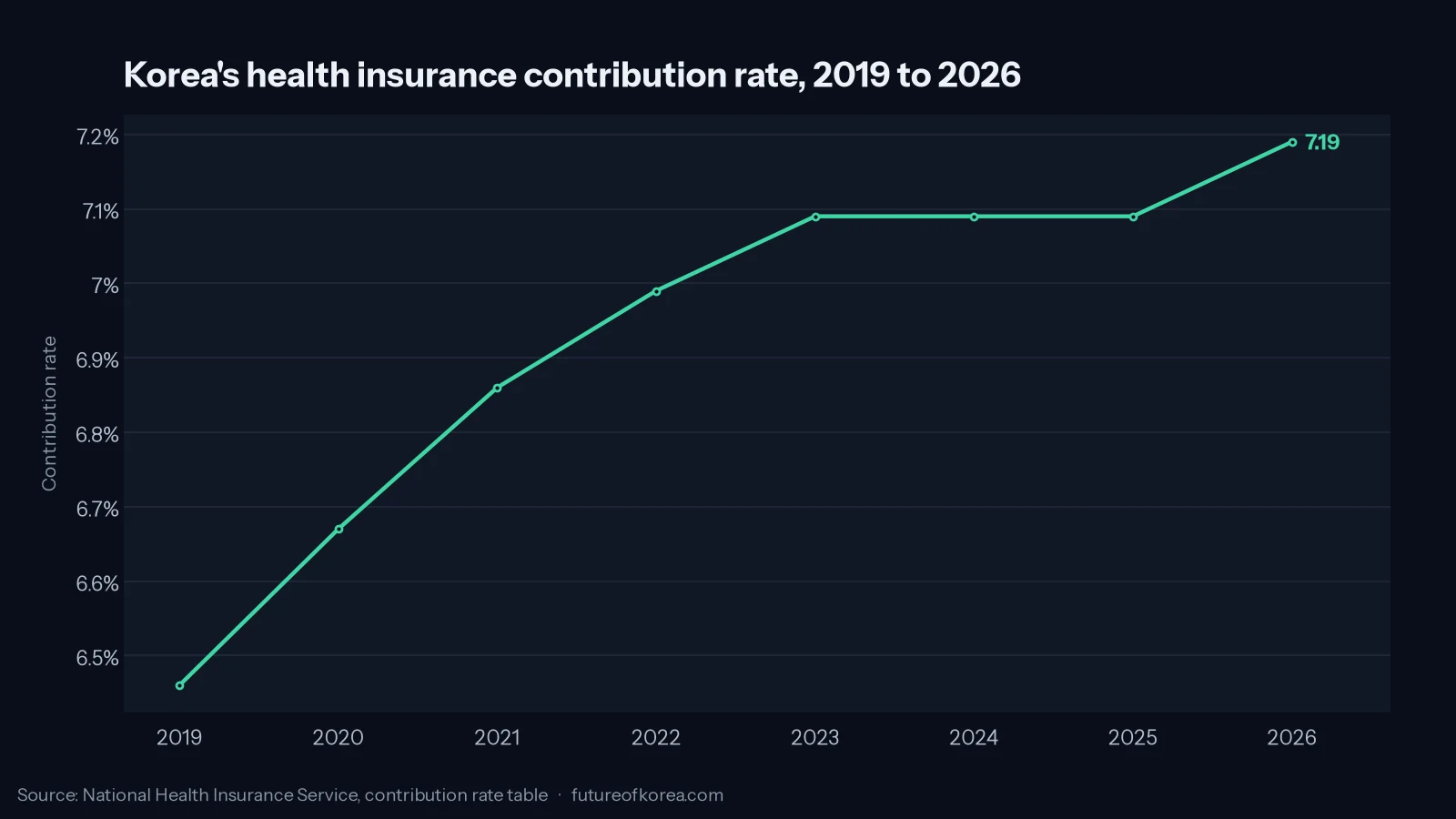
A foreign resident in Korea who is not employed pays ₩158,630 a month for national health insurance in 2026 — regardless of income, savings, or how little care they use. A salaried resident pays about 4.07% of gross wages instead, after the employer’s half. The rate behind both numbers went up in January, the first increase in three years.
Which of those two figures applies to you has almost nothing to do with how much you earn. It depends on whether you are on a payroll.
Two systems, and the one you land in is not a choice
Korea runs national health insurance in two tracks. The employee insured are enrolled through a workplace and assessed on wages. Local subscribers — everyone else, including the self-employed, the retired, students and the unemployed — are assessed on income and property.
For 2026 the National Health Insurance Service set the employee rate at 7.19% of monthly pay, split evenly between worker and employer. Long-term care insurance is charged on top at 0.9448%, calculated as a proportion of the health premium, which works out at an extra 13.1%. Your own share of the two together is 4.067% of gross wages.
| Monthly salary | Health (your half) | Long-term care (your half) | You pay |
|---|---|---|---|
| ₩3,000,000 | ₩107,850 | ₩14,172 | ₩122,022 |
| ₩4,000,000 | ₩143,800 | ₩18,896 | ₩162,696 |
| ₩5,000,000 | ₩179,750 | ₩23,620 | ₩203,370 |
| ₩6,000,000 | ₩215,700 | ₩28,344 | ₩244,044 |
| Not employed | ₩140,210 | ₩18,420 | ₩158,630 |
Calculated from the 2026 rates published by NHIS. Actual bills round to the won.
Read the last row against the others. A foreign resident with no Korean income at all is billed the same as a salaried worker on roughly ₩3.9 million a month.
The floor that produces that number
Foreign local subscribers are assessed twice. First the ordinary Korean calculation runs — income multiplied by 7.19%, plus property points multiplied by ₩211.5 each. Then NHIS compares the result to the national average premium as it stood at the end of the previous November. If your calculated premium is lower, the average is charged instead, for every month of the following year.
In 2026 that average is ₩158,630: ₩140,210 of health premium and ₩18,420 of long-term care, up 3.8% on 2025.
The health component alone implies a monthly income of about ₩1.95 million for someone whose actual income is zero. And the comparison that makes the mechanism clearest is with the domestic floor. NHIS’s 2026 notice sets the statutory minimum monthly premium for local subscribers at ₩20,160. A Korean pensioner with no income pays that. A foreign resident in the same position pays roughly seven times as much.
Two visa categories are written out of the rule entirely. Where the householder holds permanent residence (F-5) or marriage immigration (F-6), the household is assessed exactly as a Korean household would be — income, property, and the ₩20,160 floor. Recognised refugees and minors heading their own household get a partial version of the same treatment: the greater of the Korean-basis premium and the statutory minimum.
Everyone else on the list — D-2 students, D-4 trainees, D-8 investors, E-2 teachers, E-7 professionals, E-9 workers, F-1, F-2, F-3, F-4, G-1, H-1 and H-2 holders — is inside the flat floor unless a reduction applies.
The reductions are worth knowing because they are large and they are not automatic in the sense of being obvious. Students on D-2 and D-4 visas, and overseas-Korean F-4 students at recognised schools, get 50% off, which takes the monthly bill to about ₩79,300. Religious workers on D-6, humanitarian-status holders on G-1-6 and their dependants on G-1-12 get 30%, or about ₩111,000. Residents of designated islands and remote areas get 50%; farming and fishing villages, 22%; registered farmers and fishers, 28%.
What January’s increase cost
The step from 7.09% to 7.19% is 0.1 percentage points, or 1.48% more in premium. Long-term care rose harder in proportional terms, from 0.9182% to 0.9448%, a 2.90% increase. The points value used for property assessment went from ₩208.4 to ₩211.5.
On a ₩4 million salary that adds about ₩2,530 a month to what comes out of your pay, or ₩30,000 over the year. It is a small number, and the reason it is worth stating precisely is that the rate had been frozen since January 2023 — three years in which the figure on your payslip only moved when your salary did.
The paperwork that decides which number you get
Three deadlines do more to set your bill than anything about your finances.
Six months. Enrolment as a local subscriber is compulsory once you have been in Korea six months, in force since 16 July 2019. There is no application to make and no way to decline.
Fourteen days. Foreign employees can be excluded from workplace enrolment if they can document equivalent coverage under a foreign law, a foreign insurance policy or a contract with their employer — but the withdrawal form has to reach NHIS within 14 days of the date the employer reported the enrolment. This is the only opt-out in the system, and it closes fast. Local subscribers have no equivalent.
Three months. For anyone bringing family, the dependant rules tightened on 3 April 2024: foreign and overseas-Korean dependants arriving after that date must meet the same residence requirement as local subscribers rather than qualifying on arrival. The financial thresholds are unchanged — total annual income under ₩20 million and a property tax base under ₩540 million. Documents proving the family relationship must be apostilled and dated within nine months, and because NHIS has no way to track changes in foreign family registers, they generally have to be resubmitted whenever eligibility changes. The exception is a re-registration with the same subscriber within three months of losing dependant status.
Coverage does not vary with any of this. NHIS states plainly that national health insurance for foreign residents carries the same benefits as for Korean nationals: treatment, childbirth, the general health checkup, and the cancer screening programme with its 10% co-payment. The premium differs. What you can claim does not.
If you are working out the cost of a move, the premium sits alongside the residence rules — our guide to Korea’s 2026 visa overhaul covers which status you would hold, and the F-5 and F-6 carve-out above is one of the few places where visa category translates directly into money. The wider pressure on the system is demographic: long-term care is the fastest-rising line in the 2026 rate table, which is what Korea’s population arithmetic looks like when it reaches a payslip.
Figures current as of 15 August 2026. Rates, the points value and the foreign local-subscriber average premium are from the National Health Insurance Service’s 2026 notices; the assessment standard for foreign local subscribers is Ministry of Health and Welfare Notice 2019-151 as published by NHIS. Salary examples are the author’s arithmetic on those published rates and do not account for rounding applied to individual bills.
Useful links & tools
Official portals and primary data sources for this topic. Opens in a new tab.
- NHIS guidance for foreigners (English) — The service's own English page on enrolment, dependants, contributions and which visa types are covered
- NHIS contribution rate table — The rate and points value for every year since 2012 — the place to check what changed in January
- Assessment standard for foreign local subscribers — The average-premium floor, the F-5/F-6 carve-out and the full reduction schedule, in Korean
- NHIS English-language call centre — 033-811-2000 reaches an English consultant; the branch holding your address is the only office that can change an assessment
- HiKorea — Immigration portal for the residence status that determines which premium rule applies to you
Frequently asked questions
How much is Korean health insurance for a foreigner per month in 2026?
If you are employed, you pay 3.595% of your monthly wage for health insurance plus your half of the long-term care premium — about 4.07% of gross pay in total, or roughly ₩162,700 on a ₩4 million salary. If you are not employed and enrolled as a local subscriber, the National Health Insurance Service charges at least ₩158,630 a month, made up of ₩140,210 in health premium and ₩18,420 in long-term care premium, whatever your income.
Why is my health insurance bill so high if I have no income in Korea?
Because of the average-premium floor. Under the Ministry of Health and Welfare’s standard for long-staying foreign residents, your premium is first calculated the way a Korean household’s would be — on income and property — and if the result comes to less than the previous November’s national average premium, you are charged the average instead. In 2026 that average is ₩158,630. A Korean local subscriber in the same position would pay as little as ₩20,160.
Can I opt out of Korean national health insurance if I have private coverage?
Only if you are the employee insured, and only at the start. NHIS allows foreign employees and overseas Koreans to be excluded when they can prove equivalent medical coverage under a foreign law, a foreign insurance policy or a contract with their employer. The withdrawal application must be filed within 14 days of the date your enrolment was reported; miss that window and you stay in. Local subscribers cannot opt out at all.
Do I have to enrol if I am only staying a few months?
Enrolment as a local subscriber becomes compulsory once you have been in Korea six months, a rule in force since 16 July 2019. Employment triggers it sooner: if you work at a company covered by national health insurance, you are enrolled from your start date, and the premium is applied retroactively to when you were hired. Short stays under six months without employment fall outside the system.
Sources & further reading
Every figure in the key takeaways is numbered to the source it was read from. Sources marked primary are the statistics office, central bank, exchange, regulator or filing itself.
- 1Contribution Rateprimary — National Health Insurance Service · verified 2026-08-14
- 22026년도 보험료율 인상 안내 (2026 contribution rate increase notice)primary — National Health Insurance Service, December 2025 · verified 2026-08-14
- 3재외국민 및 외국인 지역보험료 부과기준 (Assessment standard for overseas-Korean and foreign local subscribers)primary — National Health Insurance Service, citing MOHW Notice 2019-151 · verified 2026-08-14
- 4Guidance for foreignersprimary — National Health Insurance Service · verified 2026-08-14
- 52026년 달라지는 건강보험·장기요양보험 제도 (What changes in 2026)primary — National Health Insurance Service, February 2026 · verified 2026-08-14
- 6외국인 건강보험제도 더 공정하고 합리적으로 개선 (Foreign dependant rules)primary — National Health Insurance Service webzine, March 2024 · verified 2026-08-14
Read next
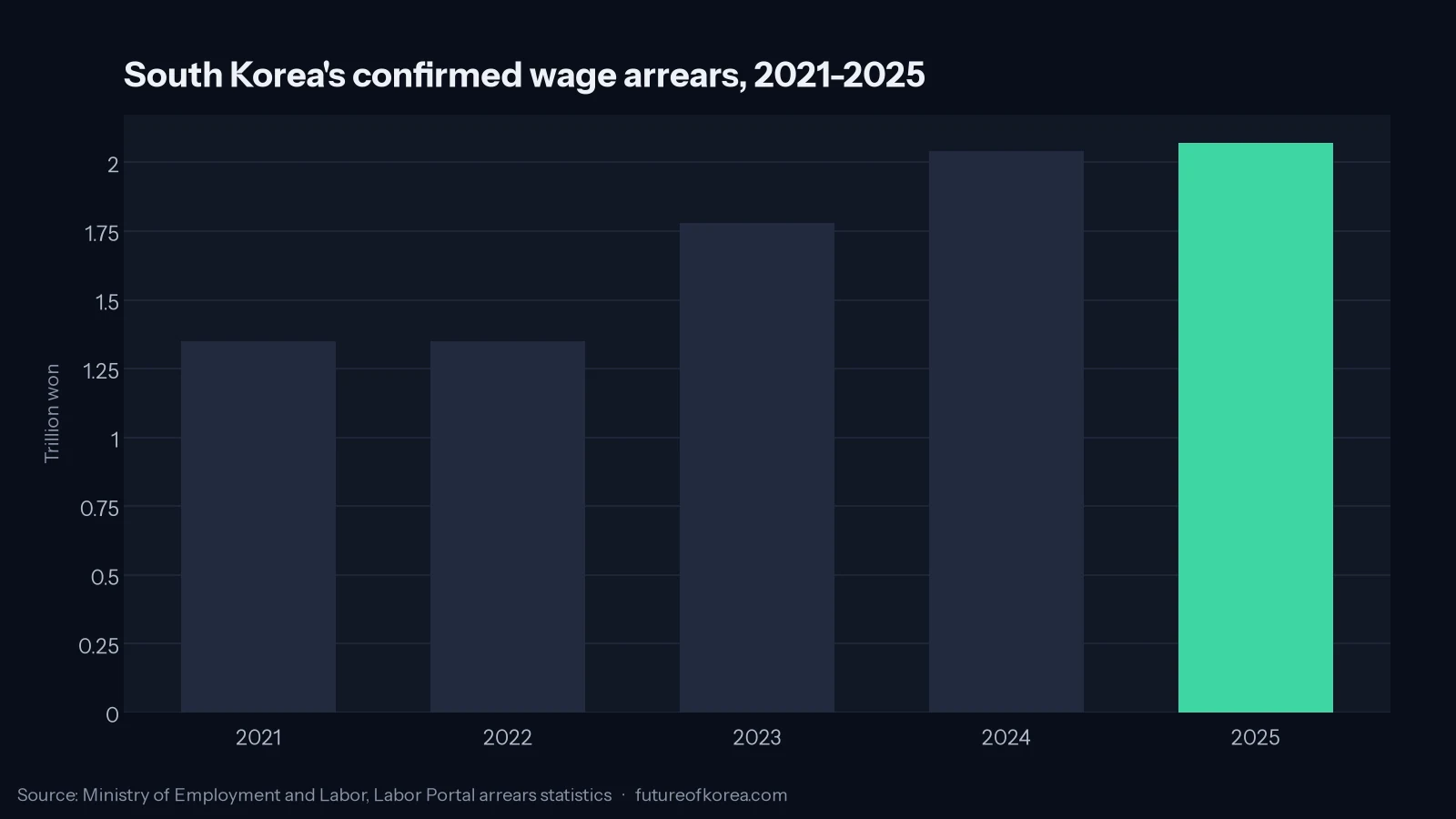
Unpaid severance is 45% of Korea's wage arrears — and the penalty rises this month
Almost half of everything Korean employers failed to pay their workers this year was severance. Here is why the money is missing, what the law says you are owed, and what changes on 18 September.
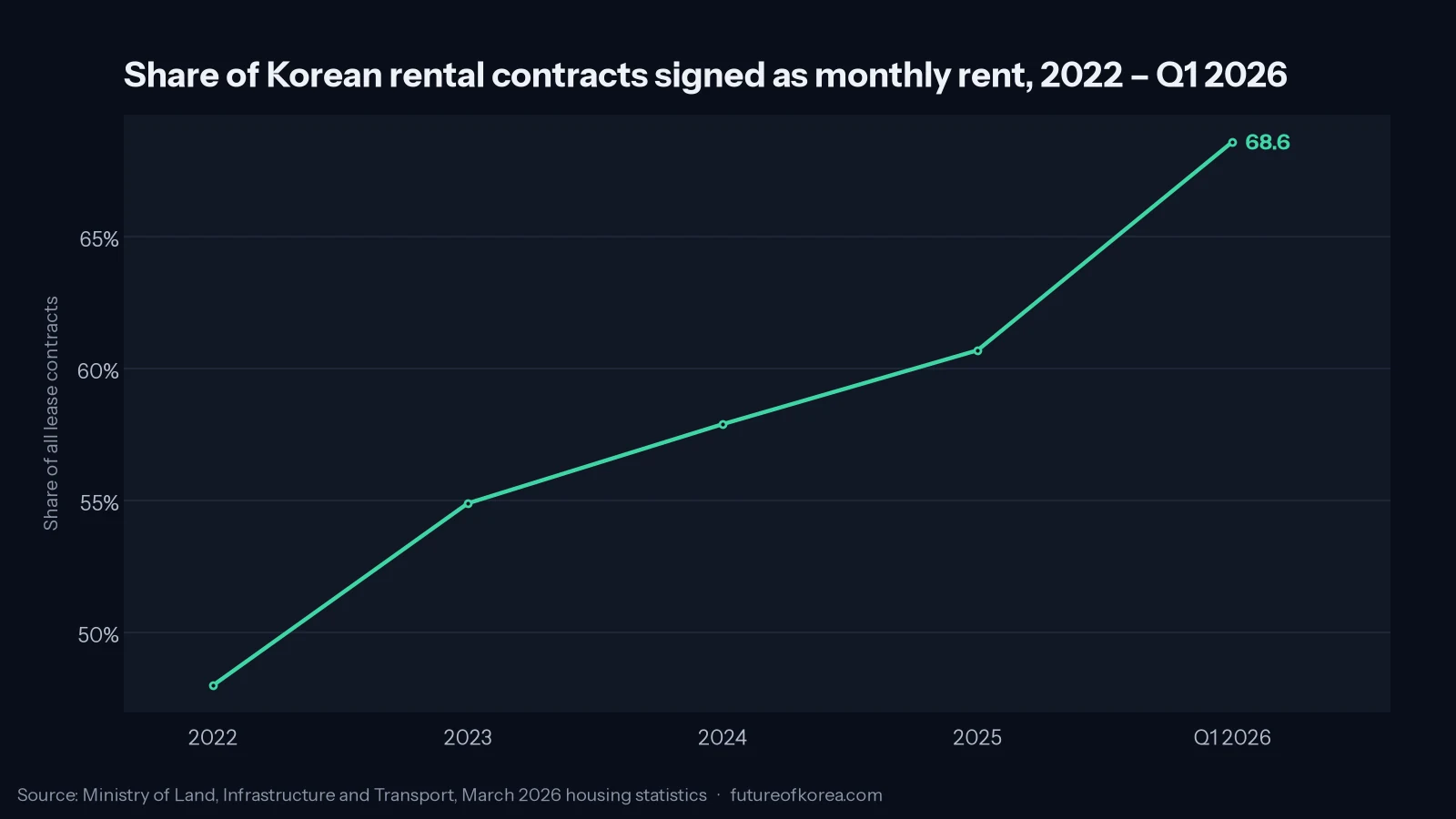
Korea will hold your jeonse deposit for you — and lend it to builders
From November, a state guarantor rather than a landlord will hold the deposit on some Korean leases. HUG invests the money in housing project-finance loans and pays the landlord the return as monthly income.
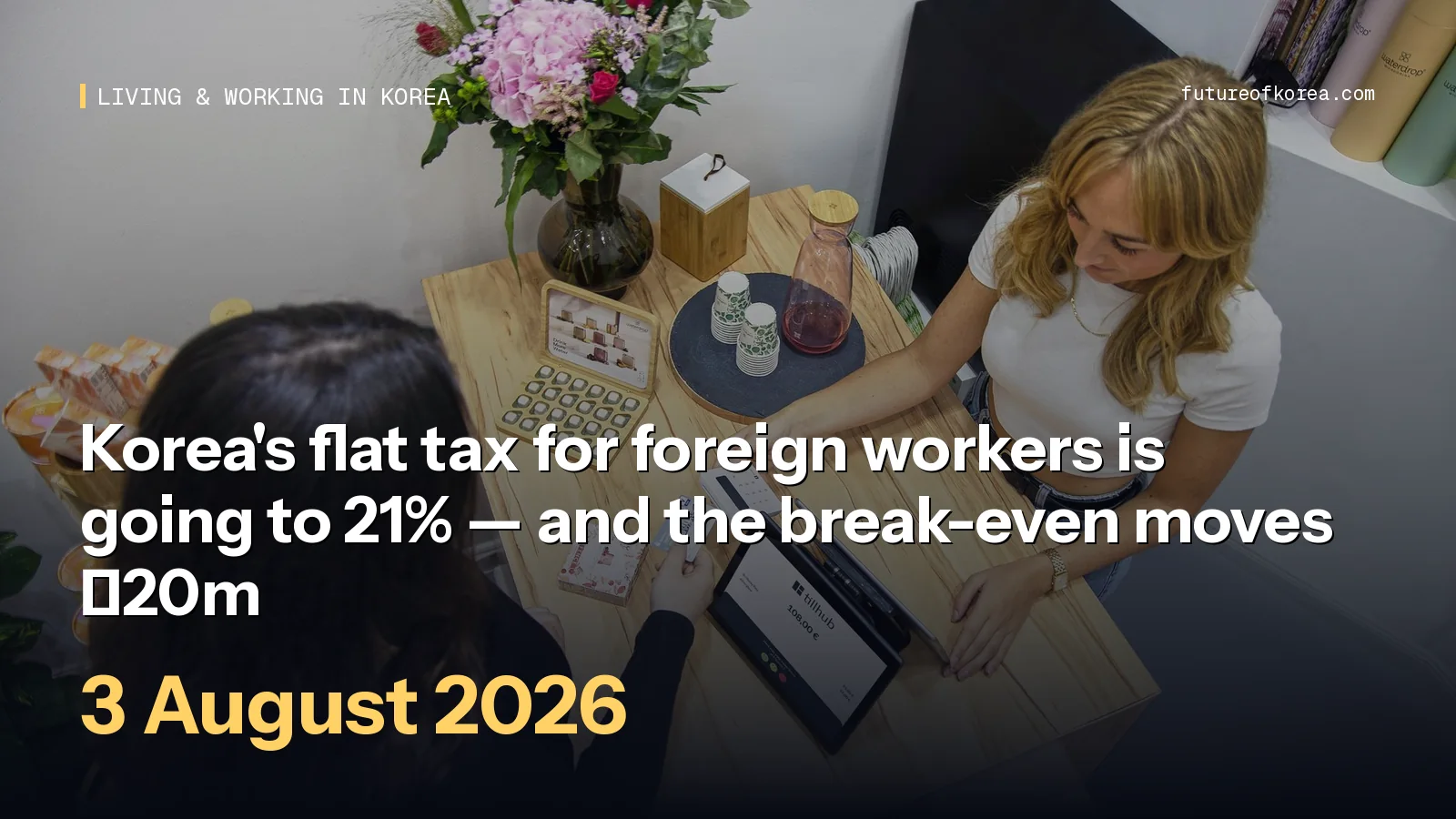
Korea's flat tax for foreign workers is going to 21% — and the break-even moves ₩20m
The 2026 tax reform package raises the optional flat rate for foreign employees by two points and extends the scheme to 2029. The rate rise pushes the salary at which electing it pays from about ₩133 million to about ₩154 million.