Korea's birth rate is rising: what the 2026 numbers actually show
Korea's fertility rate has climbed from 0.72 to around 0.9 in three years, and Q1 2026 births rose at the fastest quarterly pace since 1981. Here is what is driving it, what it does not fix, and which figures to watch.
Photograph by Catalina Herrera on Pexels.
For a decade, Korea’s fertility rate was the world’s most-cited demographic statistic — a single number, falling every year, standing in for an entire theory of what modern life does to family formation.
It has now risen three years running. That is the first genuinely new thing to happen in this story since 2015, and it deserves to be reported accurately rather than as either a miracle or a mirage.
The numbers
| Year | Total fertility rate |
|---|---|
| 2023 | 0.72 (record low) |
| 2024 | 0.75 |
| 2025 | 0.80 |
| January 2026 | 0.99 |
| February 2026 | 0.93 |
| March 2026 | 0.93 |
| Q1 2026 | 0.95 |
Q1 2026 births came in at 75,013 — up 14.8% year on year, the largest quarterly increase on record in both percentage and absolute terms since the series began in 1981. Marriages in the same quarter reached 62,309, up 6.1%. On current trajectory, the annual fertility figure could exceed 0.9 for the first time in seven years.
What is actually driving it
The most defensible explanation is not a policy triumph. It is marriage.
Korea has, by OECD standards, an exceptionally low share of births outside marriage — the overwhelming majority of children are born to married couples. That makes the marriage count a leading indicator of births, with a lag of roughly one to two years.
Marriages collapsed during the pandemic and then rebounded strongly as restrictions lifted and delayed weddings went ahead. The 2024–2026 birth figures are, substantially, that rebound arriving on schedule.
This matters enormously for how you interpret the recovery, because it sets up a testable question: is this a backlog clearing, or a level shift?
- If it is a catch-up, the effect fades once the delayed cohort has married and had first children — probably visible in 2027–2028.
- If it is a level shift — a genuine change in whether people feel able to form families — it persists.
Policy has plausibly contributed — cash payments, expanded parental leave, housing support for newlyweds, and unusually aggressive corporate schemes including large per-child payments at some conglomerates. But separating a policy effect from a marriage echo happening simultaneously is genuinely difficult, and anyone giving you a precise attribution is manufacturing confidence they do not have.
What the rebound does not fix
Replacement is 2.1. Korea at 0.9 is producing well under half the children needed to hold the population steady. This is worth restating because “birth rate rises for third year” reads like a resolved problem, and it is not one.
The population has now declined for 78 consecutive months. Deaths exceed births, month after month, and an ageing population means deaths keep rising.
The base is shrinking. This is the compounding problem people miss. The number of women in the prime childbearing cohort is itself falling, because it is composed of people born during earlier low-fertility years. A stable fertility rate applied to a shrinking base still produces fewer babies each year. To simply hold the annual birth count flat, fertility has to keep rising.
Ageing continues regardless. Everyone who will be elderly in 2050 has already been born. The child population continues to shrink while the older population grows quickly. No plausible fertility path changes the next three decades of the dependency ratio; it changes the 2060s.
Why it matters beyond demographics
The birth numbers are upstream of a lot of Korean policy that looks unrelated:
Immigration. The 2026 visa liberalisation — the Top-Tier expansion, the E-7-M manufacturing route, the F-2-R regional track — is a direct response to a shrinking working-age population and emptying regional cities. Migration is one of the few levers that operates on a policy-relevant timescale; fertility does not affect the labour force for twenty years.
Regional policy. Rural districts paying people simply to live there is what depopulation looks like at the municipal level. It is also why F-2-R exists.
Pensions and healthcare. The National Pension Service’s arithmetic depends on the ratio of contributors to recipients. Every tenth of a point of fertility, decades out, changes that calculation.
Property. Household formation drives housing demand. A marriage rebound is, in the near term, bullish for small-unit housing in the capital region and does nothing for regional oversupply.
The honest summary
Korea’s birth rate is rising, and that is real. Q1 2026 produced the fastest quarterly increase in the 45-year history of the series. The annual figure may top 0.9 for the first time since 2019.
It is also true that the population has shrunk for 78 straight months, that 0.9 is well under half of replacement, that the childbearing cohort is contracting, and that the most likely proximate cause is a pandemic marriage backlog rather than a solved problem.
Both halves belong in the same paragraph. A country can be doing better and still be in serious demographic difficulty — and the policy Korea builds over the next five years will depend on which half its politicians choose to believe.
Figures current as of 12 August 2026, sourced to Statistics Korea releases and the outlets listed below.
Useful links & tools
Official portals and primary data sources for this topic. Opens in a new tab.
- KOSIS — Korean Statistical Information Service — The primary source: births, deaths, marriages, fertility rate, population projections. English interface.
- Statistics Korea — press releases (English) — Monthly population trend releases, usually published with a two-month lag.
- OECD Family Database — For putting Korea's figures next to comparable countries rather than in isolation.
- Bank of Korea — ECOS — Where the demographic story meets the labour-force and growth data.
- Korea Institute for Health and Social Affairs (KIHASA) — Research on the drivers of low fertility, in English.
Frequently asked questions
Is Korea's population crisis over?
No. Replacement fertility is about 2.1. Korea moving from 0.72 to roughly 0.9 is a real and welcome improvement, and it is still under half of replacement. The population has now fallen for 78 consecutive months. What has changed is the rate of decline and the shape of the projections, not the direction — and because the cohort of women in their late twenties and thirties is itself shrinking, even a stable fertility rate produces fewer births each year.
Why did the rate move up at all?
The most defensible explanation is the marriage rebound. Korea has very low non-marital childbearing by OECD standards — the overwhelming majority of births occur within marriage — so marriages are a leading indicator of births with roughly a one-to-two-year lag. Marriages fell sharply during the pandemic and then recovered strongly, and the birth figures are now showing the echo. Policy support, cash incentives, expanded parental leave and corporate schemes plausibly contribute; disentangling their effect from the marriage echo is genuinely hard and anyone claiming precision about it is overstating.
Why is the monthly figure bouncing around so much?
Because monthly birth counts are small and seasonal, and the ‘monthly fertility rate’ is an annualised construction from a short window. The 0.99 / 0.93 / 0.93 sequence across January, February and March 2026 is mostly noise plus seasonality. Use annual figures for anything you intend to conclude from, and treat monthly moves as weather rather than climate.
Will the rebound last?
The honest answer is that nobody knows. If the driver is a one-off marriage catch-up after the pandemic, it will fade as the backlog clears. If the driver is a genuine shift in the cost and feasibility of family formation — housing, hours, childcare, employer norms — it persists. The test arrives in 2027–2028, once the catch-up cohort has passed through. Watch the marriage series, not the birth series, for the early signal.
How does this affect the economy and markets?
Slowly, and then all at once. Demographics move the working-age population, the pension system’s arithmetic, healthcare demand, regional property values and the labour supply available to manufacturers. None of it moves a quarterly earnings number, and all of it shapes the policy environment — including the 2026 visa liberalisation, which is a direct consequence of these figures.
Where do I get the actual data?
Statistics Korea publishes monthly and annual births, deaths and marriages, and its KOSIS portal has an English interface. It is the primary source for every figure in this article. Links are in the Useful links section.
Sources & further reading
Every figure in the key takeaways is numbered to the source it was read from. Sources marked primary are the statistics office, central bank, exchange, regulator or filing itself.
- 1KOSIS — births, deaths, marriages and fertility statisticsprimary — Statistics Korea · verified 2026-08-13
- 2Korea's birthrate rises at fastest pace on record in Q1 — Korea JoongAng Daily, 2026 · verified 2026-08-13
- 3Korea's birth rate rises to 0.93, but population shrinks for 78th month — Seoul Economic Daily, June 2026 · verified 2026-08-13
- 4Can Korea's birth rebound close its demographic gap? — The Korea Herald, 2026 · verified 2026-08-13
- 5South Korea is finally having more babies but can it last? — CNN, February 2026 · verified 2026-08-13
Read next
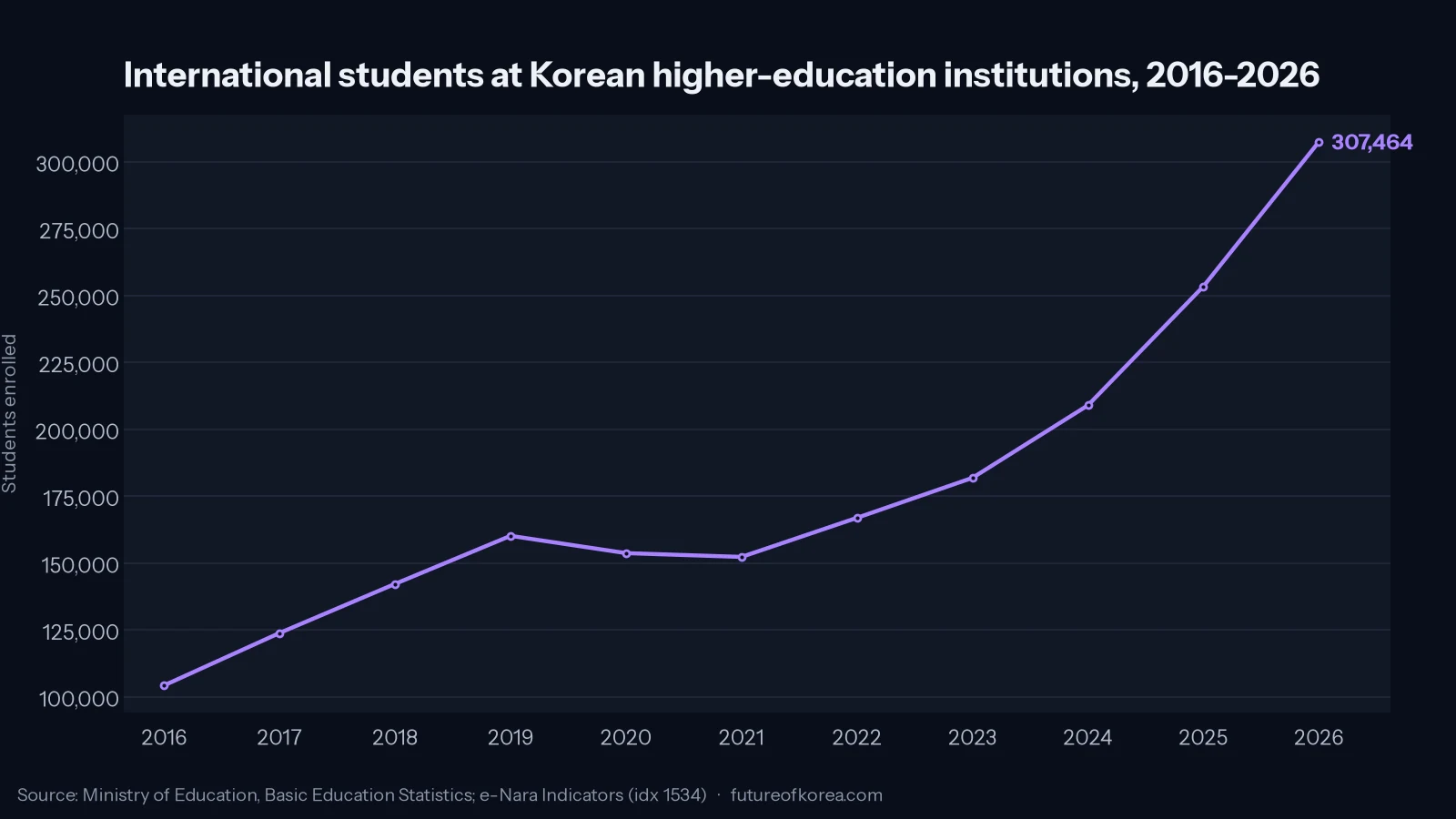
Korea's universities added 54,000 students last year. All of them were foreign.
The Education Ministry's annual census shows international enrolment up 54,030 in a year. Total higher-education enrolment rose by roughly the same number.
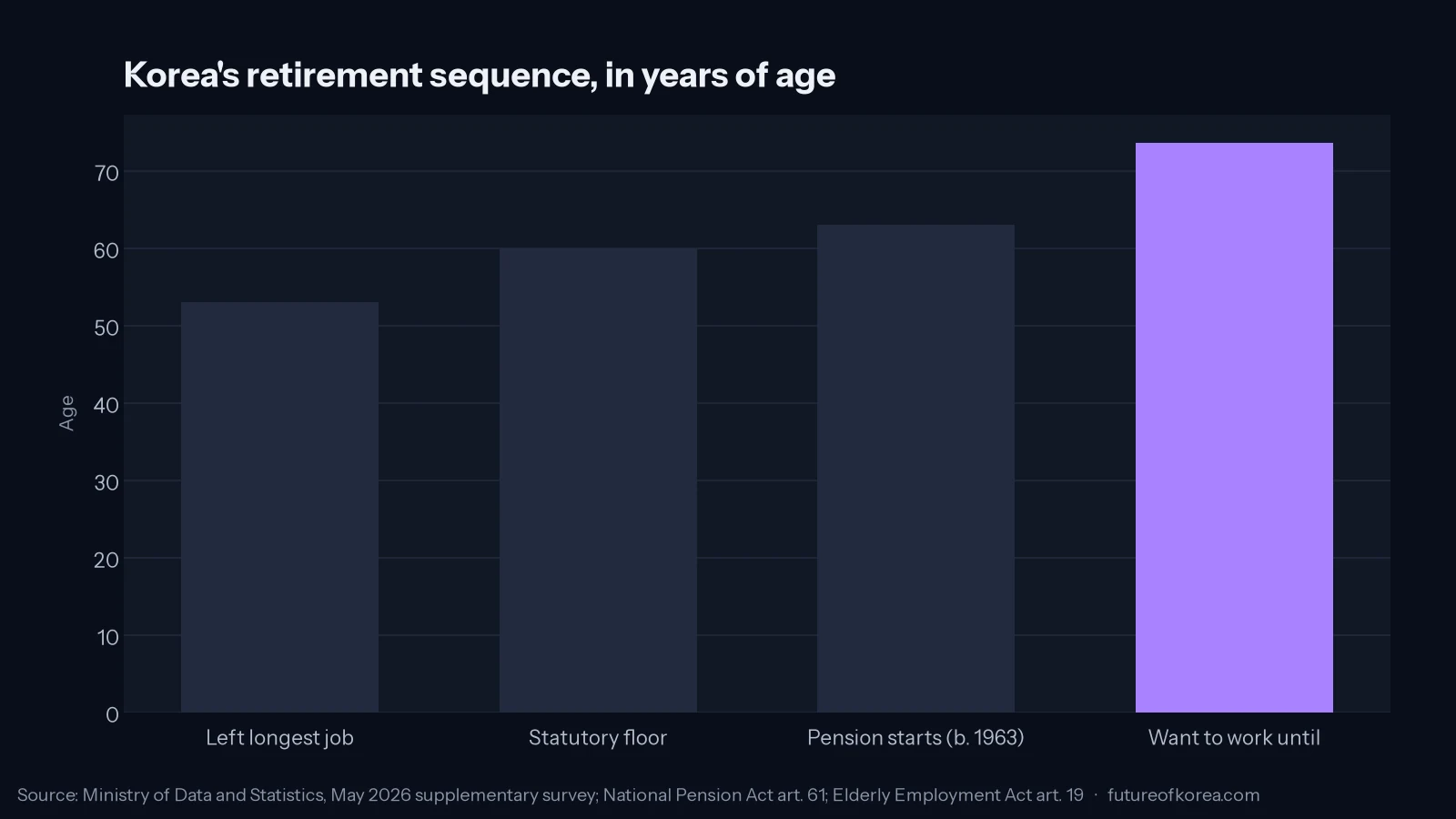
Koreans leave their longest job at 53. The state pension starts at 63.
The May 2026 supplementary survey put the average exit age from a Korean worker's longest-held job at 53.0. The statutory retirement age is 60 and the pension starts at 63. The gap is not a retirement-age problem, and raising the retirement age will not fix it.
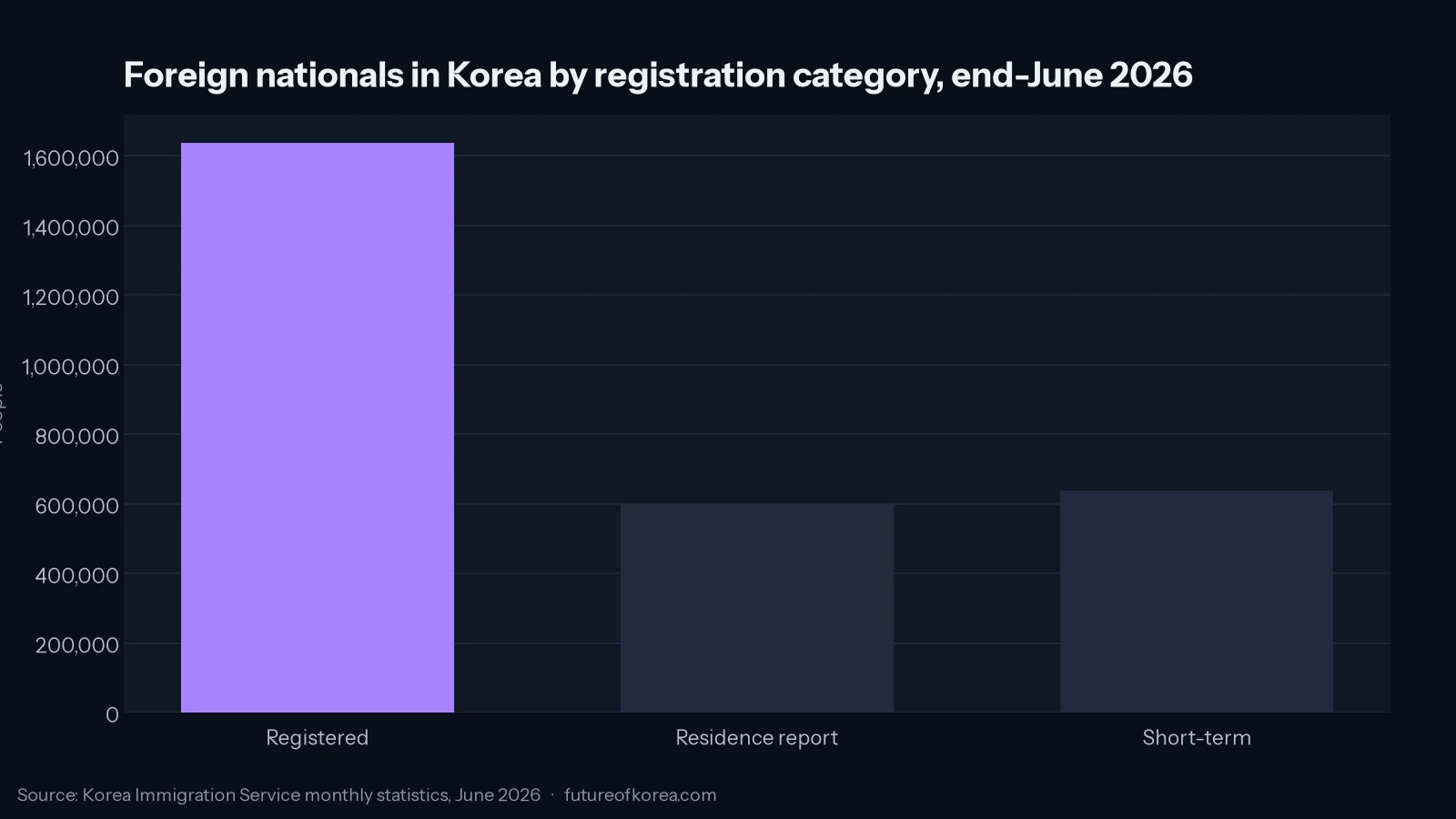
Korea has 2.87 million foreigners. Only 1.64 million of them are registered residents.
The Ministry of Justice, the National Data Agency and the Ministry of the Interior each publish a different figure for how many foreigners are in Korea. The spread between them is 1.24 million people.