Korea's universities added 54,000 students last year. All of them were foreign.
The Education Ministry's annual census shows international enrolment up 54,030 in a year. Total higher-education enrolment rose by roughly the same number.
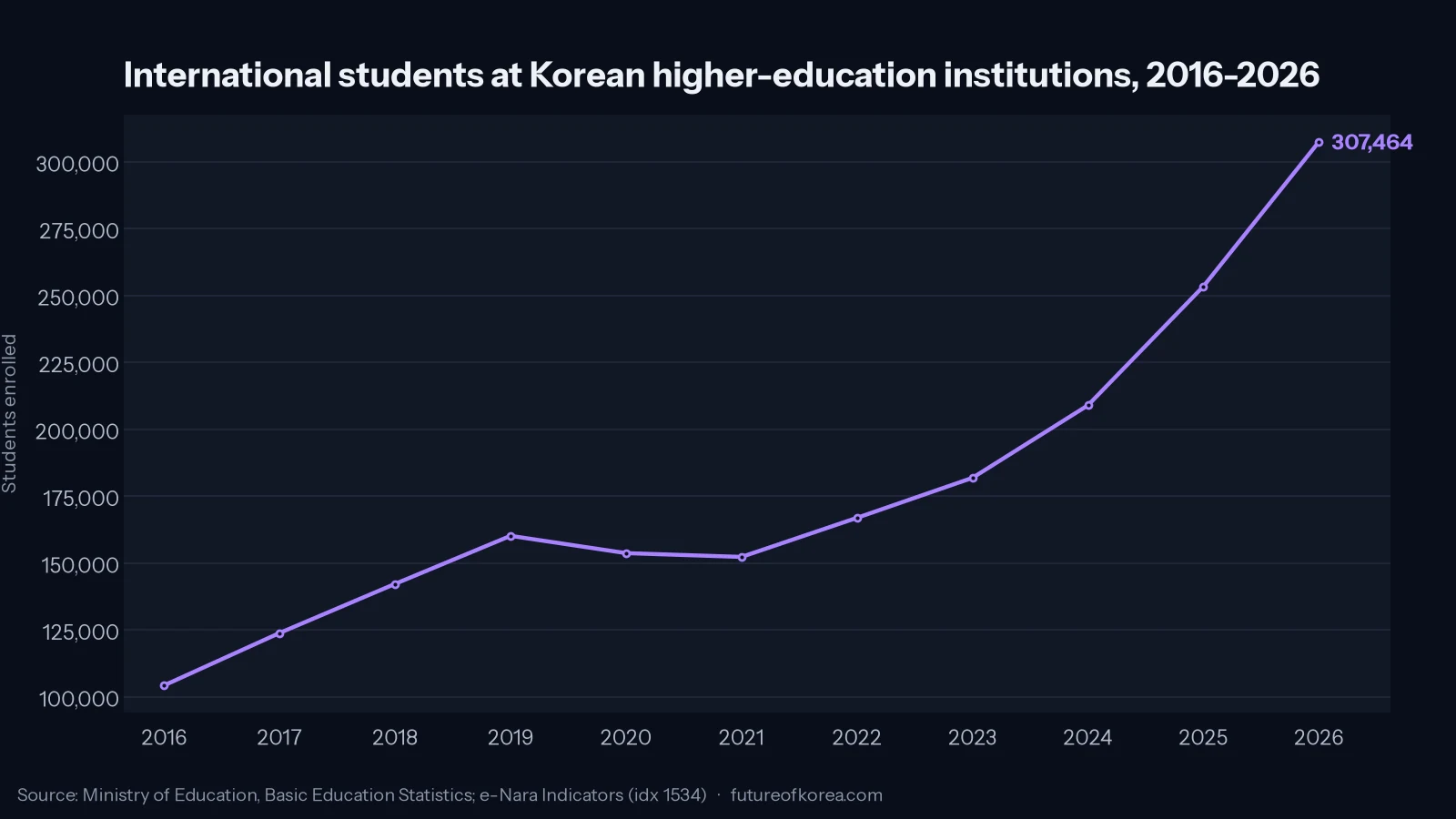
Korea’s higher-education system enrolled about 54,000 more students this year than last. The Education Ministry’s annual census, released on 26 August, puts the increase in international students at 54,030. Domestic enrolment, on those numbers, did close to nothing.
The international total reached 307,464 as of 1 April 2026, up 21.3% from 253,434, and past 300,000 for the first time. Total higher-education enrolment went from roughly 3.02 million to roughly 3.07 million, a gain of 1.8%. Both aggregates are rounded in the ministry’s release, so the two increases do not cancel to the student. The gap between them is not a rounding artefact.
Something close to one in ten people enrolled in Korean higher education is now a foreign national.
Vietnam took first place, and not narrowly
96,834 Vietnamese students were enrolled this year — 31.5% of the international total, up 28.9% in a year. Chinese nationals, who had topped the table in every edition since the survey started recording nationality in 2003, came second at 25.7%. Then Uzbekistan at 6.8%, Nepal at 6.5%, Mongolia at 5.6%.
The two largest groups are doing different things. Chinese students make up roughly a third of everyone in a degree programme. Vietnamese students make up close to half of everyone in a non-degree course, which in practice means Korean-language study at a university-attached institute on a D-4 — the standard on-ramp to a D-2 and a degree, for those who convert.
More of them converted this year than usual. Degree enrolment rose 24.6% to 223,191, outpacing the 13.5% rise in non-degree enrolment to 84,272. A language student who never matriculates is revenue for one year; a degree student is revenue for four and counts toward the enrolment quota that determines whether a department survives.
Asia supplied 92.1% of the total. An Education Ministry official described the concentration as a long-standing criticism while noting that the combined share of the three largest sending countries fell, because Chinese and Uzbek numbers dropped as Vietnamese numbers climbed. Both statements are true. Neither changes the fact that the composition of Korea’s international student body now depends heavily on the economic and visa conditions of one country.
The domestic column
5,362,281 students were enrolled from kindergarten through high school on 1 April, down 189,007 in a year. That is a 3.4% fall and the steepest of the past five years. It is not a forecast of anything — those children already exist, or rather the ones who do not already do not.
Kindergartens are absorbing it first. The national count of kindergartens, elementary, middle and high schools fell by 140 to 20,233, but kindergartens alone fell by 167, to 7,973. Net of them, the school system added buildings this year. The contraction is still queuing at the front door.
One line moved the other way. Students from migrant backgrounds numbered 210,838, up 4.3% on the year and up from 160,058 in 2021. Two-thirds of them — 138,736 — were born in Korea to a parent in an international marriage. They are Korean children, counted separately because of who their parents are, and they are the only growing part of the school-age population. That belongs in the same conversation as Korea’s foreign population count and what each official figure measures, and it is a slower-moving story than the recent uptick in births.
The exit door opened in the same month
The number of higher-education institutions fell from 421 to 416.
On 15 August, the Act on Support for the Structural Improvement of Private Universities came into force — Act No. 21010, passed a year earlier. It sets up an annual financial diagnosis of every private university, a formal designation of “management-crisis university” after review by a structural-improvement committee, and a sequence of orders the ministry can issue to a school that has been designated.
The provision that changes behaviour is at the end of that sequence. A school corporation that dissolves can now receive part of the residual assets as a dissolution settlement, or direct them to a public-interest or social-welfare foundation. Anyone convicted of embezzlement, breach of trust, accounting fraud or bribery is excluded from receiving it.
Until now, a founder who closed a private university walked away with nothing; the assets went to the state or to another school corporation. The rational response was to keep the doors open on a shrinking intake for as long as the accumulated fund lasted. The law does not order anyone to close. It puts a price on the alternative.
The two policies are pointed in the same direction, whatever they look like side by side. Recruiting abroad is what keeps a regional university above the enrolment line; the dissolution settlement is what happens when recruiting abroad stops being enough. Both assume the domestic intake is gone and is not coming back.
What the census does not measure is what happens after graduation. Retention — whether a Vietnamese engineering graduate in Gyeongsangbuk-do stays, converts to a work visa, and is still in Korea five years later — is decided by immigration rules rather than enrolment quotas, and those sit with a different ministry. The 2026 visa overhaul widened several of those routes. Next April’s census will show whether the intake held.
Figures current as of 3 September 2026, drawn from the Ministry of Education’s 2026 Basic Education Statistics (survey date 1 April 2026), the National Indicator System series on international students, and Act No. 21010 as in force from 15 August 2026.
Useful links & tools
Official portals and primary data sources for this topic. Opens in a new tab.
- Study in Korea (Korean government portal) — Official admissions, scholarship and visa information for prospective international students
- Education Statistics Service (KESS) — The full Basic Education Statistics tables, including enrolment by institution and nationality
- HiKorea — Where D-2 and D-4 applications, extensions and part-time work permits are actually filed
- Higher Education Statistics Survey — The survey instrument itself, run each spring across all 416 institutions
Frequently asked questions
How many international students are in South Korea in 2026?
307,464, measured on 1 April 2026 by the Education Ministry’s annual Basic Education Statistics census of every higher-education institution in the country. Of those, 223,191 were enrolled in degree programmes and 84,272 in non-degree courses, mostly Korean-language study at university-attached institutes. The figure covers only higher education; it excludes foreign pupils in schools and people on other visa categories.
Which country sends the most students to Korea?
Vietnam, as of 2026, with 96,834 students — 31.5% of the total and up 28.9% in a year. China had led every edition of the survey since it began collecting nationality data in 2003 and now stands second at 25.7%. Uzbekistan, Nepal and Mongolia follow at 6.8%, 6.5% and 5.6%. Students from Asian countries account for 92.1% of the total.
Is the number of Korean students at university falling?
Not yet, in aggregate. Total higher-education enrolment rose about 1.8% in 2026, from roughly 3.02 million to 3.07 million. But the entire net increase is accounted for by international students, so the domestic student body was close to flat. The pressure is arriving from below: enrolment from kindergarten through high school fell 3.4% this year, and those cohorts reach university age through the 2030s.
What happens to a Korean university that cannot fill its places?
Since 15 August 2026 there is a statutory process. An annual financial diagnosis can lead the Education Ministry to designate a school as a management-crisis university, issue structural-improvement orders, and — if the corporation dissolves — allow it to take part of the residual assets as a dissolution settlement rather than forfeiting everything. People convicted of embezzlement, breach of trust, accounting fraud or bribery are barred from receiving it.
Sources & further reading
Every figure in the key takeaways is numbered to the source it was read from. Sources marked primary are the statistics office, central bank, exchange, regulator or filing itself.
- 12026년 교육기본통계 조사 결과 발표 (2026 Basic Education Statistics)primary — Ministry of Education, August 2026 · verified 2026-09-03
- 2유학생 현황 (Students abroad and international students in Korea), indicator 1534primary — Ministry of Education / National Indicator System · verified 2026-09-03
- 3사립대학의 구조개선 지원에 관한 법률 (Act on Support for the Structural Improvement of Private Universities), Act No. 21010primary — Korea Ministry of Government Legislation · verified 2026-09-03
- 4Number of international students in South Korea jumps 21% — The Korea Herald, August 2026 · verified 2026-09-03
Read next
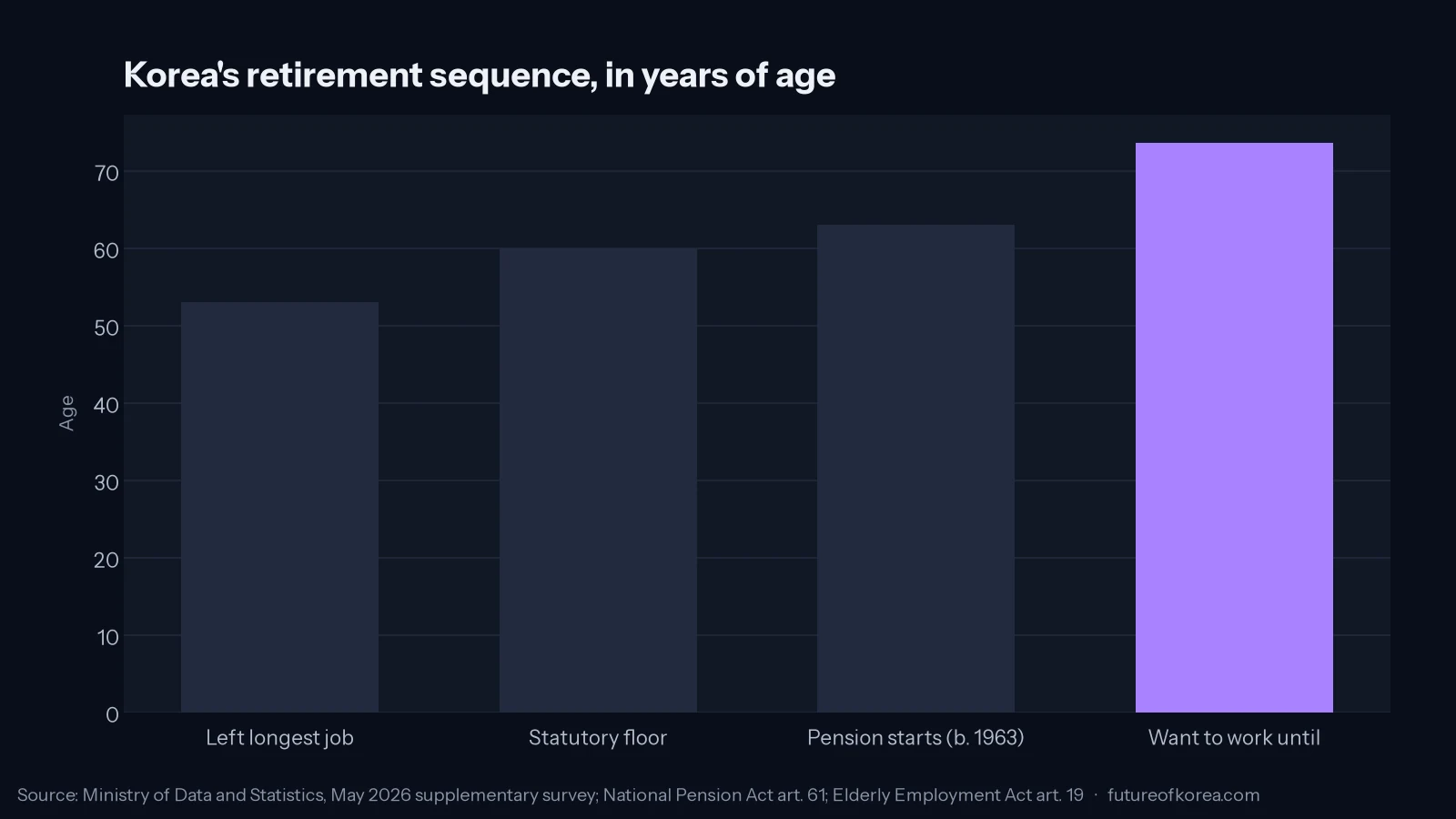
Koreans leave their longest job at 53. The state pension starts at 63.
The May 2026 supplementary survey put the average exit age from a Korean worker's longest-held job at 53.0. The statutory retirement age is 60 and the pension starts at 63. The gap is not a retirement-age problem, and raising the retirement age will not fix it.
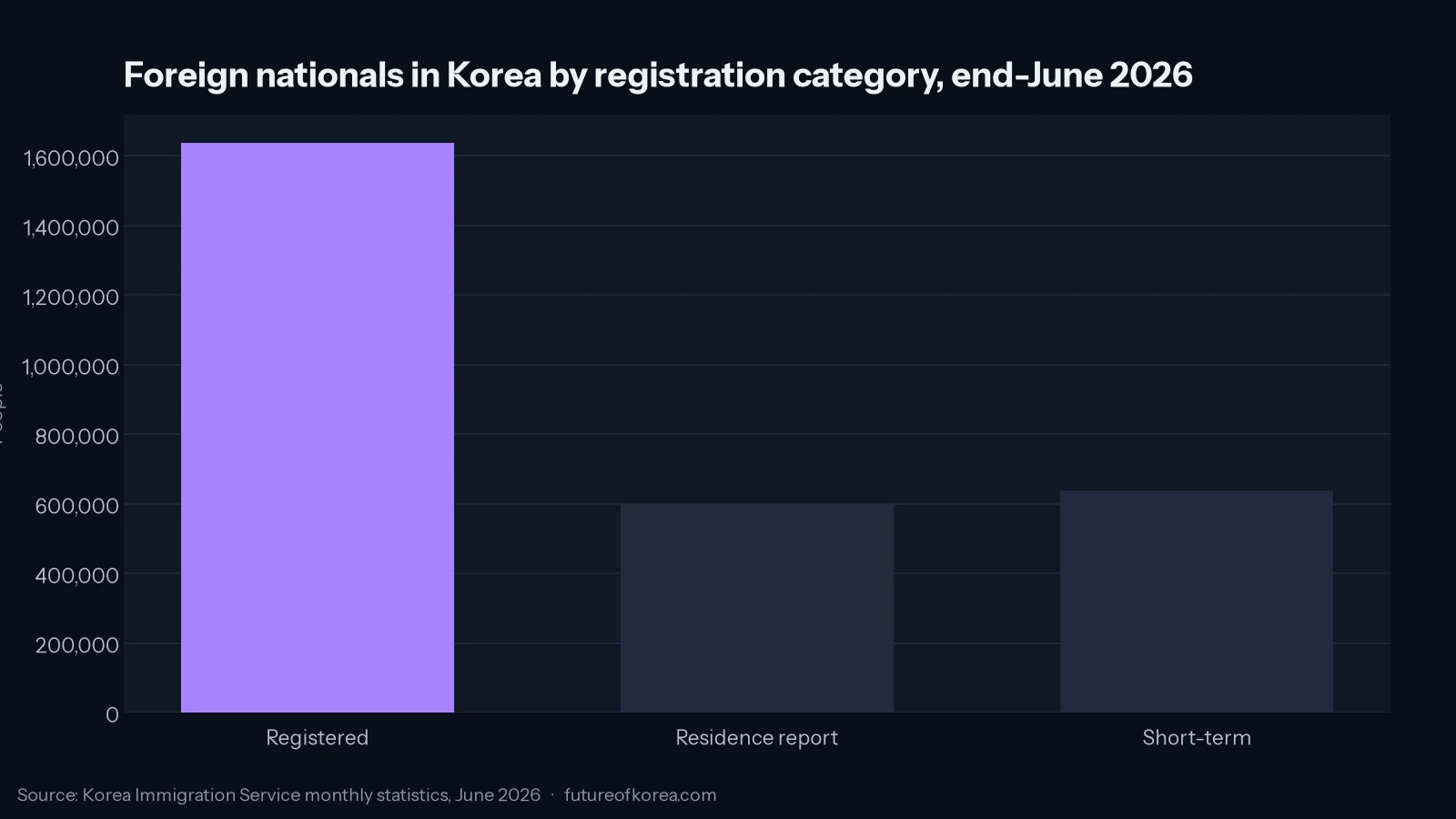
Korea has 2.87 million foreigners. Only 1.64 million of them are registered residents.
The Ministry of Justice, the National Data Agency and the Ministry of the Interior each publish a different figure for how many foreigners are in Korea. The spread between them is 1.24 million people.
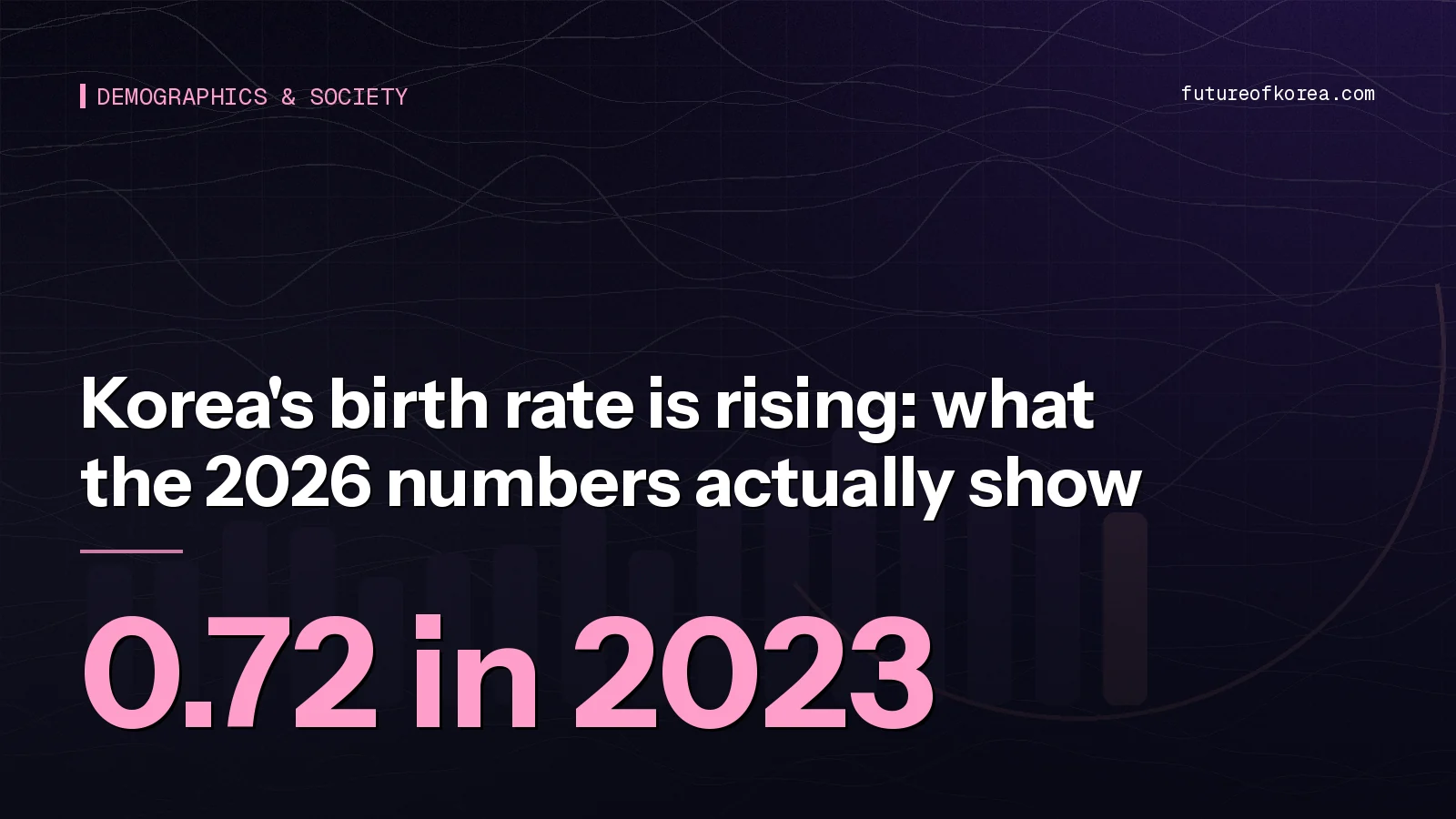
Korea's birth rate is rising: what the 2026 numbers actually show
Korea's fertility rate has climbed from 0.72 to around 0.9 in three years, and Q1 2026 births rose at the fastest quarterly pace since 1981. Here is what is driving it, what it does not fix, and which figures to watch.