Koreans leave their longest job at 53. The state pension starts at 63.
The May 2026 supplementary survey put the average exit age from a Korean worker's longest-held job at 53.0. The statutory retirement age is 60 and the pension starts at 63. The gap is not a retirement-age problem, and raising the retirement age will not fix it.
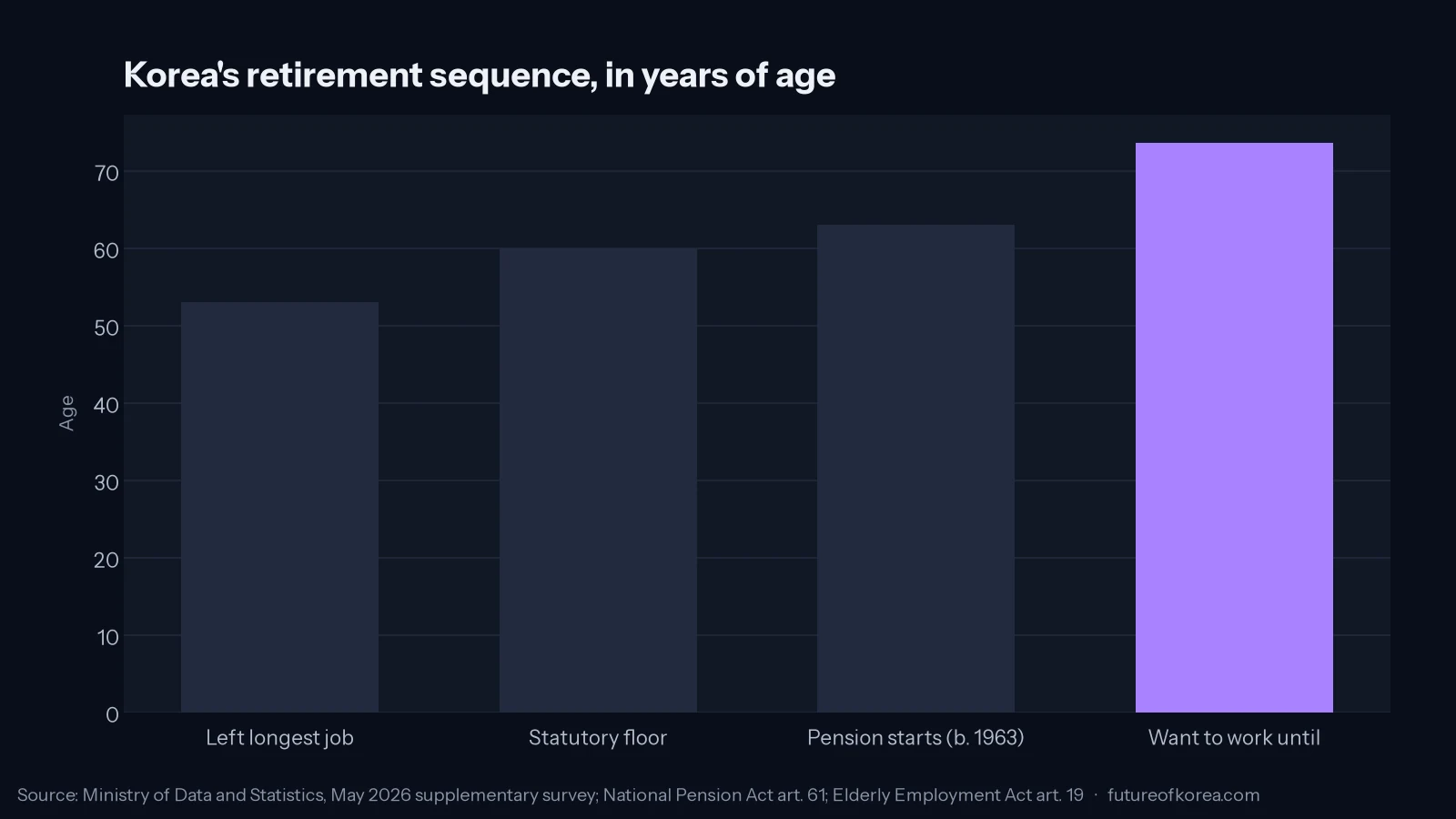
Koreans who have left the job they held longest walked out at an average age of 53.0, the Ministry of Data and Statistics reported on 5 August. The National Pension pays nobody born in the early 1960s until 63, and nobody born from 1969 onward until 65. That is a decade to fund.
Korea’s statutory retirement age of 60 sits in the middle of that decade doing very little. The gap itself is not new; what the May 2026 survey shows is that it is not closing.
The number that matters is 53, not 60
Article 19 of the Elderly Employment Act is short and unambiguous: employers must set the retirement age at 60 or above, and if they set it lower it is deemed to be 60. Every debate about Korean retirement starts there, which is the problem, because for most people the provision never comes into play.
Of the 17,017,000 Koreans aged 55 to 79 in May, 69.5% had already left their longest-held job. They left at 53.0 on average, up a tenth of a year on 2025. The 30.5% still in that job are 62.6 — a figure that has not moved in a year, and one that tells you the people who make it to the retirement age are a distinct minority, not a norm the rest fall slightly short of.
They had been there a long time. Average tenure in the longest-held job was 17 years and 7.1 months.
Then look at why they left. Business downturn, suspension of operations or outright closure accounted for 24.9%. Ill health accounted for 22.1%. Caring for a family member accounted for 15.2%. Reaching the mandated retirement age accounted for 13.2%, and being pushed out through “recommended resignation” or an early-retirement package accounted for another 9.9%.
So roughly one exit in eight is the one the retirement-age law governs. The other seven are a firm failing, a body failing, a parent needing care, or a manager making an offer that is not really an offer.
The split by sex is sharper still. Men cite business failure (27.4%) and mandatory retirement (21.4%); women cite family care (26.7%) and health (25.5%). Raising the floor from 60 to 65 reaches the male half of the first pair and almost nothing in the second.
What the pension actually pays
In the year to May 2026, 52.7% of 55-to-79-year-olds — 8,969,000 people — received a pension of some kind. That is up a full percentage point on the year before. The average payment was ₩880,000 a month, up 2.1%.
Read that number carefully, because the survey is generous about what counts. It includes the National Pension, the means-tested basic pension paid to the poorest 70% of over-65s, occupational schemes and private annuities. ₩880,000 is the average across all of them combined, not the National Pension alone.
For scale: the 2026 minimum wage is ₩10,320 an hour, which the government converts to roughly ₩2.16m a month on the 209-hour basis it has used for decades — the same convention behind the ₩2,236,300 monthly figure set for 2027. The average pension is about 41% of that. And 47.3% of the age group received nothing.
The start ages are fixed by birth year and do not move when the retirement age does.
| Born | Old-age pension starts | Earliest possible claim |
|---|---|---|
| 1952 or earlier | 60 | 55 |
| 1953–1956 | 61 | 56 |
| 1957–1960 | 62 | 57 |
| 1961–1964 | 63 | 58 |
| 1965–1968 | 64 | 59 |
| 1969 onward | 65 | 60 |
Claiming early is possible from five years before your start age, and it is not free. A claim five years early pays 70% of the entitlement, with six percentage points added back for each year you wait. That reduction is permanent — it does not revert when you reach the normal age. Going the other way, deferral adds 0.6% a month, or 7.2% a year, for up to five years.
There is one more trap for people who do keep working. For the first five years after your pension start age, earnings above the National Pension’s benchmark income figure cut the payment: ₩150,000 plus 15% of the excess where that excess is between ₩2m and ₩3m a month, rising to ₩500,000 plus 25% above ₩4m, capped at half the pension. Work and pension are not fully additive in exactly the years the gap makes work most necessary.
Ten million older workers is a demographic fact, not an achievement
Employment among 55-to-79-year-olds reached 10,125,000 in May, up 345,000 on the 9,780,000 recorded a year earlier. It is the first time the count has passed ten million.
The headline flatters. The employment rate was 59.5%, exactly where it was in 2025. The participation rate was 60.9%, exactly where it was in 2025. The population of the age band grew by 570,000. Nothing changed in behaviour; the cohort simply got bigger, and a constant share of a bigger number is a bigger number.
What did change is intent, marginally and in the wrong direction. Some 69.2% say they want to keep working — down 0.2 points — but the age they want to work until rose from 73.4 to 73.6. Wanting to work later while fewer of you want to work at all is what a squeeze looks like from the inside.
The reasons they give are consistent with a bridging problem rather than a lifestyle one. Asked what matters in choosing a job, both sexes put workload and hours first (24.9% of men, 37.5% of women), ahead of pay. On pay itself, the most common answer for men was ₩3m a month or more (34.9%); for women it was ₩1.0m to ₩1.5m (21.0%). And 41.6% of those who looked for work went through the Ministry of Employment and Labor or another public placement service, up from 38.2% a year earlier. The state, not the market, is increasingly the thing finding these jobs.
What a 65 bill would and would not do
On 10 March 2026 the National Human Rights Commission said the Ministry of Employment and Labor had told it the government would draft legislation raising the statutory retirement age in phases, as a national agenda item. The ministry has not committed to 65. Twelve employment-extension bills sit before the National Assembly; nine of them name that number, and one would let employers choose instead to rehire workers after they retire, at a wage reset to the job rather than the tenure.
That choice is the whole fight. Pay still rises with seniority at most large Korean firms, so a higher floor costs employers real money and a rehiring scheme does not. Nothing has passed.
An extension would matter enormously to the 13.2% it reaches. Those are disproportionately men in larger firms with union coverage, formal retirement rules and full contribution records — which is to say, the workers whose pensions are already in the best shape. Aligning the floor with the pension age closes the gap most completely for the people whose gap is smallest.
It does nothing for the 24.9% whose employer shut down, and nothing for the 22.1% who left because they were ill. Those exits happen at 53, and no amendment to article 19 makes a closed business reopen. The policy Korea is debating and the problem Korea has are only partly the same thing.
The rest of the machinery — the National Pension Fund’s own returns, the basic pension, the lump-sum refund rules that govern foreign contributors — carries the remainder, and none of it was designed to bridge a decade.
Figures current as of 30 August 2026. Survey data from the Ministry of Data and Statistics supplementary surveys on older persons, conducted in May 2026 and May 2025 and published on 5 August 2026 and 6 August 2025 respectively. Pension start ages and early-claim rates from article 61 of the National Pension Act as summarised by the Ministry of Government Legislation, updated 15 July 2026. Retirement age from article 19 of the Act on Prohibition of Age Discrimination in Employment and Elderly Employment Promotion, in force since 10 June 2022.
Useful links & tools
Official portals and primary data sources for this topic. Opens in a new tab.
- Ministry of Data and Statistics — employment press releases — Where the Economically Active Population Survey and its May supplementary surveys on older and younger workers are published, in Korean, usually with a PDF and an HWP.
- KOSIS — Korean Statistical Information Service — The full tables behind the press releases, including the breakdowns by sex and age band that the summaries compress into a top three.
- National Pension Service — Contribution records, entitlement estimates and the application for the old-age pension. The electronic civil affairs section will show your own start age.
- Korean Law Information Center — The statutes themselves. Article 19 of the Elderly Employment Act sets the retirement floor; article 61 of the National Pension Act sets the payment ages.
- Ministry of Employment and Labor — Publishes the continued-employment and re-employment support schemes, and would carry any retirement-age bill through the legislative process.
Frequently asked questions
At what age do Koreans actually stop working in their main job?
At 53.0 on average, according to the Ministry of Data and Statistics survey of 55-to-79-year-olds conducted in May 2026 and published on 5 August. That figure covers the 69.5% of the age group who have already left the job they held longest; the 30.5% still in that job are 62.6 on average. Average tenure in the longest-held job was 17 years and 7.1 months. Leaving that job is not the same as leaving work — most people take another one — but it is the end of the career-defining, best-paid position.
When does the Korean National Pension start paying?
It depends on your birth year. Anyone born in 1952 or earlier started at 60. Those born 1953–56 start at 61, 1957–60 at 62, 1961–64 at 63, 1965–68 at 64, and everyone born from 1969 onward starts at 65. You need at least ten years of contributions to qualify for the old-age pension at all. The schedule is set in article 61 of the National Pension Act and its 2007 addenda, and it does not change with the statutory retirement age.
How much is the average pension in Korea?
₩880,000 a month among people aged 55–79 who received one in the year to May 2026, up 2.1% on the previous year. That figure covers every kind of pension the survey counts — National Pension, the means-tested basic pension, occupational schemes and private annuities — so it is not the National Pension alone. Only 52.7% of the age group received anything at all. A full-time job at the 2026 minimum wage of ₩10,320 an hour pays roughly ₩2.16m a month by the government’s own 209-hour conversion.
Is Korea raising the retirement age to 65?
Not yet. Article 19 of the Elderly Employment Act still requires employers to set retirement at 60 or above. On 10 March 2026 the National Human Rights Commission said the Ministry of Employment and Labor had told it the government would draft phased legislation as a national agenda item, though the ministry has not committed to 65 as the destination. Twelve employment-extension bills are before the National Assembly and nine of them propose 65; one would instead let employers rehire retirees at a reset wage. None has passed, and labour and business remain far apart on what happens to seniority-based pay if one does.
Sources & further reading
Every figure in the key takeaways is numbered to the source it was read from. Sources marked primary are the statistics office, central bank, exchange, regulator or filing itself.
- 12026년 5월 경제활동인구조사 고령층 부가조사 결과 (May 2026 supplementary survey on older persons)primary — Ministry of Data and Statistics, August 2026 · verified 2026-08-30
- 22025년 5월 경제활동인구조사 고령층 부가조사 결과 (May 2025 supplementary survey on older persons)primary — Ministry of Data and Statistics, August 2025 · verified 2026-08-30
- 3노령연금 — 지급개시연령 및 조기·연기 산정 (Old-age pension: start ages, early claim and deferral)primary — Ministry of Government Legislation, updated 15 July 2026 · verified 2026-08-30
- 4고용상 연령차별금지 및 고령자고용촉진에 관한 법률 제19조 (정년) — Elderly Employment Act, article 19primary — Korean Law Information Center, Ministry of Government Legislation · verified 2026-08-30
- 5Korea sets 2027 minimum wage at 10,700 won per hour — Seoul Economic Daily, August 2026 · verified 2026-08-30
- 6인권위, '정년 65세' 연장 권고…정부 "단계적 입법 추진" — Newsis, March 2026 · verified 2026-08-30
- 7Government to push phased retirement age increase — The Korea Herald, 2026 · verified 2026-08-30
Read next
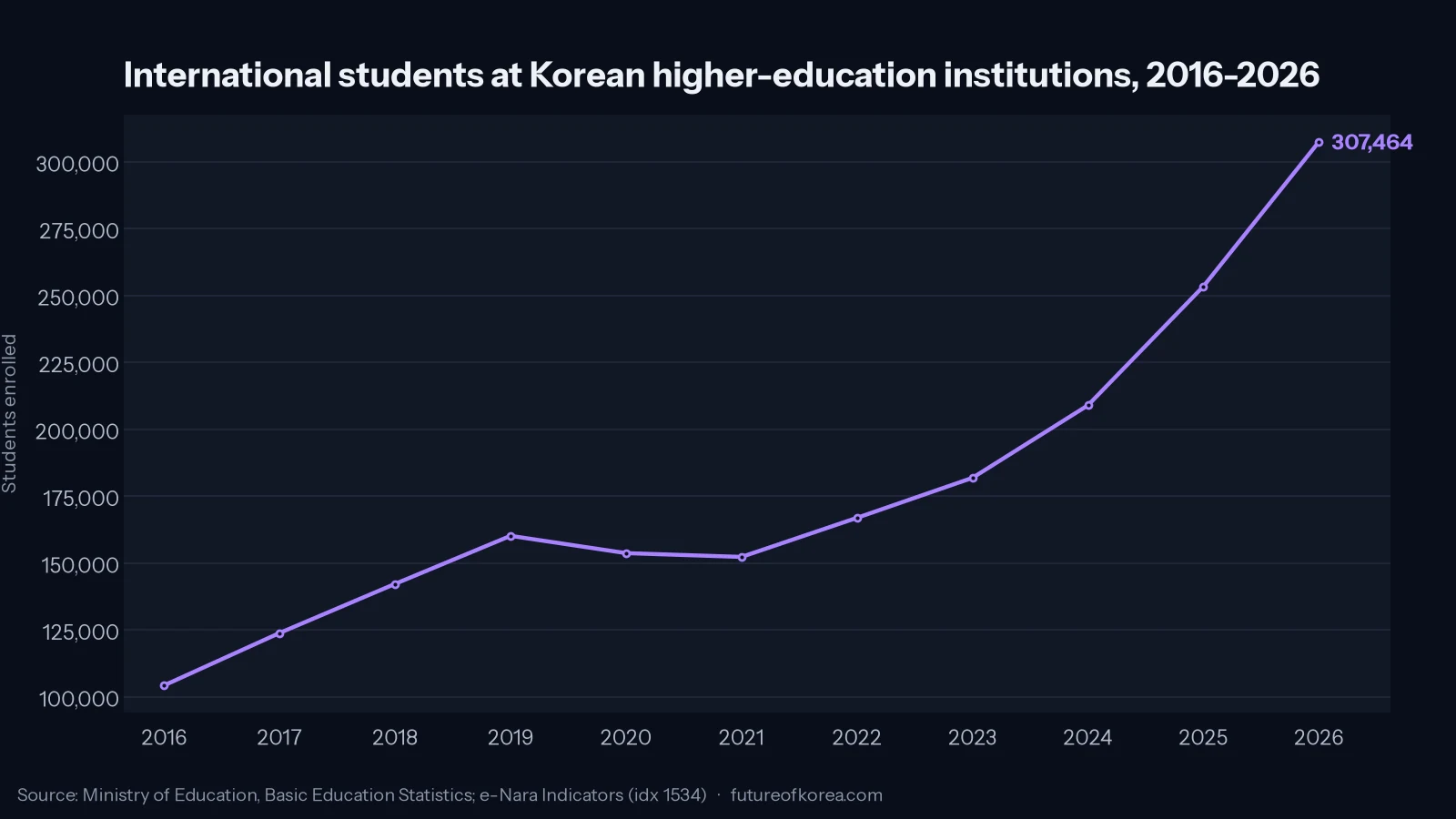
Korea's universities added 54,000 students last year. All of them were foreign.
The Education Ministry's annual census shows international enrolment up 54,030 in a year. Total higher-education enrolment rose by roughly the same number.
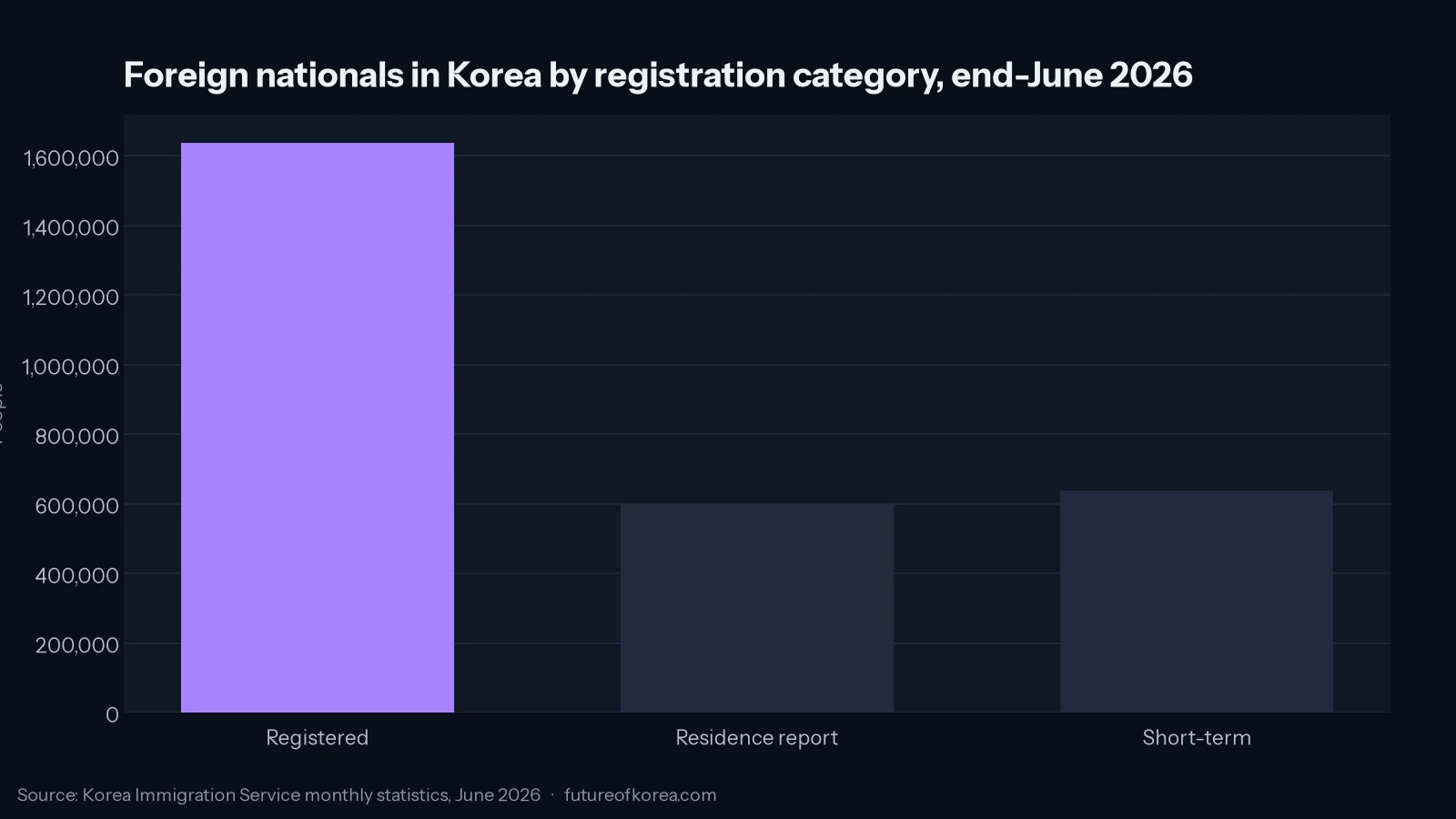
Korea has 2.87 million foreigners. Only 1.64 million of them are registered residents.
The Ministry of Justice, the National Data Agency and the Ministry of the Interior each publish a different figure for how many foreigners are in Korea. The spread between them is 1.24 million people.
Korea's birth rate is rising: what the 2026 numbers actually show
Korea's fertility rate has climbed from 0.72 to around 0.9 in three years, and Q1 2026 births rose at the fastest quarterly pace since 1981. Here is what is driving it, what it does not fix, and which figures to watch.