Korea has 2.87 million foreigners. Only 1.64 million of them are registered residents.
The Ministry of Justice, the National Data Agency and the Ministry of the Interior each publish a different figure for how many foreigners are in Korea. The spread between them is 1.24 million people.
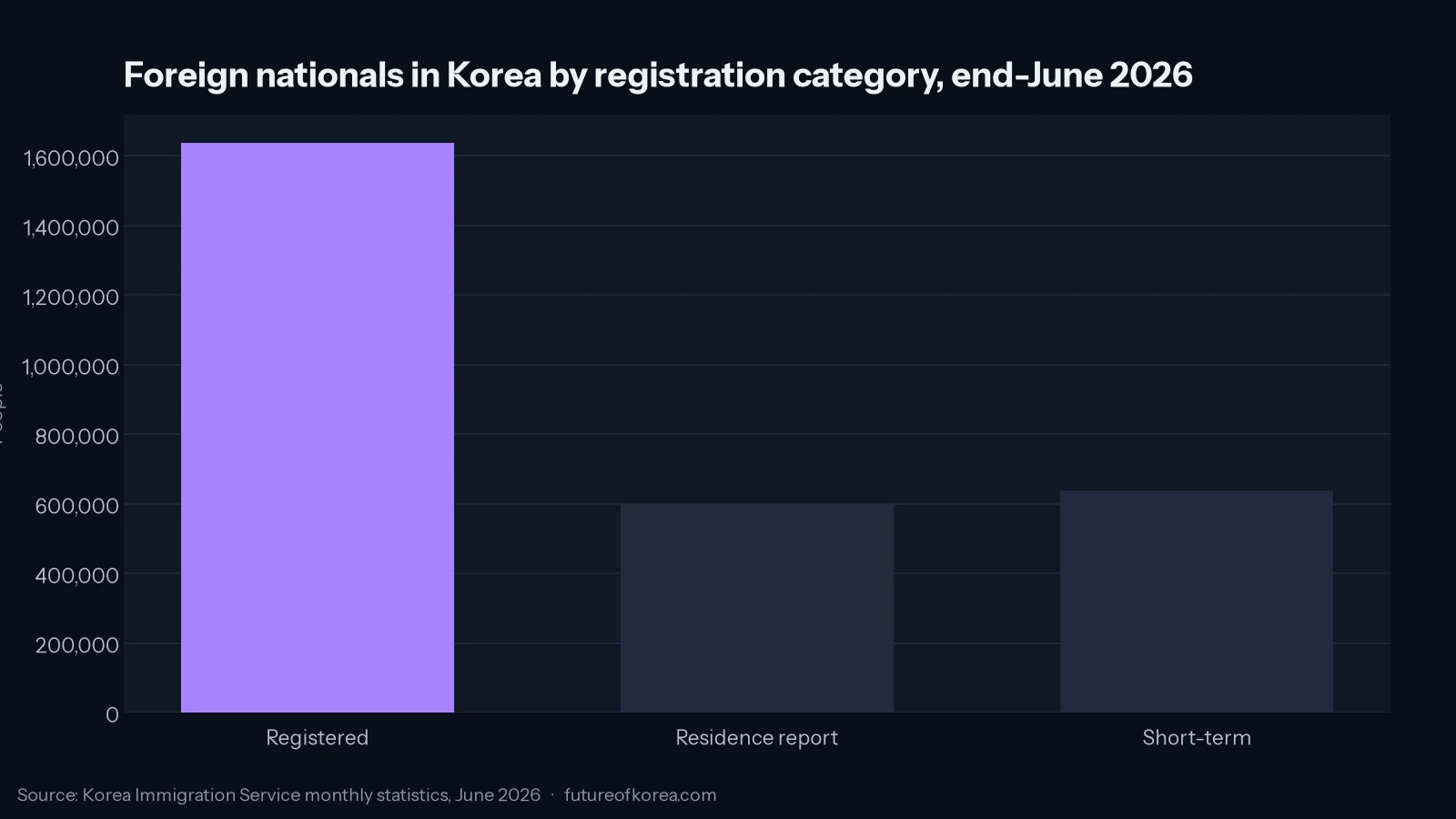
At the end of June 2026 there were 2,874,278 foreign nationals in South Korea. That is the figure the headlines use. It also includes 639,296 people who were, that week, tourists and business travellers with no address here and no intention of acquiring one. Korea’s government publishes four separate counts of its foreign population, and the gap between the largest and the smallest is 1.24 million people.
None of the four is wrong. They were built to answer different questions, and the confusion starts when a number designed for one is quoted in answer to another.
The four numbers
| Count | Figure | Reference date | Publisher |
|---|---|---|---|
| Foreign nationals present in Korea | 2,874,278 | 30 June 2026 | Korea Immigration Service |
| Long-term residents (registration + residence report) | 2,234,982 | 30 June 2026 | Korea Immigration Service |
| Census foreign population | 2.11 million | 1 November 2025 | National Data Agency |
| Registered foreigners | 1,636,922 | 30 June 2026 | Korea Immigration Service |
The top line, 체류외국인, means everyone holding a valid status on Korean soil at the moment the register is read. It rose 5.2% over the year from 2,732,797 in June 2025, and it is the number the Justice Ministry leads with every month.
Underneath it sit three categories that do very different work.
Registered foreigners — 1,636,922, or 57.0% of the total — are people who stayed past 90 days and filed alien registration at an immigration office. That filing produces the residence card that a bank asks for before opening an account and an employer asks for before running payroll. If you want to know how many foreigners are embedded in Korean economic life, this is the closest single proxy.
Foreign nationals of Korean descent are counted separately. Rather than registering as foreigners, they file a domestic residence report against a Korean address, and 598,060 of them had done so by the end of June. Most hold F-4 status. They are long-term residents in every practical sense — they rent, work, pay into the health system and appear in our breakdown of what foreign residents pay for Korean health insurance — but they never appear in the registered-foreigner line, which is why that line understates settled residence by well over half a million.
Add the two and Korea’s long-term foreign population was 2,234,982 at the end of June: 77.8% of the headline figure.
The remaining 639,296 are short-term stayers, under 91 days, no registration required. Their number swings with the tourist calendar. It is the reason the top-line count peaks in autumn and sags in February, and the reason a month-on-month move in that headline sometimes says nothing at all about migration.
Why the percentages never match
Every few months an English-language story reports that foreigners have passed some share of Korea’s population — 4%, 5.3%, 5.44%. The figures conflict because the arithmetic underneath them does.
Korea’s most-quoted population number is the resident registration count kept by the Ministry of the Interior and Safety: 51,091,769 at the end of June 2026, down 0.14% on the year. That register contains Korean nationals. Foreigners are not in it. So dividing 2,874,278 by 51,091,769 — which is how the 5.6% figure is produced — puts the numerator entirely outside the denominator. The result is a ratio, not a share.
The register-based census does the sum properly. Released on 28 July 2026 and dated to 1 November 2025, it links administrative registers from thirteen institutions into a single population and reports both groups on the same basis: 51.82 million people in total, of whom 49.71 million were Korean nationals and 2.11 million were foreign, up 3.2% year on year. That is 4.1% — the only one of these percentages where numerator and denominator describe the same population.
The census also explains why its foreign count sits below the immigration bulletin’s. It requires three months of actual residence, so it captures registered residents and residence-report holders while excluding almost all short-term stayers. Carry 2.11 million forward through seven months of growth and it lands close to the 2,234,982 long-term figure for June 2026. The two series agree. They just measure on different days with different rules.
What this actually changes
Korea’s foreign population is growing at a time when its Korean-national population is not. The resident registration count fell 72,813 over the year to June 2026 while the foreign count rose 141,481 — so foreigners are the reason total population held flat, and the census duly recorded a 0.02% increase against a 0.1% decline in the Korean-national base. Set against a birth count that is rising off a very low floor, that arithmetic is doing more work each year.
Which number gets used determines what looks true. Quote 2.87 million and Korea appears to be one of Asia’s more open societies. Quote 1.64 million registered foreigners against 51.1 million Koreans and it looks like 3.2% — below Japan on most comparisons. The honest answer is the census one, and it is the least reported: 4.1%, rising by about a tenth of a percentage point a year.
For anyone whose own status is in one of these lines, the practical consequence is narrower and sharper. Which document you hold — registration card or residence report — is what determines your entry in the statistics, and, more usefully, what a bank, an employer or the pension service will ask to see. Korea’s 2026 visa overhaul changed which categories are available; it did not change the two documents everything else is filed against.
The next monthly bulletin covering July 2026 is due within weeks. The next census results, for reference date 1 November 2026, land around July 2027.
Figures current as of 23 August 2026, sourced to the government portals and data releases listed below.
Useful links & tools
Official portals and primary data sources for this topic. Opens in a new tab.
- Korea Immigration Service — monthly statistics — The monthly bulletin itself, in Korean, with the full breakdown by status and nationality
- KOSIS — national statistics portal — English tables for resident registration, census and immigration series in one place
- HiKorea — Where alien registration and residence reports are actually filed and amended
- Resident registration population statistics — Monthly Korean-national population counts down to the neighbourhood level
Frequently asked questions
How many foreigners actually live in South Korea?
It depends on what you mean by live. At the end of June 2026 the Korea Immigration Service counted 2,874,278 foreign nationals present in the country, but 639,296 of those were short-term stayers who had not registered and in most cases would leave within weeks. The long-term figure — people holding either alien registration or an overseas-Korean residence report — was 2,234,982. The register-based census, which requires three months of actual residence, put the foreign population at 2.11 million as of November 2025.
What is the difference between alien registration and a domestic residence report?
Alien registration is what a foreign national files with an immigration office when staying in Korea longer than 90 days; it produces the residence card that banks, employers and insurers ask for. A domestic residence report is the parallel document for foreign nationals of Korean descent, most of them on F-4 status, who report a Korean address rather than register as foreigners. Both make the holder a long-term resident in the statistics, but they are counted in separate lines of the monthly bulletin.
Why do news reports give different percentages for foreigners in Korea?
Because they divide different numerators by different denominators. Dividing the Justice Ministry’s 2,874,278 by the Interior Ministry’s resident registration population of 51,091,769 gives 5.6%, but that denominator counts only Korean nationals, so the people in the numerator are absent from the base. The census avoids the problem by counting both groups on the same basis and reports 4.1%. Both figures are published by the government and neither is wrong; they answer different questions.
When is Korea's foreign population data updated?
The Korea Immigration Service publishes its monthly immigration and foreign policy statistics bulletin roughly three weeks after each month ends, with figures broken out by status, nationality and region of residence. The Ministry of the Interior and Safety updates resident registration counts monthly. The register-based census results, which reconcile administrative registers into a single population figure, come out once a year — the 2025 edition was released on 28 July 2026.
Sources & further reading
Every figure in the key takeaways is numbered to the source it was read from. Sources marked primary are the statistics office, central bank, exchange, regulator or filing itself.
- 12026년 6월 출입국·외국인정책 통계월보 (June 2026 immigration and foreign policy monthly statistics)primary — Korea Immigration Service, Ministry of Justice · verified 2026-08-23
- 22025년 인구주택총조사 결과 (등록센서스 방식) — 2025 Population and Housing Census, register-basedprimary — National Data Agency, July 2026 · verified 2026-08-23
- 3주민등록 인구통계 — Resident registration population statisticsprimary — Ministry of the Interior and Safety · verified 2026-08-23
- 4주민등록인구 — KOSIS key indicatorprimary — KOSIS, National Data Agency · verified 2026-08-23
- 5S. Korea's foreign population reaches all-time high of 2.73 million — The Korea Herald, July 2025 · verified 2026-08-23
Read next
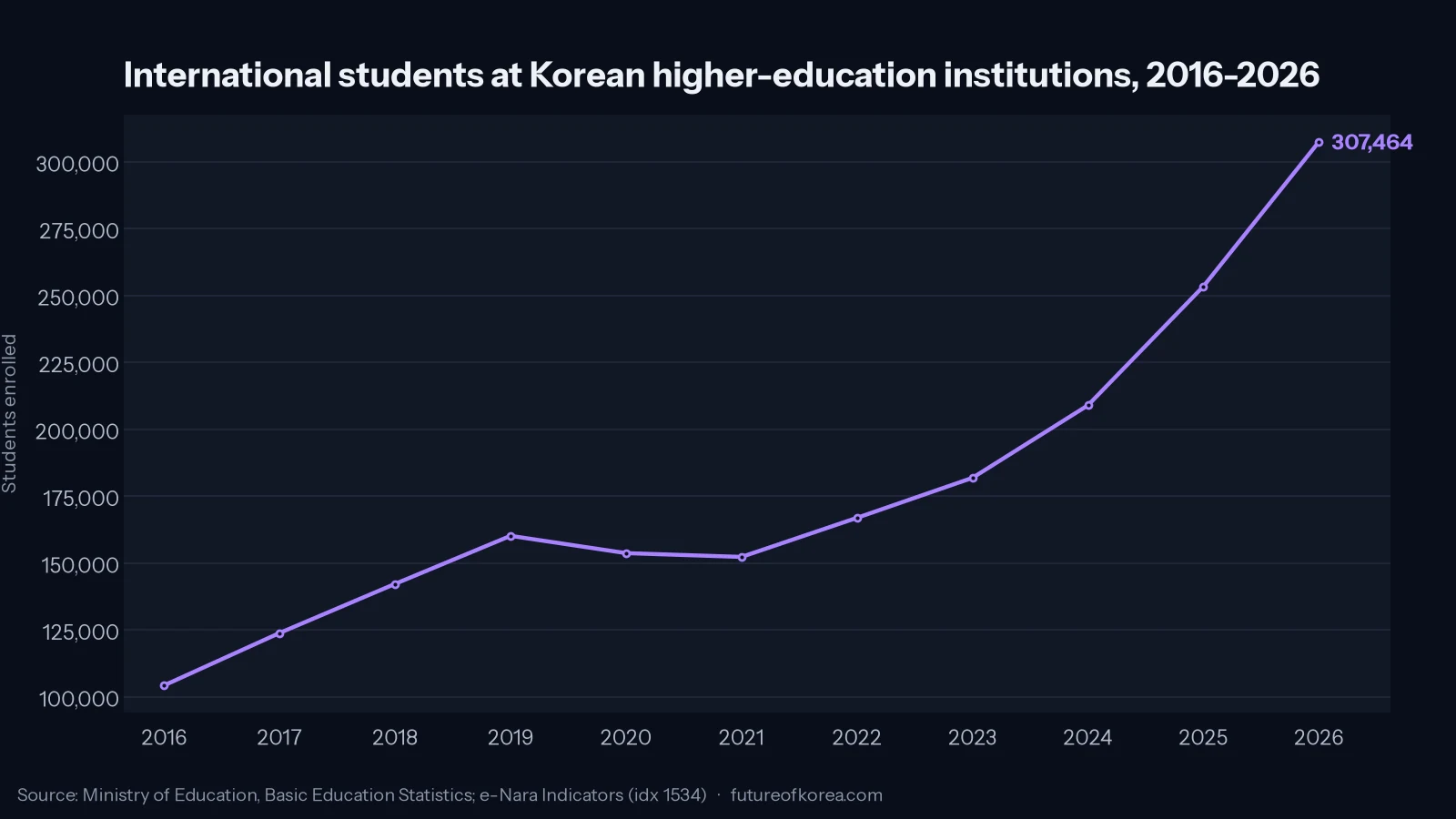
Korea's universities added 54,000 students last year. All of them were foreign.
The Education Ministry's annual census shows international enrolment up 54,030 in a year. Total higher-education enrolment rose by roughly the same number.
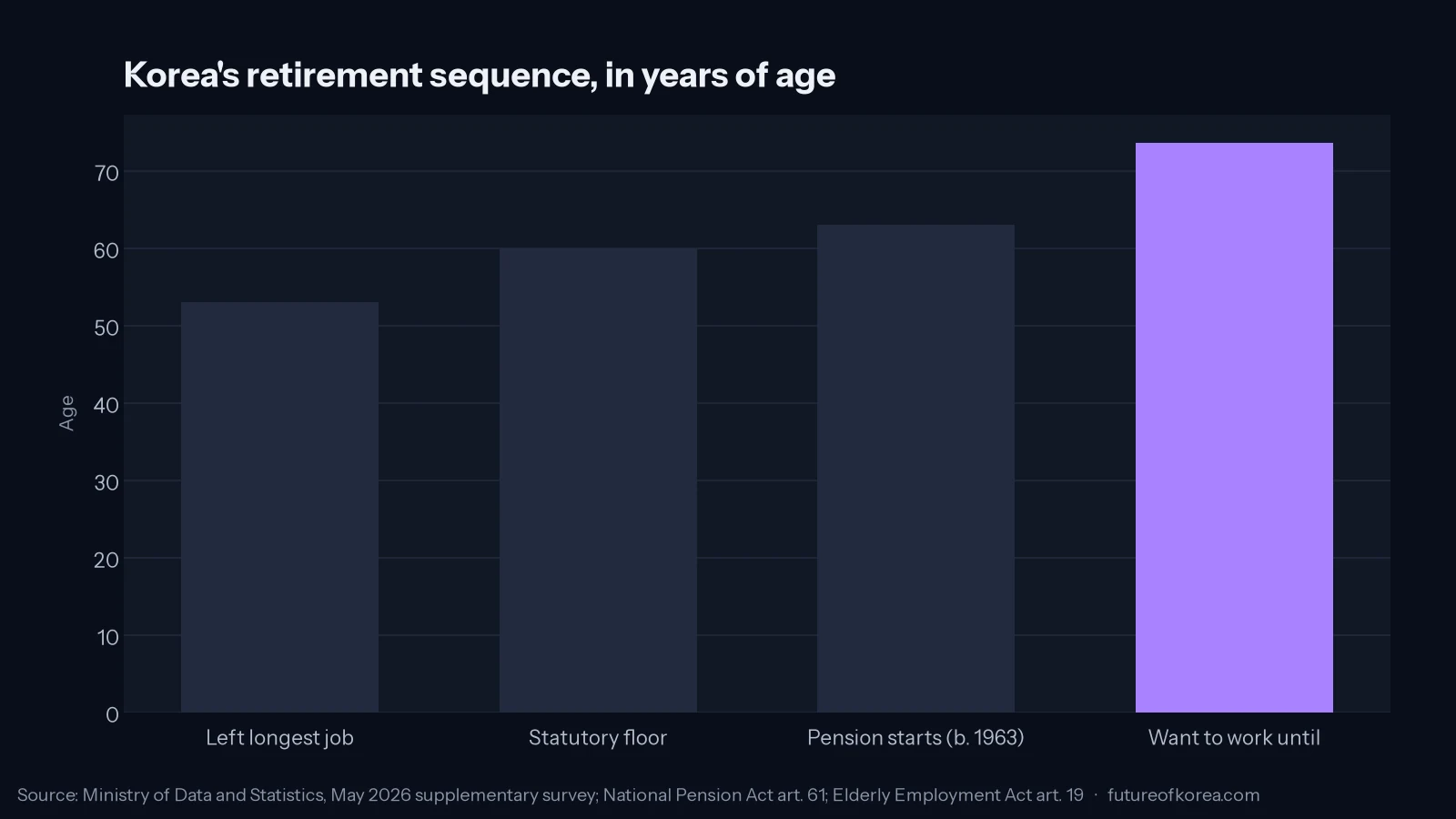
Koreans leave their longest job at 53. The state pension starts at 63.
The May 2026 supplementary survey put the average exit age from a Korean worker's longest-held job at 53.0. The statutory retirement age is 60 and the pension starts at 63. The gap is not a retirement-age problem, and raising the retirement age will not fix it.
Korea's birth rate is rising: what the 2026 numbers actually show
Korea's fertility rate has climbed from 0.72 to around 0.9 in three years, and Q1 2026 births rose at the fastest quarterly pace since 1981. Here is what is driving it, what it does not fix, and which figures to watch.