Korea's defence order book keeps growing. The margins peaked last year.
Three Korean defence contractors reported the second quarter of 2026 within a fortnight of each other. Two of them grew revenue and shrank profit. The order books have never been fuller, and that is not the same thing.
Hyundai Rotem sold 13.3% more in the second quarter of 2026 than it did a year earlier, and earned 9.7% less doing it. Revenue was ₩1.606tn, operating profit ₩232.4bn. The same filing reported an order backlog of ₩30.4046tn — above ₩30tn for the first time in the company’s history.
Both facts are true and they point in opposite directions. That gap is the most useful thing in this year’s Korean defence numbers, and it is not what the sector is being priced on.
Three companies, three directions
Hanwha Aerospace, Hyundai Rotem and LIG Defense & Aerospace all reported the June quarter within a fortnight of each other. Read at the headline level, all three are booming. Read at the margin line, they separate.
| Company / segment | Q2 2026 revenue | Q2 2026 operating profit | Operating margin | Margin a year earlier |
|---|---|---|---|---|
| Hanwha Aerospace — ground defence | ₩2.1075tn (+19%) | ₩533.0bn (+2%) | 25.3% | about 29.5% |
| Hyundai Rotem — consolidated | ₩1.606tn (+13.3%) | ₩232.4bn (−9.7%) | 14.5% | about 18.2% |
| LIG Defense & Aerospace | ₩1.1101tn (+17.4%) | ₩105.7bn (+29.5%) | 9.5% | 8.6% |
The year-earlier margins for Hanwha and Rotem are computed from the growth rates the companies reported; LIG published its own comparison. Hanwha Aerospace’s consolidated result was a record — ₩9.2929tn of revenue and ₩1.3655tn of operating profit, the first time the group has cleared a trillion won in a quarter. Almost none of that came from the guns. Hanwha Ocean, consolidated into the group, contributed ₩736.1bn of it on the back of the LNG carriers that are carrying Korean yards this year, with operating profit up 98%. Strip the shipyard out and the defence engine grew profit by 2%.
Why the premium fades
Korean contractors have been unusually candid about the arithmetic underneath the boom. Domestic programmes negotiated with the Defense Acquisition Program Administration carry margins of roughly 2–5% by design; the state buys at cost-plus and the plus is small. Export contracts are priced by negotiation with a foreign ministry of defence, and for the past four years they have been priced by a foreign ministry of defence in a hurry.
That is the whole story of the margin expansion between 2021 and 2025. Hanwha Aerospace’s operating margin went from 5% in 2021 to 11.4% in 2025. Hyundai Rotem’s went from 4.66% in 2022 to 17.22% in 2025. Korea Aerospace Industries went from 2.27% to 7.28%. None of those companies got three times better at building things in four years. Their customer mix changed.
Customer mixes revert. The first Polish framework was signed in 2022 and executed in tranches; the tranches being built now were priced against a different won, a different steel cost and a different competitive field. Buyers who signed in a panic have had four years to learn what the market clears at, and the deals being negotiated in 2026 come with conditions the 2022 deals did not: local assembly, technology transfer, offset obligations, decades of maintenance work. Those terms are what make an export relationship durable. They are also structurally lower-margin than putting a finished howitzer on a ship in Changwon.
DAPA’s own framing describes the shift approvingly — the industry moving from finished-product exports to what it calls ecosystem exports, transplanting supply chains into customer countries. That is almost certainly the right strategy. It is not a margin-accretive one.
The export total and the profit have come apart
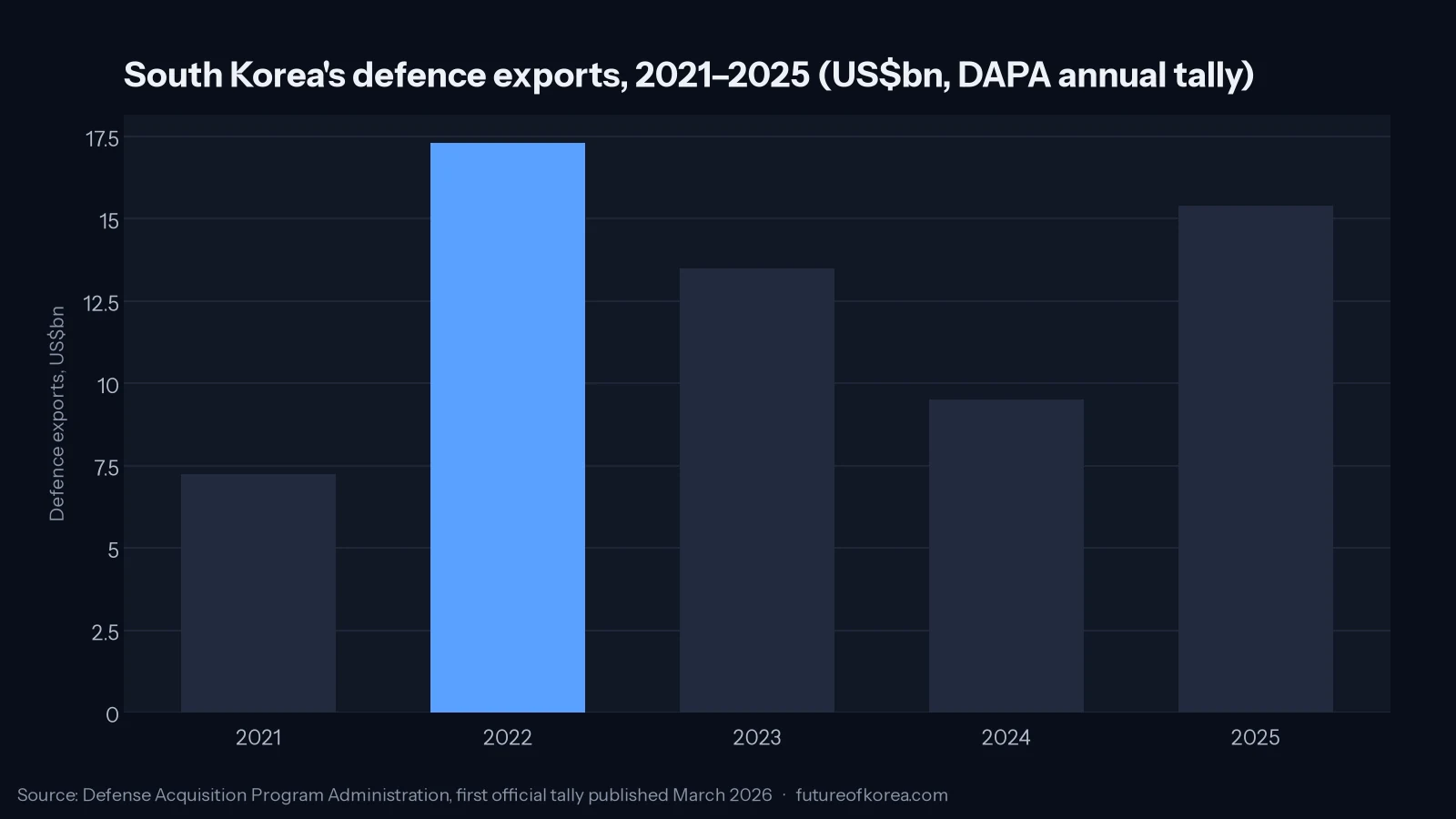
Korea’s 2025 defence exports were $15.4bn on DAPA’s first official tally, up 60.4% on a weak 2024. It is worth being precise about what that number is not. It is not a record: 2022 was $17.3bn. It is not the government’s target either, which was $20bn. And it counts contracts signed, not equipment delivered, which is why a single ₩5.6tn Chunmoo execution contract signed with Poland on 30 December swung the year.
Now put that next to the earnings. The big four — Hanwha Aerospace, Hyundai Rotem, LIG and KAI — booked combined revenue of ₩40.45tn in 2025 and operating profit of ₩4.63tn. Both were all-time highs, in a year when the headline export figure was 11% below its 2022 peak.
So the export tally and the profit line have decoupled, and the decoupling ran in the industry’s favour for three years. There is no reason to assume it only runs that way. The Export-Import Bank of Korea’s research institute expects 2026 exports above $27bn, which would be comfortably a record. Two of the three companies above are already converting that order flow into less profit per won of revenue than they did last year.
What LIG is doing differently
LIG Defense & Aerospace is the counter-example, and it matters because it shows the compression is not simply what happens when exports grow. Its margin rose to 9.5% from 8.6% precisely because exports grew — to 25.4% of revenue from 17.4%. LIG’s export book is weighted to Cheongung-II air defence sales into the Middle East, negotiated later and in a market where the alternatives are American and expensive.
The catch sits in its order intake. LIG booked ₩326.35bn of new orders in the second quarter against ₩1.1101tn of revenue, and its backlog grew only ₩1.11tn over the twelve months to end-June, to ₩24.57tn. A book-to-bill under 0.3 for a quarter is not a crisis in a business with lumpy multi-year contracts. It is a reminder that the pipeline everyone is extrapolating is being consumed faster than it is being refilled at some of these companies.
There is also a currency question sitting under all of it. Export contracts signed in dollars and built with won costs have been flattered for four years by a won that has stayed weak while Korea’s exports boomed. That tailwind is a price, not a capability, and it is not permanent either.
None of this argues the boom is over. Sixteen destination countries in 2025 against seven in 2022 is a structural change in who buys Korean equipment, and the maintenance obligations attached to a K9 fleet in Finland or Egypt will produce revenue into the 2040s. The argument is narrower: the extraordinary margins of 2024 and 2025 were a function of when those contracts were signed, and that window has closed. An investor treating 17% operating margins at a tank manufacturer as the new baseline is extrapolating a moment.
Figures current as of 29 August 2026, sourced to the company filings and outlets listed below. Company results are second-quarter 2026 preliminary figures on a consolidated basis; year-earlier margins for Hanwha Aerospace and Hyundai Rotem are computed from reported growth rates. Nothing here is investment advice — see the disclaimer.
Useful links & tools
Official portals and primary data sources for this topic. Opens in a new tab.
- DART — Financial Supervisory Service electronic disclosure — Where Hanwha Aerospace, Hyundai Rotem and LIG Defense & Aerospace file preliminary and full quarterly results. Segment tables are in the quarterly report, not the one-page earnings notice.
- DART English disclosure viewer — English-language mirror. Thinner coverage than the Korean site, but the major filings of listed companies are there.
- Defense Acquisition Program Administration — The agency that signs and counts Korea's arms export contracts. Its annual tally is the number every other source quotes.
- Korea Exchange market data portal — Daily prices and investor-type flows for the listed defence names, including the pension and foreign buckets that drove the 2026 re-rating.
- Export-Import Bank of Korea — Overseas Economic Research Institute — Publishes the annual economic and industry outlook that carries the state lender's own defence export forecast.
Frequently asked questions
Are Korean defence companies still growing in 2026?
Revenue yes, profit not uniformly. In the second quarter of 2026 Hyundai Rotem grew revenue 13.3% year on year while operating profit fell 9.7%; Hanwha Aerospace’s ground defence division grew revenue 19% and operating profit 2%; LIG Defense & Aerospace grew revenue 17.4% and operating profit 29.5%. All three reported order backlogs at or near record levels. The divergence is in margin, not in demand.
Why are Korean defence margins falling if exports are rising?
Because the mix inside the export book is changing. Korean firms have said domestic contracts negotiated with the government carry margins of roughly 2–5%, while overseas deals are priced by negotiation and have been far richer. The earliest European tranches were the richest of those. Follow-on execution contracts, local production commitments, technology transfer and long-run maintenance work all carry less margin than shipping a finished vehicle out of a Korean plant, and each of those is a larger share of the order book than it was in 2022.
How big was Korea's defence export total in 2025?
$15.4bn, according to the Defense Acquisition Program Administration’s first official annual tally, published in March 2026. That was up 60.4% on 2024 but short of the government’s $20bn target and still below the $17.3bn recorded in 2022. Poland accounted for more than 40% of the total, largely because of a ₩5.6tn Chunmoo execution contract signed on 30 December 2025. The number of destination countries rose from seven in 2022 to sixteen in 2025.
Does a record order backlog mean record future profits?
Not on its own. A backlog is a revenue commitment, not a margin commitment, and it does not say when the work converts. Hyundai Rotem’s ₩30.4046tn backlog at end-June 2026 is roughly two-thirds railcars and rail infrastructure rather than defence. LIG Defense & Aerospace’s backlog rose only ₩1.11tn over the year to end-June, and it booked just ₩326.35bn of new orders in the second quarter against ₩1.1101tn of revenue. Backlog and margin have to be read together.
Sources & further reading
Every figure in the key takeaways is numbered to the source it was read from. Sources marked primary are the statistics office, central bank, exchange, regulator or filing itself.
- 1Electronic disclosure system — second-quarter 2026 results filings of Hanwha Aerospace, Hyundai Rotem and LIG Defense & Aerospaceprimary — Financial Supervisory Service (DART) · verified 2026-08-29
- 2Hyundai Rotem Q2 Revenue Rises 13%, Order Backlog Tops 30 Trillion Won for First Time — Seoul Economic Daily, July 2026 · verified 2026-08-29
- 3Hanwha Aerospace Posts Record Quarterly Operating Profit Above 1 Trillion Won — The Elec, August 2026 · verified 2026-08-29
- 4LIG D&A Q2 Operating Profit Jumps 29.5% on K-Defense Boom — Seoul Economic Daily, August 2026 · verified 2026-08-29
- 5Korea's Defense Exports Hit $15.4 Billion in 2025, Set to Grow Further — Seoul Economic Daily, reporting the Defense Acquisition Program Administration, March 2026 · verified 2026-08-29
- 6Hanwha Aerospace Posts Record Q2 Operating Profit of 1.37 Trillion Won — Seoul Economic Daily, July 2026 · verified 2026-08-29
Read next
Korea won 17% of the world's ship orders this year. Its yards are making record money anyway.
China books four times Korea's tonnage. Korea books the ships that pay. The second-quarter filings show what that trade is worth — and the backlog shows what it costs.

The HBM4 handover: who actually supplies the AI memory in 2026
SK hynix still leads high-bandwidth memory, Micron has overtaken Samsung on some measures, and the HBM4 qualification race for NVIDIA's Rubin platform resets the board. What the share numbers mean and what they don't.

Korea's pop-culture industry billed ₩15.4tn. Its artists average ₩1.5m a month from performing.
A statutory government survey counted every registered Korean talent agency and production house, and asked the people signed to them what they earn. The answers do not look like the industry's press releases.