Why the won stays weak while exports boom — and what September's FX reform changes
Korea runs large trade surpluses and its currency keeps weakening. The explanation is capital outflow, not trade — and the FX market infrastructure launching in September 2026 is designed to address exactly that.
Photograph by UMA media on Pexels.
Here is a puzzle that has been irritating Korea-watchers for three years. Korea sells the world semiconductors, ships, cars and batteries. It runs a substantial current-account surplus. Its export numbers in the AI cycle have been excellent.
And its currency keeps weakening.
USD/KRW sat around 1,415 on 12 August 2026 — stronger than a month earlier by roughly 5.5%, but still down about 2.6% over twelve months, and comfortably in the range that used to be reserved for crises. On 16 July 2026 the Bank of Korea raised its Base Rate 25bp to 2.75%, its first hike since January 2023. The won barely noticed.
The explanation is not complicated once you look at the right account.
Trade is only half the balance of payments
A country’s currency responds to all cross-border flows, not just goods.
The current account — mostly trade — brings dollars in. Korea’s is comfortably positive.
The financial account — investment flows in both directions — is where Korea’s dollars leave. And they leave in volume, through three channels:
- Retail portfolio outflow. Korean households have accumulated very large holdings of US equities. Every won-to-dollar conversion to buy them is a won sale. This has become one of the most-discussed features of Korea’s modern balance of payments, and unlike a trade flow it does not reverse when export orders are strong — it is a persistent allocation decision by millions of households.
- Corporate outward FDI. Korean manufacturers have been building capacity abroad — battery plants in the United States and Europe, chip fabs and assembly outside Korea, automotive plants near end markets. Sensible industrial strategy; sustained won selling.
- Institutional allocation. Pension funds and insurers holding a rising share of assets overseas.
There is a fourth, more cyclical factor: exporters not repatriating. Korean firms earning dollars can choose to hold them offshore rather than convert. When they expect further won weakness, holding dollars is the rational choice — which weakens the won further. That reflexivity is why currency trends persist longer than fundamentals alone suggest.
Why the rate hike did so little
Textbook logic says a higher policy rate attracts capital and lifts the currency. In practice, a 25bp move to 2.75% did roughly nothing, for two reasons.
The differential is still adverse. What matters is the gap versus the dollar, not the level. A modest narrowing does not flip the carry calculation.
The outflows are not rate-sensitive. A household allocating retirement savings into US technology stocks is not comparing Korean deposit rates. A conglomerate building a plant in Georgia to sit inside a tariff wall is not either. Monetary policy moves the marginal speculative flow; it does not redirect a structural reallocation of national savings.
There is also a constraint most commentary skips. The Bank of Korea is simultaneously worried about household debt and property, which argues for tighter policy, and about growth, which argues for looser. Defending the currency is a third objective competing for the same instrument. It cannot get all three, and the currency is usually the one that gives.
Who wins and who loses
| Group | Effect of a weak won |
|---|---|
| Exporters (semiconductors, autos, shipbuilding) | Positive — dollar revenue translates into more won |
| Importers, especially energy and food | Negative — Korea imports nearly all of both; feeds inflation |
| Foreign investors in Korean equities | Negative — currency eats local returns |
| Korean households holding US assets | Positive — dollar gains amplified in won terms |
| Inbound travellers | Positive — Korea gets cheaper |
| Koreans travelling or studying abroad | Negative, sharply |
| Korean banks and firms with dollar liabilities | Negative — funding costs rise, as reported through July 2026 |
The distributional split is the reason there is no clean policy answer. A weaker won is a transfer from Korean consumers to Korean exporters, and both are constituencies.
September 2026: the structural change
The most consequential development is not a rate decision. New FX market infrastructure launches in September 2026, extending won trading accessibility for international participants.
To see why this matters, consider what the won has historically been. Offshore trading was restricted. Onshore hours were narrow. Non-resident access was limited. For a global institution, that meant awkward hedging, wider spreads, and settlement risk — real deterrents to holding Korean assets at scale, and a longstanding factor in Korea’s difficulties with developed-market index classification.
The reform is aimed squarely at that. Its logic is: make the currency easy to hold and hedge, and the assets become easier to own.
What we’re watching
The won is where three of Korea’s biggest stories collide. Its weakness was one of the reasons foreign investors sold a record ₩148.3tn of Korean equities in the first half of 2026 even as the index nearly doubled — the mechanics of which we covered in the 2026 crash explainer. It is also the reason a strong semiconductor export cycle has not translated into the currency strength you would naively expect from the HBM boom.
If September’s reform lowers the cost of holding Korean assets, one of the three reasons foreigners sold gets meaningfully weaker. That is the thing to watch this autumn.
Rates and figures current as of 12 August 2026 and sourced below. Nothing here is investment or currency advice — see the disclaimer.
Useful links & tools
Official portals and primary data sources for this topic. Opens in a new tab.
- Bank of Korea — ECOS statistics database — Official USD/KRW series, policy rate history, balance of payments and capital-flow data.
- Bank of Korea — monetary policy decisions (English) — Rate decisions, statements and the Governor's press conferences.
- Ministry of Economy and Finance (MOEF) — press releases — Where FX market structure reforms are announced.
- Korea Customs Service — monthly trade statistics — Export and import values, published in the first days of each month — the fastest read on the trade side.
- Korea International Trade Association (KITA) — Trade analysis and commodity-level detail, with English resources.
Frequently asked questions
How can a country with a big trade surplus have a weak currency?
Because the exchange rate is set by the whole balance of payments, not by trade alone. Korea’s current account (mostly trade) sends dollars in. Its financial account sends them out — via residents buying foreign securities, corporates investing in overseas plants, and portfolio outflows. When outflows exceed inflows, the won weakens no matter how good the export numbers look. In 2026 the outflow side has consistently won.
Why didn't the July rate hike strengthen the won?
Interest-rate differentials matter for currencies, but they are only one input. A 25bp move to 2.75% narrows the gap with US rates modestly; it does not reverse a structural outflow driven by households allocating savings abroad and corporates building factories overseas. Rate moves shift the marginal carry trade. They do not redirect a decade-long portfolio reallocation.
Is a weak won good or bad for Korea?
It depends entirely on who you are. Exporters selling in dollars book better won-denominated earnings. Importers — including every energy and food buyer, in a country importing almost all of both — pay more, which feeds inflation. Foreign investors in Korean equities lose part of their return to the currency. Korean households holding US stocks gain. Inbound tourists get cheaper travel; Koreans travelling abroad get more expensive travel. There is no single answer, which is precisely why the policy response is complicated.
What exactly is changing in September 2026?
Korea is launching revamped FX market infrastructure aimed at improving won trading accessibility for international participants — part of a multi-year effort to make the won behave more like a currency global investors can hold and hedge conveniently. Historically, restricted offshore trading hours and limited non-resident access made the won awkward for foreign institutions and contributed to Korea’s index-classification difficulties. Check the Bank of Korea and Ministry of Economy and Finance releases for the operative detail.
Will FX reform strengthen the won?
Not directly, and that is not its purpose. Better market infrastructure reduces frictions and hedging costs, which makes Korean assets easier for foreign institutions to hold. If that draws sustained inflows, the currency benefits as a second-order effect. It also cuts both ways: a more accessible currency is easier to sell, not only easier to buy.
What does this mean if I hold a Korea ETF?
Your return is the local equity return multiplied by the currency move, unless you hold a hedged share class. In a year when the won moved several percent in a month, that term is not a rounding error. See our guide to buying Korean stocks from abroad for how to check whether your fund is hedged.
Sources & further reading
Every figure in the key takeaways is numbered to the source it was read from. Sources marked primary are the statistics office, central bank, exchange, regulator or filing itself.
- 1Economic Statistics System — exchange rates, base rate and balance of paymentsprimary — Bank of Korea · verified 2026-08-13
- 2Why South Korea's currency is weak despite strong exports — Korea Economic Institute of America · verified 2026-08-13
- 3Weak South Korean won meets first Bank of Korea rate hike since 2023 — Best Exchange Rates, 2026 · verified 2026-08-13
- 4Why is the Korean won still down in 2026 despite the AI memory boom? — EBC Financial Group, 2026 · verified 2026-08-13
- 5Rate hike seen as strongest tool to support won as FX measures lose impact — The Korea Times, June 2026 · verified 2026-08-13
Read next

Korea will charge 90% after your 300th outpatient visit. Last year that was 7,765 people.
The cabinet cut the excess-use threshold from 366 visits a year to 301 on 8 September. Fewer than eight thousand people crossed the old line — which is the clearest sign the rule is not really aimed at them.
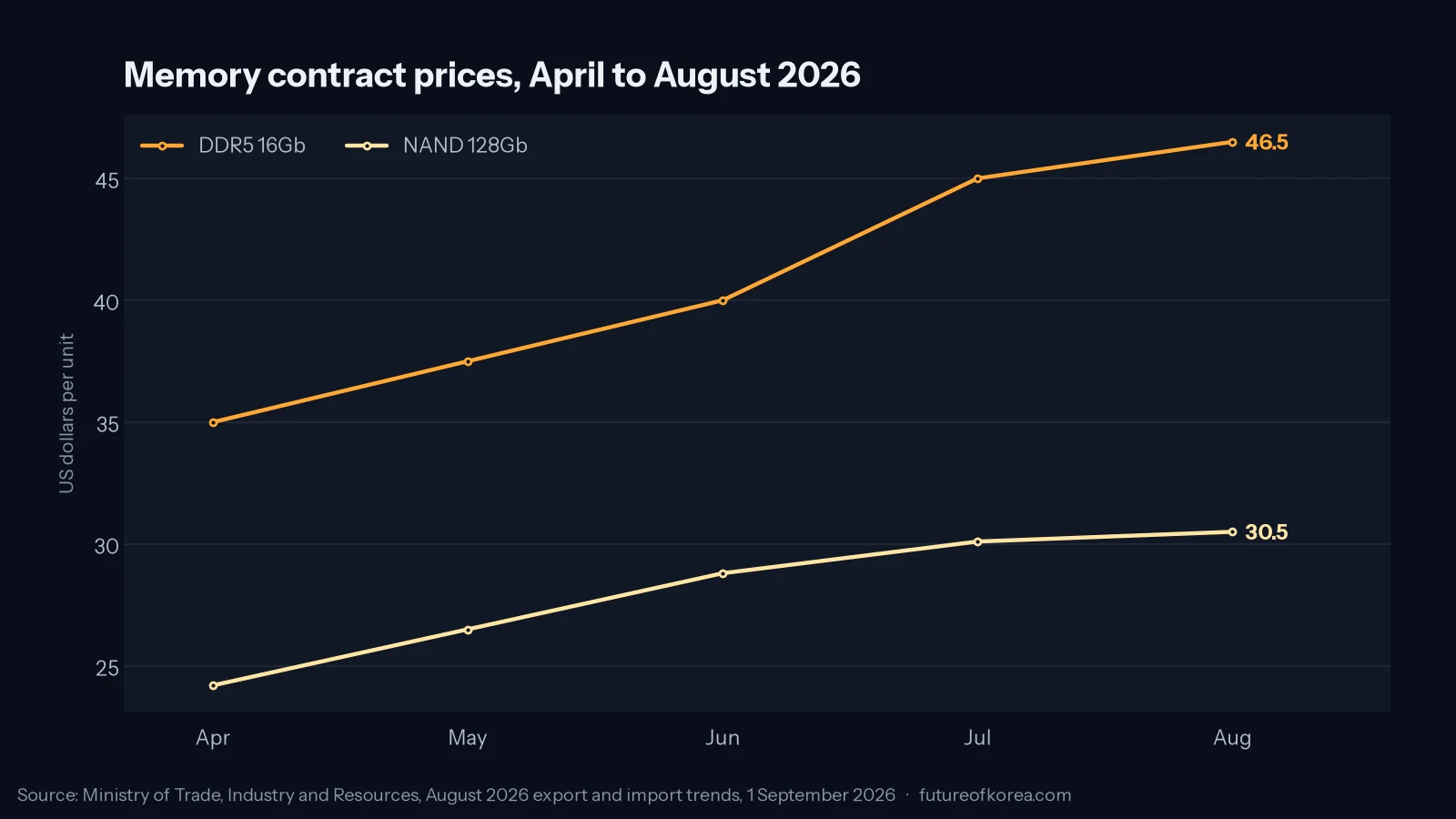
Korea's exports grew 68.7% in August. Strip out three product lines and they grew 2%.
August was Korea's third-biggest export month on record and produced a $34.75bn trade surplus. Almost the entire year-on-year gain came from three lines, and all three are priced rather than produced.
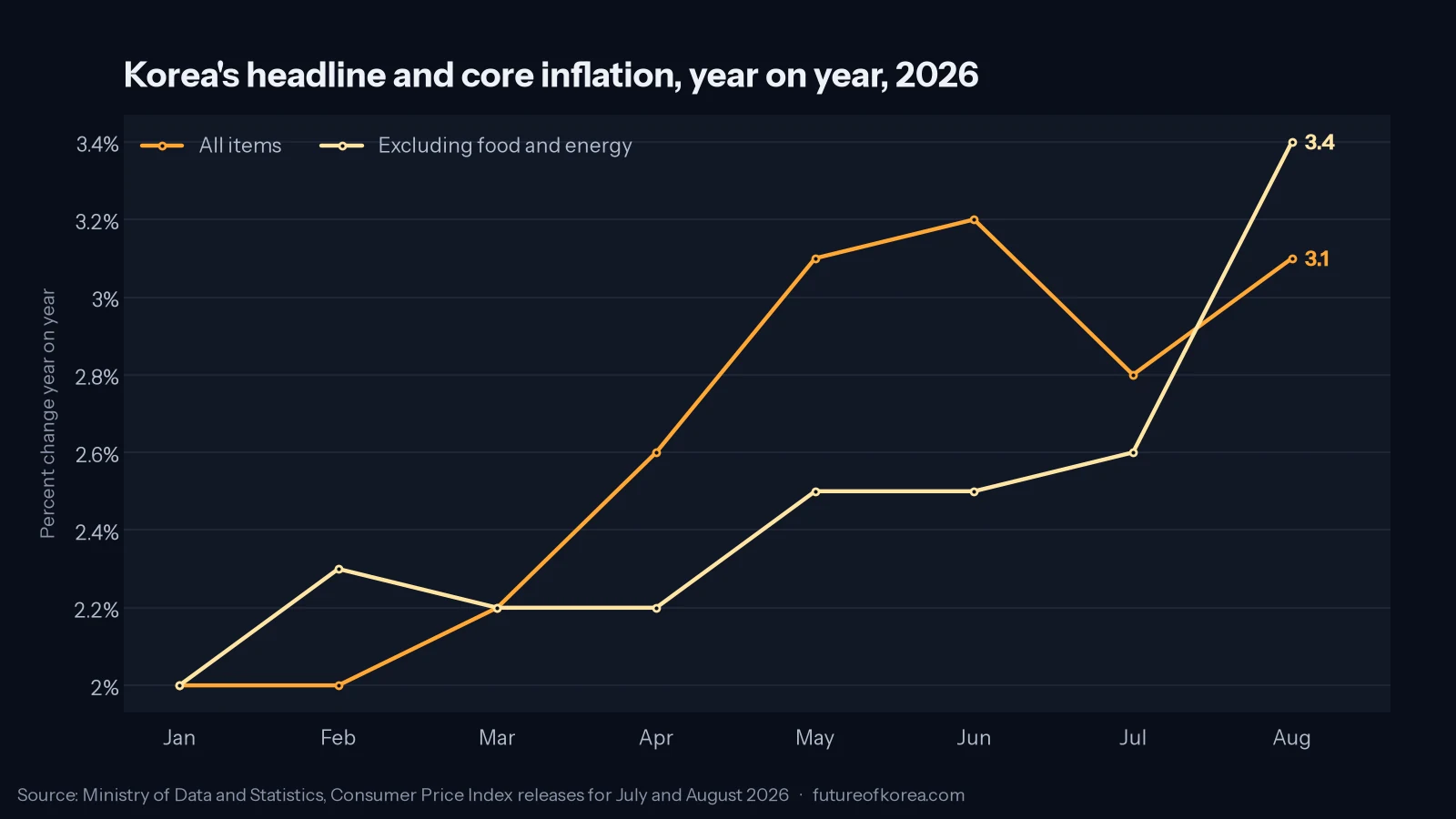
Korea's core inflation hit 3.4%. A phone bill from last August did most of it.
Consumer prices rose 3.1% in August and core inflation rose 3.4%, the sharpest one-month acceleration of the year. Strip out a single expenditure group and the same data show inflation falling.