The HBM4 handover: who actually supplies the AI memory in 2026
SK hynix still leads high-bandwidth memory, Micron has overtaken Samsung on some measures, and the HBM4 qualification race for NVIDIA's Rubin platform resets the board. What the share numbers mean and what they don't.
Photograph by Jakub Pabis on Pexels.
Roughly two Korean companies decide how fast the world’s AI infrastructure can be built. That is not hyperbole — it is a description of the high-bandwidth memory market, and it is the reason the Korean stock index behaved like a leveraged AI bet in 2026.
The competitive picture inside that market changed meaningfully this year. Here is what actually moved.
First, the number that isn’t one number
If you search for HBM market share you will find figures that contradict each other by twenty percentage points. All of them are being quoted in good faith. Consider a representative sample from 2026 coverage:
| Source framing | SK hynix | Samsung | Micron |
|---|---|---|---|
| Q2 2026 share | 62% | 17% | 21% |
| 2026 bit-output forecast (conservative) | 50% | 28% | — |
| 2026 bit-output forecast (alternative) | 54% | 28% | 18% |
These cannot all describe the same quantity, and they don’t. Note that the spread on SK hynix alone — 50% to 62% — is wider than Samsung’s entire share.
What is consistent across every source is the shape of the market: SK hynix still leads decisively, and the contest underneath it has changed. On Q2 2026 numbers SK hynix holds 62%, with Micron at 21% ahead of Samsung at 17% — the first time Samsung has not been the clear number two. Full-year bit-output forecasts put SK hynix anywhere from 50% to 62%, which tells you how much of this depends on what you are counting.
The genuinely new fact: Micron passed Samsung
The headline most people missed is not about SK hynix at all. On several 2026 estimates, Micron overtook Samsung in HBM.
That would have been an implausible claim two years ago. Samsung is the largest memory manufacturer on earth by capacity. But HBM is not commodity DRAM — it is a stacking, packaging, thermal and yield problem as much as a lithography one, and Samsung’s difficulties qualifying HBM3E with the dominant accelerator customer cost it a generation of position while Micron executed cleanly.
The lesson generalises: in HBM, capacity is necessary and nowhere near sufficient. Qualification is the gate.
What HBM4 changes
HBM3E still accounts for the bulk of 2026 shipments, with HBM4 ramping through the second half. Market-size projections for 2026 vary widely between houses and we are not quoting a single figure here, because the ones in circulation differ by tens of billions of dollars and none is a primary source.
HBM4 is not a routine increment. Two changes matter:
The interface widens dramatically. More parallel lanes at lower per-lane rates — better bandwidth per watt, harder signal integrity and packaging.
The base die becomes a logic problem. The layer at the bottom of an HBM4 stack moves closer to a custom logic die, which drags foundry-grade capability into what used to be a pure memory competition. That is why HBM4 positions are not simply inherited from HBM3E: the required skill mix has changed, and companies with strong logic and packaging arms have a route back in.
The capacity race underneath
Both Korean suppliers are spending against the same bet, that AI memory demand outruns supply through 2027:
- Samsung is targeting roughly 50% capacity expansion in 2026.
- SK hynix has signalled a substantial increase in planned infrastructure investment; check its quarterly disclosures on DART for the current figure rather than relying on a number quoted second-hand.
Numbers of that shape carry a specific risk. HBM capacity is not fungible — it is built for a generation and a customer, with committed advanced-packaging lines behind it. If accelerator demand slows while three suppliers are mid-expansion, the industry gets a classic memory glut, except in a product with much higher fixed costs. The memory industry has run this experiment before, repeatedly, and it has never ended gently.
Why this is a Korea story and not just a semiconductor story
Because of concentration. Samsung Electronics and SK hynix together make up a very large share of the KOSPI, and HBM economics drove their 2026 earnings expectations. When the index gained about 92% in the first half of the year and then fell some 40% from its June peak, that was — in substance — the market repricing this one product cycle twice in six months. We covered the mechanics in the 2026 crash explainer.
For anyone holding a Korea ETF, the practical implication is blunt: you own the HBM cycle, whether or not you meant to. Our guide to buying Korean stocks from abroad sets out how to see that concentration in your own holdings before you size a position.
Figures current as of 12 August 2026, sourced to the outlets and company disclosures listed below. Where trackers disagree, we have shown the range rather than selecting one.
Useful links & tools
Official portals and primary data sources for this topic. Opens in a new tab.
- SK hynix newsroom — market outlook and HBM announcements — First-party product and capacity announcements, in English.
- Samsung Semiconductor newsroom — Product launches, process-node and packaging announcements.
- DART — Korean company filings — Quarterly results and capex disclosures for both Korean suppliers, in primary form.
- Counterpoint Research — DRAM and HBM market share tracker — One of the more transparent public share trackers; note its methodology before quoting it.
- Korea Customs Service — trade statistics — Semiconductor export values by month — the fastest public read on the cycle.
Frequently asked questions
Why do published HBM market-share figures disagree so much?
Because they measure different things. Some trackers count revenue, some count bit shipments, some count wafer starts. Some report a single quarter, some a trailing year. HBM3E and HBM4 carry very different prices per bit, so a revenue-share number and a volume-share number can diverge by twenty points and both be correct. When you see an HBM share figure, always establish three things: revenue or volume, which quarter, and which generations are included.
What actually is HBM, in one paragraph?
High-Bandwidth Memory is DRAM stacked vertically into a cube, connected by through-silicon vias, and placed on the same package as the processor. Instead of data crossing a long, narrow path to distant memory modules, it crosses a very short, very wide one. For AI training and inference — which are memory-bandwidth-bound far more than they are compute-bound — this is the difference between an accelerator running at capacity and one waiting for data.
Is HBM4 a bigger jump than previous generations?
Structurally, yes. HBM4 widens the interface substantially and, critically, changes the base die — the logic layer at the bottom of the stack — into something closer to a custom logic component, which pulls foundry capability into what was previously a pure memory problem. That is why the competitive order in HBM4 is not guaranteed to match HBM3E: it rewards a different mix of skills.
Does this mean Samsung is losing?
It means Samsung lost the HBM3E generation’s early lead and is trying to recover position in HBM4. It is the world’s largest memory manufacturer by overall capacity and it is expanding aggressively. A company can simultaneously be third in one high-value product line and structurally central to the industry. Both things are true here.
How does this connect to the KOSPI?
Directly and almost mechanically. Samsung Electronics and SK hynix dominate the Korean index, and HBM economics drove their 2026 earnings expectations. The index’s near-doubling and subsequent crash were, in substance, a repricing of this one product cycle — see our 2026 crash explainer.
What would change the picture fastest?
A qualification decision. HBM supply is sole-sourced or dual-sourced per accelerator platform, and being designed into a flagship product locks in volume for years. Watch for qualification announcements around NVIDIA’s Rubin generation and for custom-accelerator programmes at the large cloud providers, which increasingly specify their own memory partners.
Sources & further reading
Every figure in the key takeaways is numbered to the source it was read from. Sources marked primary are the statistics office, central bank, exchange, regulator or filing itself.
- 12026 market outlook: HBM to fuel the AI memory boomprimary — SK hynix (company newsroom) · verified 2026-08-13
- 2Global DRAM and HBM market share, quarterly — Counterpoint Research · verified 2026-08-13
- 3SK hynix holds 62% of HBM, Micron overtakes Samsung, 2026 battle pivots to HBM4 — Astute Group, 2026 · verified 2026-08-13
- 4The HBM qualification race: who actually passed whose qual, 2022-2026 — Silicon Analysts, 2026 · verified 2026-08-13
- 5Samsung, SK hynix reportedly tapped as NVIDIA Rubin HBM4 suppliers — TrendForce, March 2026 · verified 2026-08-13
Read next
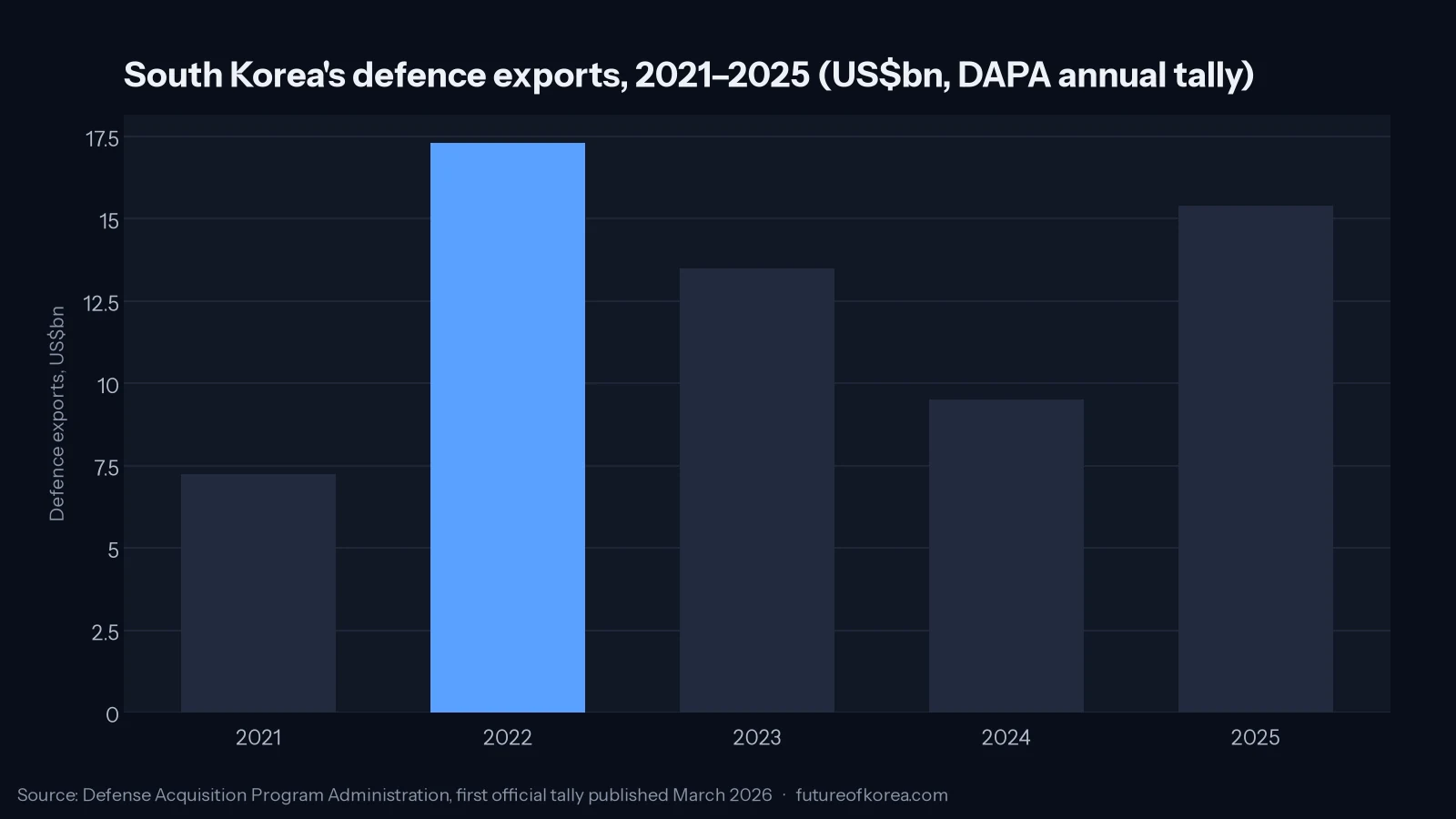
Korea's defence order book keeps growing. The margins peaked last year.
Three Korean defence contractors reported the second quarter of 2026 within a fortnight of each other. Two of them grew revenue and shrank profit. The order books have never been fuller, and that is not the same thing.
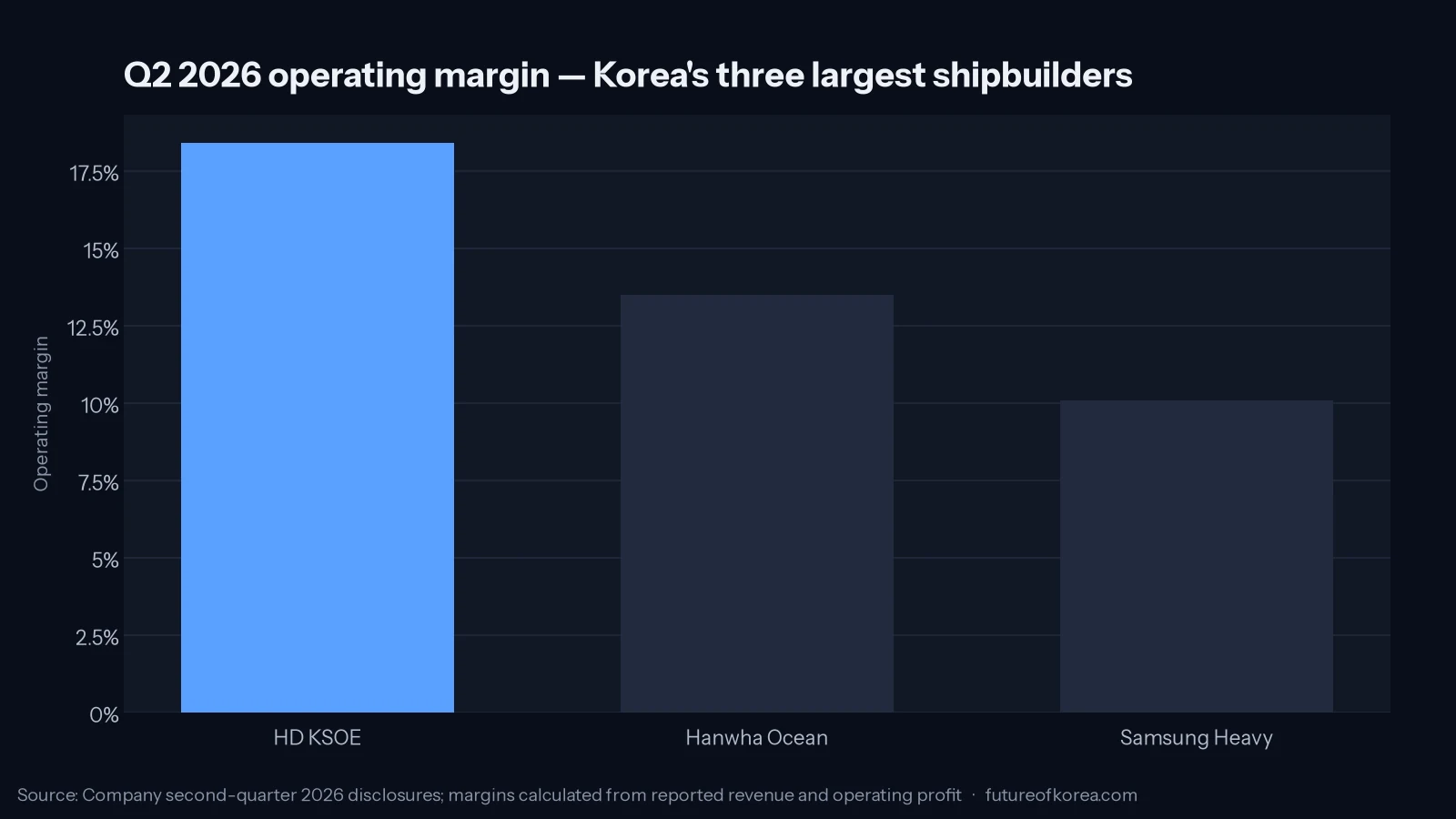
Korea won 17% of the world's ship orders this year. Its yards are making record money anyway.
China books four times Korea's tonnage. Korea books the ships that pay. The second-quarter filings show what that trade is worth — and the backlog shows what it costs.

Korea will charge 90% after your 300th outpatient visit. Last year that was 7,765 people.
The cabinet cut the excess-use threshold from 366 visits a year to 301 on 8 September. Fewer than eight thousand people crossed the old line — which is the clearest sign the rule is not really aimed at them.