Korea won 17% of the world's ship orders this year. Its yards are making record money anyway.
China books four times Korea's tonnage. Korea books the ships that pay. The second-quarter filings show what that trade is worth — and the backlog shows what it costs.
South Korea’s shipyards took 17% of the world’s new ship orders in the first seven months of 2026. China took 75%. And Korea’s three largest builders have just closed the most profitable half-year any of them has had, with a combined operating profit of ₩4.78 trillion — up 72.4% on the same period of 2025.
Both numbers describe the same market. Reconciling them is most of what you need to know about where Korean heavy industry stands.
Tonnage measures work, not money
Clarkson Research counted 50.93 million compensated gross tons of new orders worldwide between January and July, across 1,778 vessels, 65% more tonnage than the same stretch of 2025. Korea booked 8.70 million CGT across 218 ships. China booked 38.02 million CGT across 1,394.
Divide it out. The average vessel Korea took is about 39,900 CGT. The average vessel China took is about 27,300. Korea’s typical order is roughly 46% larger by the industry’s own workload measure, and that gap is not a quirk of one quarter — it is the direct result of which contracts Korean yards agree to sign.
The type mix is where it turns into cash. At the end of July, Clarkson priced a new LNG carrier at $248.5 million, an ultra-large container ship of 22,000 to 24,000 TEU at $259.5 million, and a very large crude carrier at $130.5 million. Those are the berths the Korean yards fill. Bulk carriers and mid-size product tankers, which absorb an enormous amount of tonnage for a fraction of the money, mostly go to China.
The margins came off a book priced three years ago
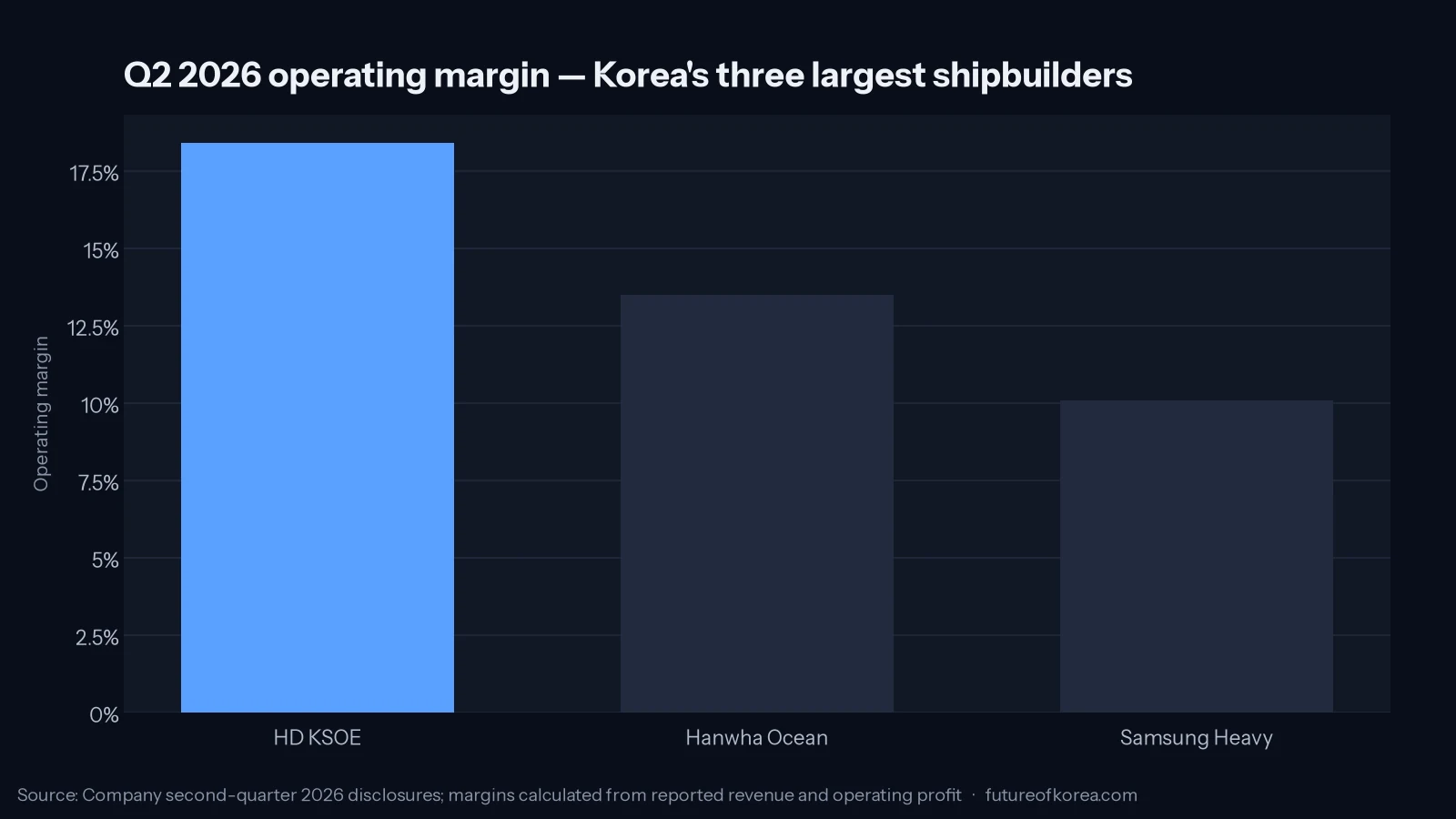
HD Korea Shipbuilding & Offshore Engineering, the intermediate holding company for HD Hyundai’s yards, reported second-quarter revenue of ₩8.927 trillion and operating profit of ₩1.6451 trillion. That is an 18.4% margin against 12.8% a year earlier, and the strongest quarter since the company was formed in June 2019.
| Yard | Q2 2026 revenue | Q2 2026 operating profit | Margin |
|---|---|---|---|
| HD KSOE | ₩8.927tn | ₩1.6451tn | 18.4% |
| Hanwha Ocean | ₩5.4432tn | ₩736.1bn | 13.5% |
| Samsung Heavy Industries | ₩3.23tn | ₩325bn | 10.1% |
Hanwha Ocean’s revenue rose 65.2% and operating profit 98%, flattered by roughly ₩1.5 trillion of offshore project revenue recognised in a single quarter. Samsung Heavy lifted its margin from 7.6% to 10.1%.
Samsung’s is the instructive number, because it came in about 18% below the ₩398.5 billion the analysts had modelled. Performance bonuses and a heavier weighting of overseas tanker work did the damage. Margin at these yards is a function of mix, not of being Korean.
Underneath all three sits the price of the hulls now being handed over. Clarkson’s newbuilding price index closed July at 185.49, 29% above the 143.95 it registered in July 2021. Ships contracted in 2023 and 2024, priced on the way up, are being invoiced against 2026 cost bases. A soft currency helps as well, since the contracts are written in dollars and the welders are paid in won — the same arithmetic that ran through the won’s stubborn weakness in the first half of 2026.
Trade data tracks the deliveries rather than the orders. Ship exports rose 46.9% year on year to $3.29 billion in July, a sixth consecutive monthly increase, driven by LNG carriers and tankers, inside a month when Korea’s total exports hit $98.89 billion — the second-highest figure on record.
The backlog is the part that should bother you
Korea’s order backlog stood at 38.23 million CGT at the end of July, 18% of the world total. It fell by 480,000 CGT during the month. China’s rose by 3.61 million CGT to 140.22 million, or 66% of everything on order anywhere.
Extend that to a year and the divergence stops looking like noise. Korea added 3.03 million CGT of backlog over twelve months. China added 34.64 million — more than eleven times as much.
July was thin for everyone: 3.57 million CGT ordered globally, down 56% from June and 22% below July 2025. Korea took 570,000 CGT of that, 21 ships, 16% of the month. China took 81%.
What decides whether this holds
Prices have stopped climbing quickly. The newbuilding index gained 0.34 points in July, from 185.15 to 185.49. Flat prices with a shrinking book is a different position from rising prices with a growing one, and the yards have roughly a delivery cycle’s worth of time before the difference starts showing in the accounts.
The three companies have guided investors towards ₩60 trillion of revenue and ₩10 trillion of operating profit for the full year. The first half produced ₩31.854 trillion and ₩4.7764 trillion, plus about $31.1 billion of new orders, more than double the first half of 2025. On revenue they are ahead of the run rate. On profit they need the second half to resemble the first, which requires the high-value slots to keep filling at prices that are no longer rising.
Korea’s export economy spent 2026 concentrating rather than spreading out, most visibly in semiconductors, which now account for 47% of exports. Shipbuilding is the counterweight nobody counts — around a thirtieth of monthly export value, but with an order book that fixes revenue years in advance and employs people in Ulsan, Geoje and Okpo rather than in a fab. A thinning backlog is precisely the loss of that quality, and it will show up in the regional economy long before it shows up in a quarterly margin.
Figures current as of 17 August 2026. Order, backlog and newbuilding price data from Clarkson Research to end-July 2026, as reported by The Herald Business on 12 August 2026. July export figures from the Ministry of Trade, Industry and Resources release of 1 August 2026. Second-quarter and first-half results from the three companies’ own disclosures, filed with the Financial Supervisory Service in late July 2026; margins are calculated from reported revenue and operating profit. Nothing here is investment advice — see the disclaimer.
Useful links & tools
Official portals and primary data sources for this topic. Opens in a new tab.
- Clarksons Research — The source of the CGT order, backlog and newbuilding price series every Korean outlet quotes
- DART — Electronic Disclosure System — Where the Korean quarterly and half-year filings themselves live, in full, free
- MOTIR press releases — Monthly export releases in English, including the ship export line, published on the first of each month
- KOSHIPA — The Korean shipbuilders' association — order, delivery and employment statistics for the domestic industry
- KRX Global — Prices and disclosures for the three listed yards, in English
Frequently asked questions
Why does China win most ship orders while Korean yards earn more per ship?
Because tonnage and money are different measures. Compensated gross tonnage weights a hull by type and size to approximate the work involved, and China took 38.02 million CGT of orders between January and July against Korea’s 8.70 million. But the average Korean order was about 39,900 CGT and the average Chinese order about 27,300, because Korea’s yards concentrate on LNG carriers, very large crude carriers and ultra-large container ships. At end-July prices those cost $248.5 million, $130.5 million and $259.5 million respectively — several times a mid-size bulk carrier.
What is compensated gross tonnage and why is it used instead of the number of ships?
CGT is the shipbuilding industry’s workload unit. It takes a vessel’s gross tonnage and applies a coefficient for ship type and size, so that a complex gas carrier counts for more than a simple bulker of the same volume. Clarksons Research and national shipbuilding bodies report order and backlog share in CGT for that reason. It measures how much yard work an order represents, not how much the yard gets paid for it, which is why share-of-CGT and share-of-revenue are not the same number.
Are these Korean shipbuilding profits sustainable into 2027?
The near term is largely fixed, because the ships being delivered now were contracted in 2023 and 2024 when prices were climbing, and Korea holds 38.23 million CGT of backlog. The risk sits further out. Korea’s backlog shrank by 480,000 CGT in July while China’s grew by 3.61 million, and Clarksons’ newbuilding price index has flattened, gaining just 0.34 points during the month. Flat prices plus a thinning book is a different position from rising prices plus a growing one.
Which Korean shipbuilders are listed, and how do they differ?
Three are listed in Seoul. HD Korea Shipbuilding & Offshore Engineering (009540) is the intermediate holding company for HD Hyundai’s yards, including HD Hyundai Heavy Industries, which absorbed HD Hyundai Mipo at the end of 2025. Hanwha Ocean (042660) is the former Daewoo Shipbuilding, now carrying a large offshore and naval component. Samsung Heavy Industries (010140) is the most concentrated of the three in LNG carriers and floating production units. Their quarterly filings are on DART.
Sources & further reading
Every figure in the key takeaways is numbered to the source it was read from. Sources marked primary are the statistics office, central bank, exchange, regulator or filing itself.
- 1July 2026 Exports Reach $98.89 Billion, Second-Highest on Recordprimary — Ministry of Trade, Industry and Resources, 1 August 2026 · verified 2026-08-17
- 2Global shipbuilding orders up 65% in first 7 months; South Korea holds 17% share — The Herald Business, reporting Clarkson Research data to end-July 2026 · verified 2026-08-17
- 3Hanwha Ocean Q2 Operating Profit Jumps 98% to 736.1 Billion Won — Seoul Economic Daily, reporting the company's 27 July 2026 regulatory filing · verified 2026-08-17
- 4South Korea's Big Three Shipbuilders Post Record USD 22.45 Billion Revenue and USD 31.1 Billion in New Orders for H1 2026 — iMarine, 7 August 2026, compiling the three companies' H1 2026 results · verified 2026-08-17
- 5Electronic Disclosure System — quarterly reports of HD KSOE, Hanwha Ocean and Samsung Heavy Industriesprimary — Financial Supervisory Service · verified 2026-08-17
Read next
Korea's defence order book keeps growing. The margins peaked last year.
Three Korean defence contractors reported the second quarter of 2026 within a fortnight of each other. Two of them grew revenue and shrank profit. The order books have never been fuller, and that is not the same thing.

The HBM4 handover: who actually supplies the AI memory in 2026
SK hynix still leads high-bandwidth memory, Micron has overtaken Samsung on some measures, and the HBM4 qualification race for NVIDIA's Rubin platform resets the board. What the share numbers mean and what they don't.

Korea will charge 90% after your 300th outpatient visit. Last year that was 7,765 people.
The cabinet cut the excess-use threshold from 366 visits a year to 301 on 8 September. Fewer than eight thousand people crossed the old line — which is the clearest sign the rule is not really aimed at them.