Korea extended its foreign home-buying permits. The buyers were never in Gangnam.
The Ministry of Land, Infrastructure and Transport kept its capital-region permit zone for another year and added 353 islands. The transaction data underneath shows a policy aimed at Gangnam catching a market in Bucheon.
The Ministry of Land, Infrastructure and Transport said on 20 August that the permit zone covering foreign home purchases in Seoul, most of Gyeonggi and Incheon stays in force for another year, to 25 August 2027. The same day it put 353 outlying islands under a separate permit order, requested by the National Intelligence Service.
Two announcements, one legal instrument, and almost nothing else in common.
What the permit actually catches
Inside the capital-region zone, a foreign buyer must obtain permission from the district office before signing a purchase contract. Not after. A contract signed without it is void, and the Act on Report on Real Estate Transactions provides for up to two years’ imprisonment or a fine of up to ₩20 million.
“Foreign” here is wider than a passport check. Article 2(4) of the Act reaches non-Korean individuals, entities incorporated under foreign law, and — the clause that catches institutional buyers out — Korean-registered companies in which foreigners hold half or more of the capital or half or more of the voting rights. A Seoul-domiciled REIT with a majority overseas sponsor applies for the same permission as an individual.
The size thresholds are small enough to be effectively universal: any residential land share above 6㎡, or above 15㎡ in a commercial zone. Covered types are detached houses, multi-family houses, row houses, multiplex houses and apartments, as classified in the Building Act enforcement decree. Officetels are not on that list.
Geography barely moved. All 25 Seoul districts. Twenty-three Gyeonggi cities and counties — Yangju, Icheon, Uijeongbu, Dongducheon, Yangpyeong, Yeoju, Gapyeong and Yeoncheon are outside. Incheon appears as nine autonomous districts rather than last year’s seven, which is bookkeeping: the city split Jung-gu and Seo-gu into new districts on 1 July, its first redraw in 31 years.
The number the ministry led with, and the one underneath it
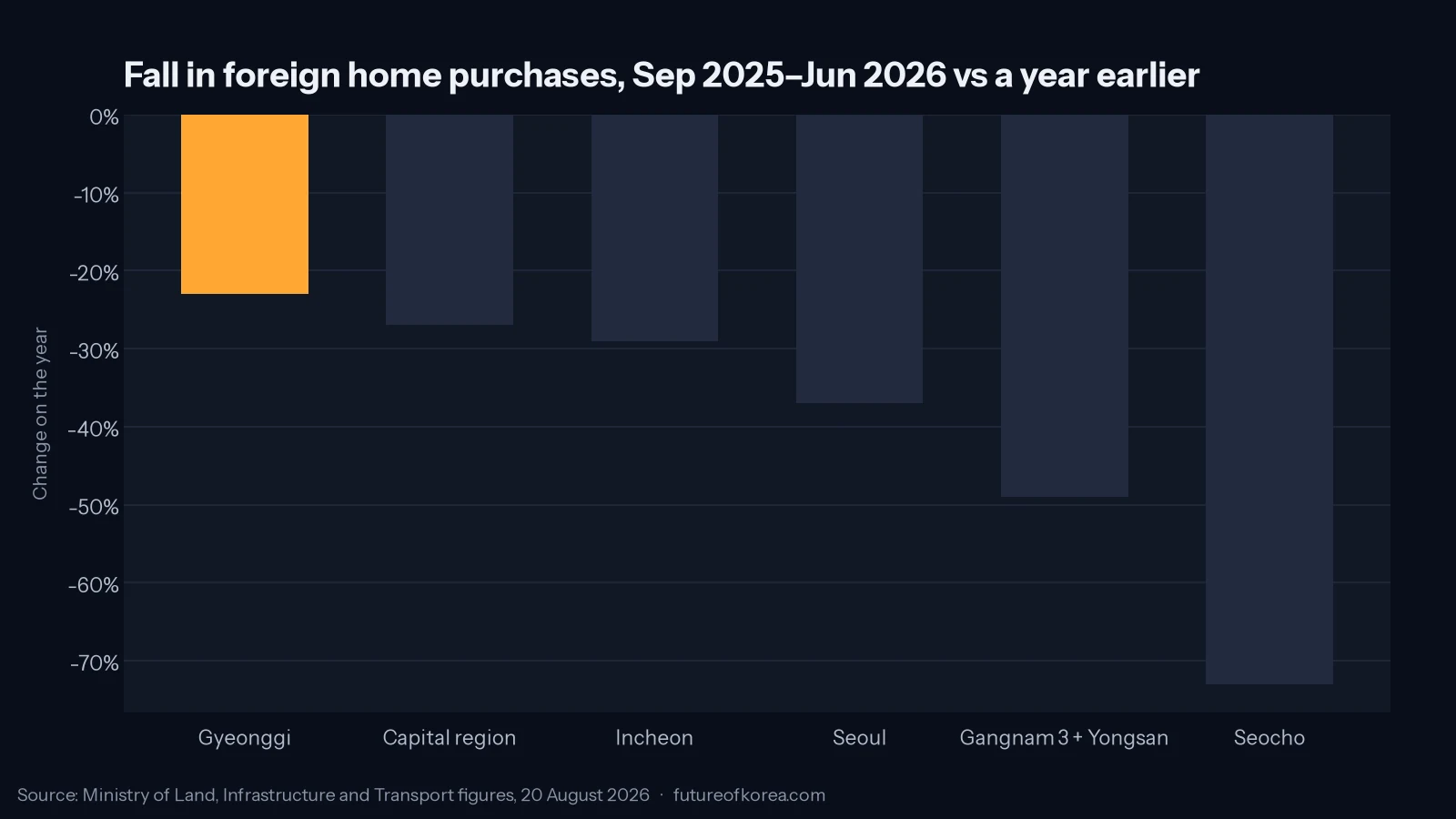
From September 2025 to June 2026, foreigners bought 4,397 homes in the capital region, against 6,024 in the same ten months a year earlier. Down 27%. Seoul fell 37%, Incheon 29%, Gyeonggi 23%. Across the three Gangnam districts and Yongsan the fall was 49%; in Seocho alone, 73%. American buying dropped 40% and Chinese buying 24%, though Chinese nationals still accounted for 72% of all foreign purchases against America’s 13%.
Now the composition of those 4,397 transactions.
Gyeonggi took 66% of them. Seoul and Incheon 17% each. Eighty-one per cent were homes priced at ₩600 million or below. Apartments were 62% of the total and multiplex units another 33%.
The steepest declines landed where the least activity was. Seocho’s 73% is a large percentage of a small number. What foreign home-buying in Korea mostly consists of is a mid-priced flat near an industrial complex — Bucheon, Ansan, Suwon, Siheung, Pyeongtaek, Bupyeong in Incheon — bought by someone who works there.
The stock data agrees. MOLIT’s end-2025 count, published on 29 May, puts foreign-owned homes at 108,231, or 0.55% of Korea’s 19.65 million dwellings. Gyeonggi holds 42,000 of them, Seoul 25,000, Incheon 11,000. Chinese nationals own 61,000, Americans 23,000, Canadians 6,500. Foreign-held land runs to 270,176 thousand square metres, 0.27% of the country, and 21.7% of that area by use is industrial.
None of which makes the designation pointless. The government’s stated worry was specific: a buyer funding a purchase from abroad sits outside the lending caps that bind everyone else, and Korea has spent this year tightening those caps hard as households pile into floating-rate mortgages while the Bank of Korea raises rates. Closing a channel that bypasses a rule is defensible on its own terms. It is just a much smaller channel than the Seocho headline implies, and the permit falls on 4,397 transactions to reach the few hundred anyone was actually arguing about.
The islands are a different policy wearing the same clothes
The 353-island order borrows the permit mechanism and nothing else. It came from the National Intelligence Service through interagency consultation, cleared the Central Urban Planning Committee, and is about title to land near the territorial baseline. Ulleungdo is the largest at 72.3㎢, followed by Daeheuksando at 21.2㎢ and Deokjeokdo at 20.8㎢. Two earlier rounds — eight baseline islands in December 2014, another seventeen including the five West Sea islands in February 2025 — had brought the running total to 25.
One measure asks whether offshore money is inflating Seoul apartment prices. The other asks who holds the deed next to a naval approach. Filing them under the same phrase makes the second look like housing policy, which it is not.
The designation is annual. It has now been renewed once, on unchanged boundaries, which is the pattern of a measure the ministry intends to keep rather than unwind. The next renewal falls due in August 2027, and the interesting question is not whether it survives but whether the officetel gap and the ₩600-million median finally get addressed — either by widening the property types or by admitting the zone is drawn around the wrong postcode.
Figures current as of 21 August 2026, sourced to the ministry releases and data portals listed below.
Useful links & tools
Official portals and primary data sources for this topic. Opens in a new tab.
- 국토교통 통계누리 — MOLIT Statistics Nuri — The ministry's own data portal, where the foreign land and housing ownership series is published twice a year
- 실거래가 공개시스템 — Actual Transaction Price Disclosure — Every reported sale price and rent in Korea, by building and by month; the check to run before agreeing any price
- 부동산거래관리시스템 (RTMS) — Where transaction reports and land transaction permit applications are filed and tracked
- 국가법령정보센터 — Korea Law Information Center — The statute and its enforcement decree in force, in Korean and in official English translation
- 대한민국 정책브리핑 — Policy Briefing — Ministry press releases in full, usually the same day they are issued
Frequently asked questions
Can a foreigner still buy a home in Seoul in 2026?
Yes, but not freely. Every one of Seoul’s 25 districts sits inside the foreign land transaction permit zone until 25 August 2027, so a non-Korean buyer must apply to the district office and be granted permission before signing a purchase contract. Permission is given for the buyer’s own residence, which rules out a purely investment purchase. The application asks where the money is coming from, including overseas funding, and what visa the applicant holds.
Does an F-2 or F-5 visa exempt you from the permit?
No. The permit regime keys off nationality, not residence status, so a long-term resident or permanent resident who has not naturalised is still a foreigner for these purposes and still needs permission. The category is wider than passports: under Article 2(4) of the Act on Report on Real Estate Transactions it also covers entities formed under foreign law, and Korean-registered companies in which foreigners hold at least half the capital or half the voting rights.
Are officetels covered by the permit requirement?
Not by this designation. The covered property types are detached houses, multi-family houses, row houses, multiplex houses and apartments, as classified under the Building Act enforcement decree. An officetel is registered as a business-use building rather than housing, so it falls outside that list. That gap is well known and worth watching, because the designation is renewed annually and its scope can be redrawn each time.
What happens if you sign a contract without the permit?
The contract is void — not voidable, not curable after the fact. Ownership never transfers, and the buyer is left pursuing a refund from the seller rather than holding a home. On top of that the Act provides for up to two years’ imprisonment or a fine of up to ₩20 million. Because the permit must be obtained before signing, a deposit paid on a handshake in a covered district is money at risk.
Sources & further reading
Every figure in the key takeaways is numbered to the source it was read from. Sources marked primary are the statistics office, central bank, exchange, regulator or filing itself.
- 1외국인등의 토지거래 허가구역 지정 고시 (Notice designating land transaction permit zones for foreigners)primary — Ministry of Land, Infrastructure and Transport · verified 2026-08-21
- 2ACT ON REPORT ON REAL ESTATE TRANSACTIONS, ETC. (official English translation)primary — Korea Law Information Center, Ministry of Government Legislation · verified 2026-08-21
- 3국토교통 통계누리 — 외국인 토지·주택 보유통계 (Foreign land and housing ownership statistics, end-2025)primary — Ministry of Land, Infrastructure and Transport, published 29 May 2026 · verified 2026-08-21
- 4서울시 전역, 인천시 7개 구, 경기도 23개 시·군 외국인 토지거래허가구역 지정 (original designation press release)primary — Ministry of Land, Infrastructure and Transport, August 2025 · verified 2026-08-21
- 5외국인 토지거래허가구역 1년 연장… 외곽 섬 353곳도 새로 묶는다 — Money Today, August 2026 · verified 2026-08-21
- 6외국인 토지거래허가구역 1년 연장…수도권 주택거래 27% 줄어 — EBN, August 2026 · verified 2026-08-21
- 7국내 외국인 집주인 10만8231가구…중국인 비중이 56.4% — Money Today, May 2026 · verified 2026-08-21
- 8수도권 내 주택 등에 대한 외국인 토지거래허가 제도 시행 — Kim & Chang, August 2025 · verified 2026-08-21
- 9실거주 안하는 외국인, 서울 등 수도권 주택 구입 불가 — Korean Culture and Information Service, August 2025 · verified 2026-08-21
Read next

Korea will charge 90% after your 300th outpatient visit. Last year that was 7,765 people.
The cabinet cut the excess-use threshold from 366 visits a year to 301 on 8 September. Fewer than eight thousand people crossed the old line — which is the clearest sign the rule is not really aimed at them.
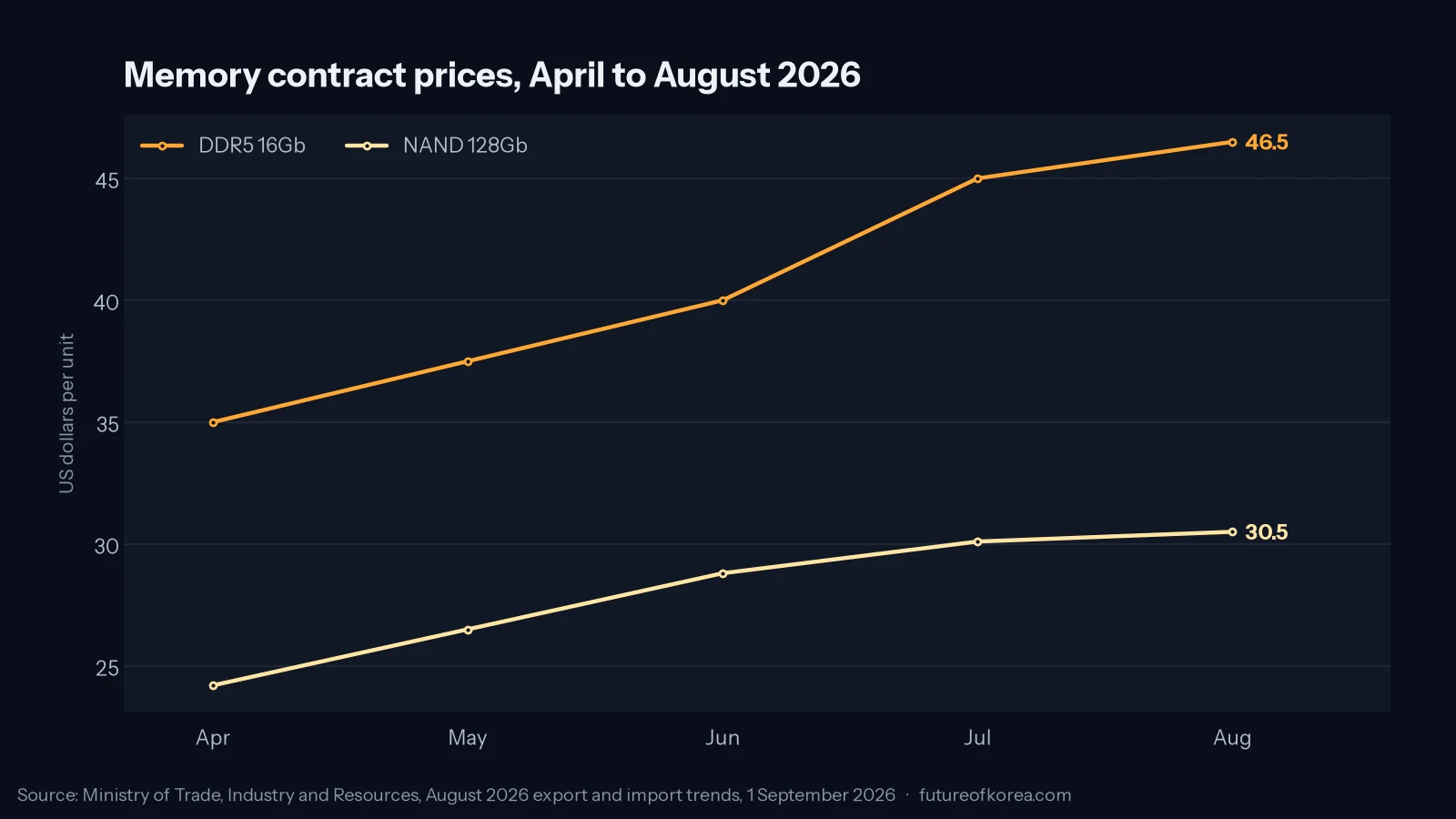
Korea's exports grew 68.7% in August. Strip out three product lines and they grew 2%.
August was Korea's third-biggest export month on record and produced a $34.75bn trade surplus. Almost the entire year-on-year gain came from three lines, and all three are priced rather than produced.
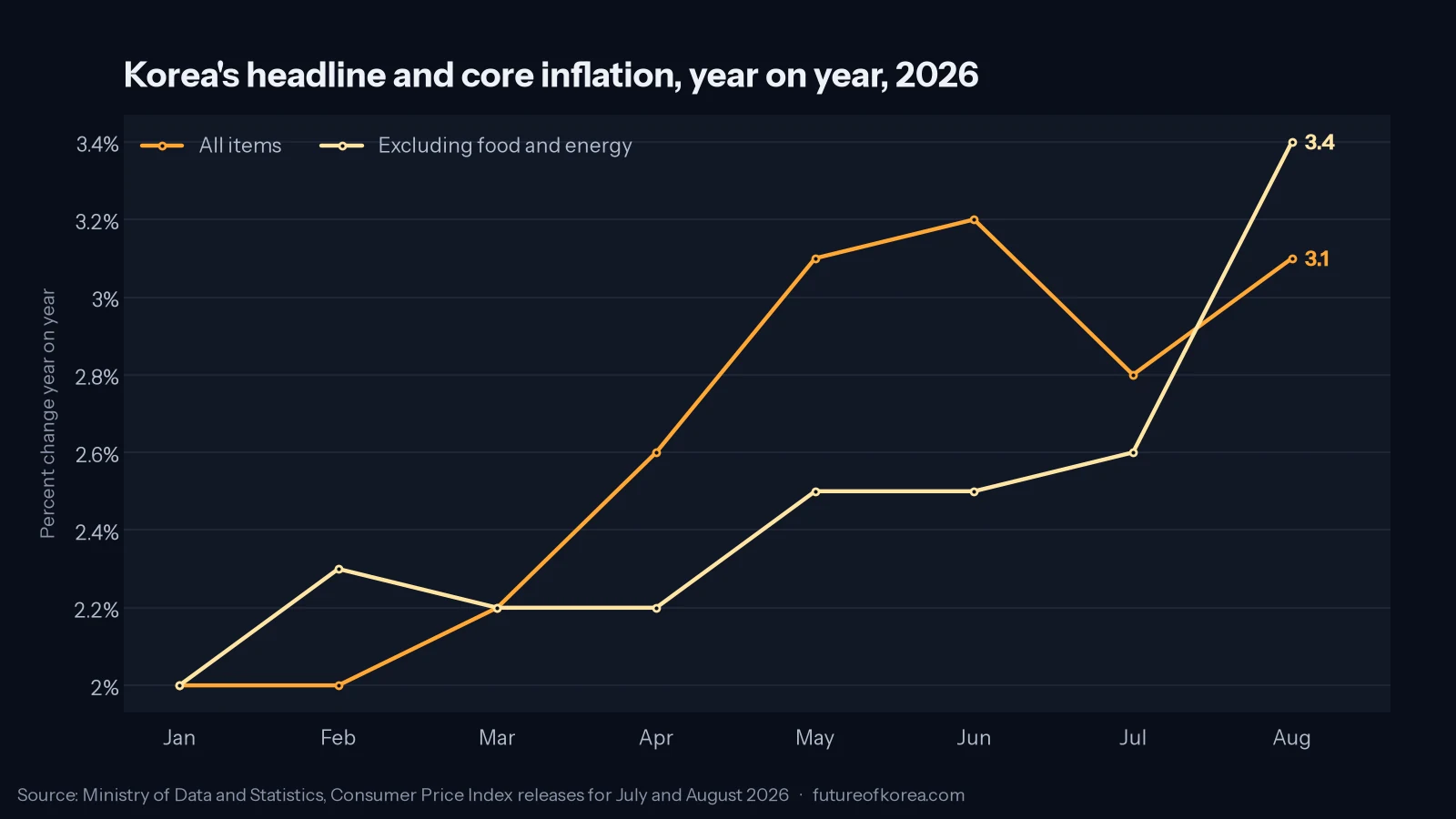
Korea's core inflation hit 3.4%. A phone bill from last August did most of it.
Consumer prices rose 3.1% in August and core inflation rose 3.4%, the sharpest one-month acceleration of the year. Strip out a single expenditure group and the same data show inflation falling.