Korea raised the tax on selling shares in 2026 — without a vote in parliament
The tax on a KOSPI sale went from 0.15% to 0.20% on 1 January. It moved by cabinet decree, because that is where Korea's securities transaction tax rate has lived for years.
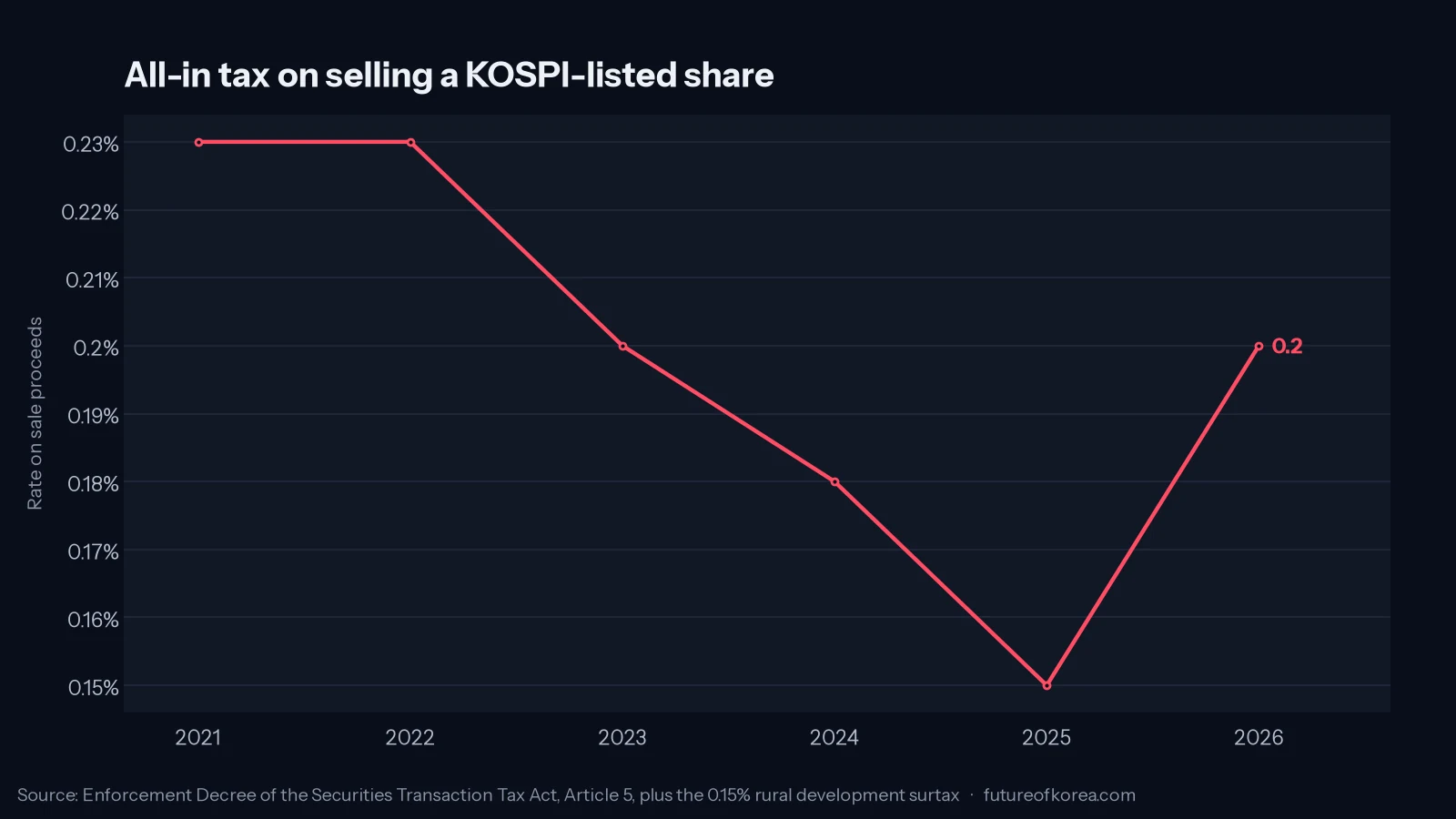
Since 1 January 2026, selling a KOSPI-listed share costs 0.20% of the proceeds. It cost 0.15% for the whole of 2025. The increase arrived in a Presidential Decree signed on 31 December, applies to every seller — Korean, foreign, retail, institutional — and required no vote in the National Assembly.
That last part is not a procedural footnote. It is the design.
Article 8 of the Securities Transaction Tax Act fixes the rate at 0.35% and then, in its second paragraph, hands the government a lever: where it is judged urgently necessary to develop the capital market, the rate may be lowered or set at zero for exchange-traded shares, board by board, by Presidential Decree. Every rate a Korean investor has actually paid in years has been a number in that decree rather than in the statute. So the rate can move again, quickly, and the only place to read it is a document most investors have never opened.
What the decree now says
Article 5 of the enforcement decree, as amended on the last day of 2025, sets three rates. Add the rural development surtax that rides on KOSPI sales and the picture looks like this.
| Where the shares trade | Transaction tax | Rural surtax | Total paid by the seller |
|---|---|---|---|
| KOSPI | 0.05% | 0.15% | 0.20% |
| KOSDAQ and K-OTC | 0.20% | — | 0.20% |
| KONEX | 0.10% | — | 0.10% |
| Unlisted shares | 0.35% | — | 0.35% |
The two main boards land in the same place, as they have for years. Whenever Seoul cut the KOSPI transaction tax it cut KOSDAQ by the same number of basis points, and the surtax that applies only to KOSPI kept the totals level. What changed in January was the level itself, not the balance between the boards.
The tax was being dismantled. Then the thing it was traded for died.
The path down was deliberate and staged: 0.23% in 2021 and 2022, 0.20% in 2023, 0.18% in 2024, 0.15% in 2025. Read as a series it looks like a government quietly making its market cheaper to trade.
It was not that. It was the consideration in a bargain.
Korea legislated a financial investment income tax in 2020 — a tax on realised gains, of the kind most developed markets run — and the transaction tax was supposed to shrink as the gains tax phased in. Start date 2023, then deferred to 2025. Retail investors organised against it, both major parties eventually campaigned against it, and on 10 December 2024 the National Assembly voted it out of existence before it ever collected a won.
That left the concession without the trade. Through 2025 Korea taxed neither KOSPI turnover, in any meaningful sense, nor gains on listed shares held by ordinary investors. A cut made as the price of a gains tax that no longer exists is a straightforward thing to reverse, and in December the government reversed roughly a third of it.
What 0.20% actually costs
Not much, once. Sell ₩10 million of stock and ₩20,000 goes to the state — less than the spread on a thinly traded small cap, comparable to what a full-service broker charges in commission.
The number bites at frequency, not at size. It is charged on every sale, so a strategy that turns its book over ten times a year pays 2% of the portfolio annually before commissions, and pays it whether or not the year made money. That is the feature investors most often miss. The tax base under Article 7 is the transfer value, not the gain. Sell at a loss and you still pay.
For a long-term holder this is close to noise, which is roughly the point of a transaction tax: it prices frequency. Anyone weighing the routes into Korean equities from abroad should note that it also prices venue. The tax attaches to the transfer of a Korean share certificate. Sell an American depositary receipt or an offshore ETF and no Korean transaction tax arises, because no Korean share certificate changed hands — a difference of 20 basis points a round trip that compounds for anyone rebalancing often, and one of the few places where the wrapper genuinely matters.
The larger line on a foreign investor’s statement
Transaction tax is rarely the biggest number a non-resident pays on Korean shares. Dividends are.
Without treaty relief, a dividend to a non-resident is withheld at 20% national tax plus a local surtax of 10% of that — 22% all in. Treaty rates cut it, unevenly. A UK or Japanese portfolio holder gets 15% and no surtax. A US resident gets the 15% treaty rate but Korea’s local surtax still rides on top, for 16.5%. On a 3% yield, the gap between 16.5% and 22% is worth more each year than the transaction tax on a full round trip.
And the paperwork changed this year in a way that matters. Treaty relief has never been automatic in Korea — it requires an application and a certificate of residence lodged with the payer before the dividend is paid. From 1 January 2026 the withholding agent must also file that application with the district tax office by the end of February of the following year. In practice the burden lands on the custodian, and the failure mode is familiar: no current residence certificate on file, 22% withheld, and a refund claim that takes far longer than the dividend did.
The transaction tax is the part everyone can see and the part that costs least. It is also the part that can change on 31 December with no debate, which is why the enforcement decree is worth a bookmark. Korea spent five years cutting this tax to buy a reform, lost the reform, and took most of the cut back in a single line of secondary legislation. Nothing in the statute stops the same lever moving the other way the next time the KOSPI has a bad year and Seoul wants to look supportive.
Figures current as of 20 August 2026. Rates verified against the Securities Transaction Tax Act and its enforcement decree at the National Law Information Center, and cross-checked against PwC Worldwide Tax Summaries. Tax treatment depends on your residence and your holding; this is journalism, not tax advice.
Useful links & tools
Official portals and primary data sources for this topic. Opens in a new tab.
- National Law Information Center — The government's own statute database — the enforcement decree here is the only authoritative statement of the current rate
- Korea Legislation Research Institute — English statutes — English translation of the Securities Transaction Tax Act; useful for structure, but the rates in it lag the Korean text
- DART — Electronic Disclosure System — Dividend declarations and record dates for every listed Korean company, free and in full
- KRX Global — Prices, indices and market statistics for the KOSPI, KOSDAQ and KONEX boards in English
Frequently asked questions
Who pays Korea's securities transaction tax, the buyer or the seller?
The seller. Article 9 of the Securities Transaction Tax Act requires the taxpayer — the central securities depository for exchange trades, or the brokerage for most other transfers — to collect the tax from the transferor at settlement. Buying Korean shares carries no transaction tax at all. Because it is withheld at settlement rather than billed, most investors never see it as a separate line and only notice it in the difference between the price they sold at and the cash that arrived.
Does the transaction tax apply to foreign investors buying Korean shares from abroad?
Yes. The tax attaches to the transfer of Korean share certificates, not to the residence of the person transferring them, so a foreign investor selling Samsung Electronics through a Seoul broker or an overseas custodian pays the same 0.20% as a Korean retail account. The one route around it is not holding the Korean line at all — an American depositary receipt or an offshore ETF is a different security, and selling it is not a transfer of a Korean share certificate.
Why do some sources say the KOSPI rate is 0.05% and others say 0.20%?
Both are right, and they are describing different taxes. The securities transaction tax on a KOSPI sale is 0.05% under Article 5 of the enforcement decree. Riding on the same sale is a separate 0.15% levy earmarked for rural and fishing communities, which has applied to KOSPI transfers for years and was untouched in December. Add them and the seller pays 0.20%. KOSDAQ carries no surtax, so its whole 0.20% is securities transaction tax.
Can the rate change again without a new law?
It can, in one direction. Article 8 of the Securities Transaction Tax Act sets the rate at 0.35% and lets a Presidential Decree lower it or set it to zero for exchange-traded shares where that is judged urgently necessary to develop the capital market. Anything at or below 0.35% is therefore a cabinet decision. Going above 0.35% would require the National Assembly to amend the Act itself.
Sources & further reading
Every figure in the key takeaways is numbered to the source it was read from. Sources marked primary are the statistics office, central bank, exchange, regulator or filing itself.
- 1증권거래세법 시행령 제5조 (Enforcement Decree of the Securities Transaction Tax Act, Article 5 — flexible tax rates)primary — National Law Information Center, Ministry of Government Legislation — text in force from 2 January 2026, Article 5 as amended 31 December 2025 · verified 2026-08-20
- 2증권거래세법 제7조·제8조·제9조 (Securities Transaction Tax Act — tax base, tax rate, collection)primary — National Law Information Center, Ministry of Government Legislation · verified 2026-08-20
- 3Korea, Republic of — Corporate — Other taxes — PwC Worldwide Tax Summaries, last reviewed 4 June 2026 · verified 2026-08-20
- 4Korea, Republic of — Corporate — Withholding taxes — PwC Worldwide Tax Summaries, rates stated as of January 2026, last reviewed 4 June 2026 · verified 2026-08-20
Read next
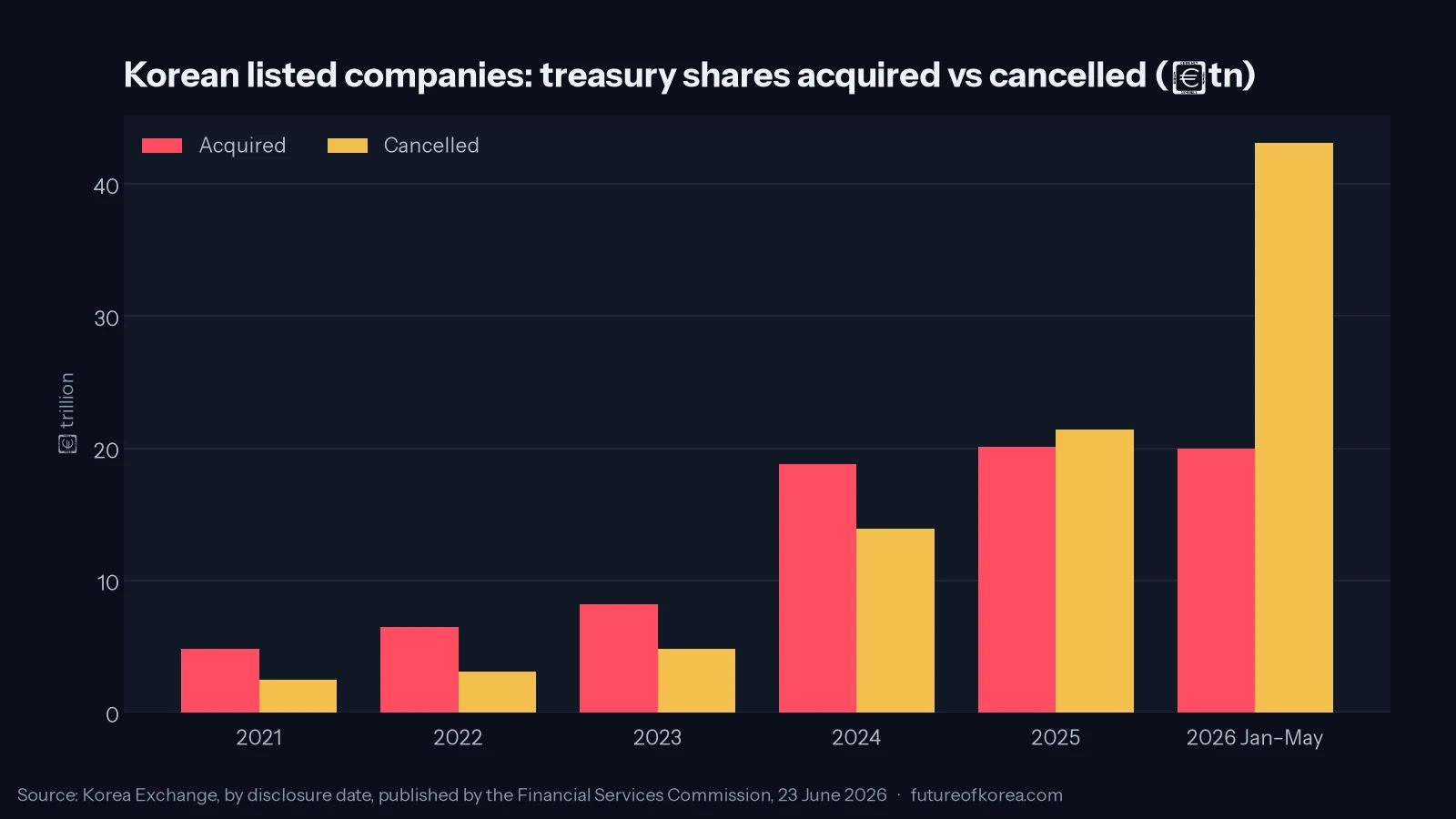
Korean companies cancelled ₩43.1tn of their own shares in five months — and bought only ₩20tn
A law that took effect on 6 March 2026 turned the treasury share from a control device into a countdown. Companies have until September 2027 to empty the vault, and the Korea Exchange numbers show them doing it faster than they are refilling it.
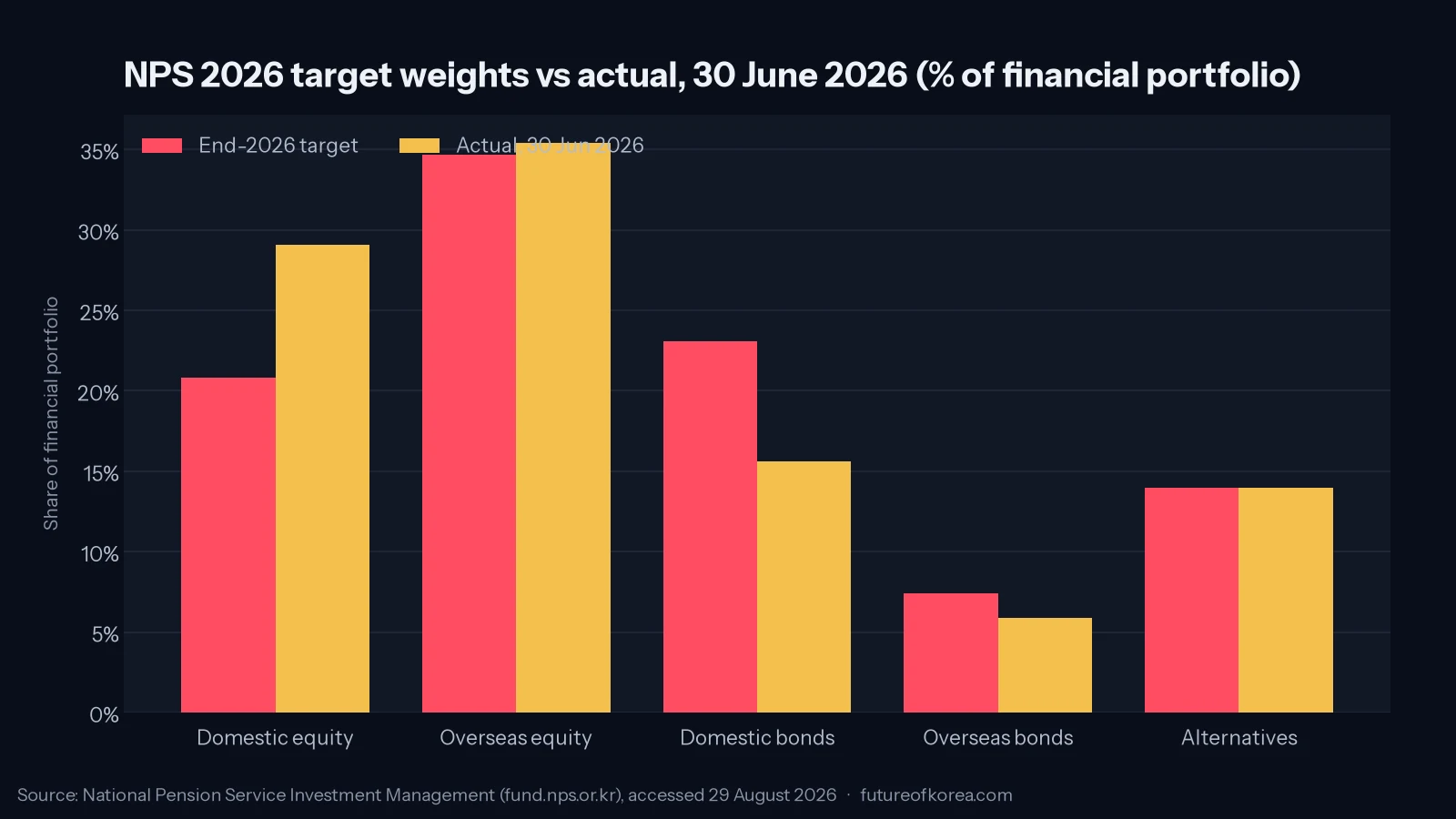
The National Pension Service raised its Korea target to 20.8%. It was already holding 29.1%.
On 28 May the National Pension Service raised its 2026 target weight in Korean shares from 14.9% to 20.8%. Five weeks later the fund held 29.1%. The gap, and what the fund is quietly underweight, matter more than the headline.
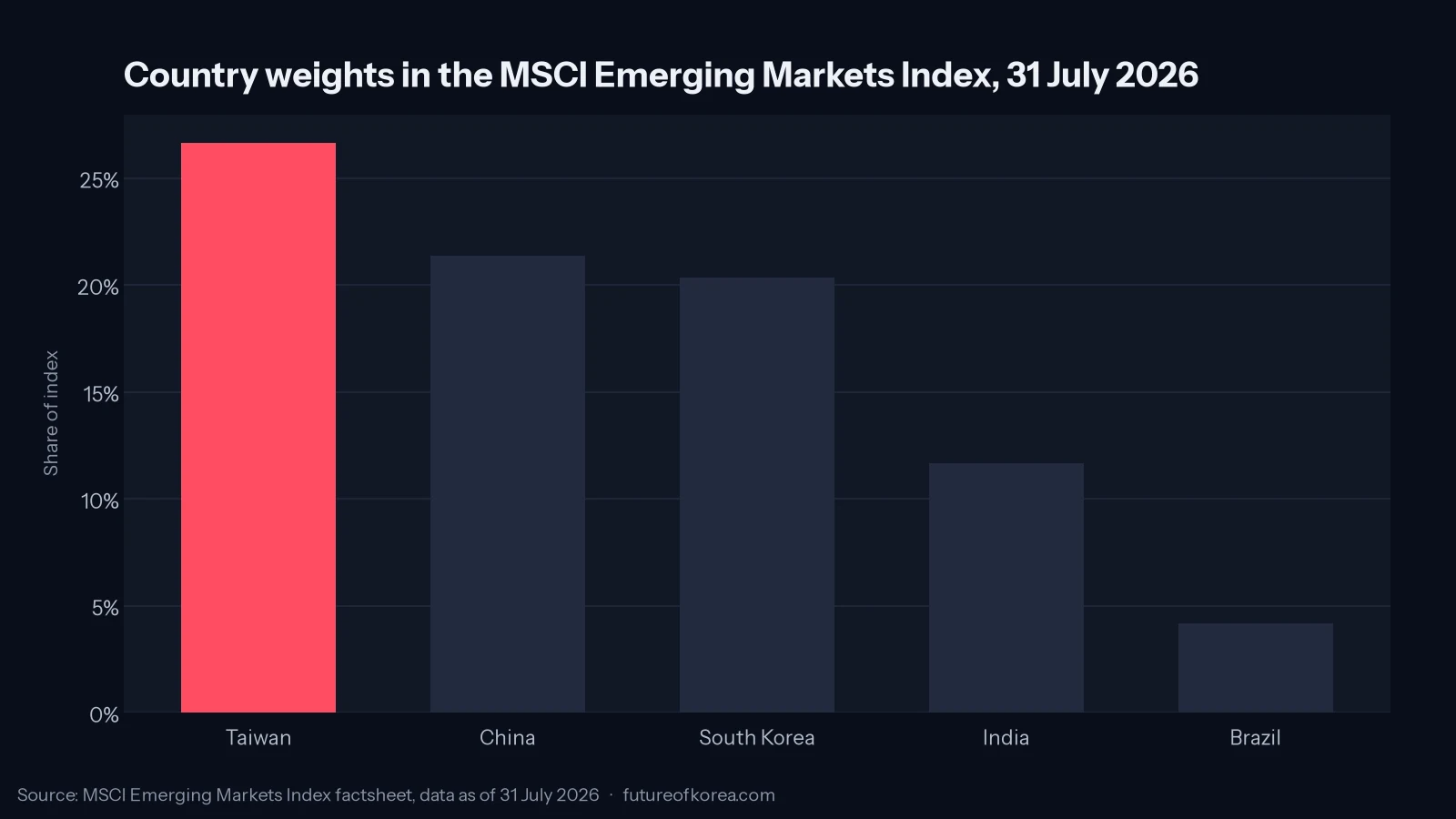
FTSE calls Korea a developed market. MSCI still calls it emerging.
Two index providers look at the same exchange and reach opposite conclusions. The disagreement is about the won, and the arithmetic of an upgrade is less flattering than the campaign for one suggests.