How to buy Korean stocks from abroad in 2026: ADRs, ETFs and direct access, compared
Four realistic routes into Korean equities for a non-resident investor — ADRs, US-listed ETFs, local-listed ETFs and a direct KRX account — with the costs, tax treatment, currency exposure and access frictions of each.
Photograph by Alesia Kozik on Pexels.
After the year Korean equities have had, the question arriving in our inbox most often is the least glamorous one: how do I actually buy this?
It is a fair question, because the answer is genuinely non-obvious and most of the advice online is several years out of date. Korea spent a decade with a reputation as a difficult market for foreigners. Much of that reputation is now wrong. Some of it is still true. Here is the current state of play, as of August 2026.
Read the disclaimer first: none of this is investment advice, and the Korean market has just demonstrated exactly how violent it can be.
The four routes, at a glance
| Route | Access effort | Costs | FX exposure | Tax admin | Who it suits |
|---|---|---|---|---|---|
| US/EU-listed Korea ETF | Buy in your existing account | 0.09–0.70% expense ratio | Unhedged by default | None beyond your normal filing | Almost everyone |
| ADR / GDR of a single Korean company | Buy in your existing account | Brokerage + ADR fee | Embedded, unhedged | Withholding handled by depositary | Anyone wanting a specific large cap that has one |
| Korea-listed ETF via international broker | Needs KRX market access | Low TER, but FX + custody | Direct KRW | Possible local filing | Investors wanting Korea-domiciled products |
| Direct KRX brokerage account | Registration + FX account | FX spread, custody, commission | Direct KRW | Withholding, possible filing | Larger accounts, single-stock strategies |
Route 1 — Korea ETFs (where most people should stop)
The cleanest exposure for a non-resident is a Korea equity ETF listed on your own exchange. In the US, the long-established option is the iShares MSCI South Korea ETF (EWY); European investors have UCITS equivalents from the major issuers.
What you are actually buying. Understand this before you press the button: a broad Korea ETF is overwhelmingly a semiconductor position. Samsung Electronics and SK hynix dominate the index, and in 2026 they drove almost the entire move — up and then down. A “Korea allocation” that is really a two-stock memory bet is fine as long as you know that is what it is.
The main advantages are the boring ones that matter: same-day liquidity in your own currency, no local registration, no Korean tax filing, no FX account, no custody arrangement, and a total expense ratio that is trivially small next to the frictions of the alternatives.
Route 2 — ADRs, and the Samsung problem
An American Depositary Receipt lets you buy a foreign company on a US exchange in dollars. Several Korean names have them: KB Financial Group (KB), Shinhan Financial Group (SHG), POSCO Holdings (PKX), Korea Electric Power (KEP) and LG Display (LPL) all carry NYSE-listed ADRs.
And then there is the question everyone asks.
The same caution applies to SK hynix, which likewise lacks a mainstream US listing.
Route 3 and 4 — going direct to the KRX
This is where the outdated advice bites. For years, every guide told foreign investors they needed an Investment Registration Certificate from the Financial Supervisory Service before they could trade. That requirement was abolished in 2023, as part of the access reforms Korea undertook while pursuing developed-market index reclassification. Institutions now identify with a Legal Entity Identifier; individual non-residents register through their broker.
What you still need, in practice:
- A broker with genuine KRX market access. Several large international brokers offer this; many do not. Ask specifically whether they route to the Korea Exchange rather than to an OTC line.
- A KRW settlement arrangement. Your broker converts and holds won. The FX spread here is frequently the largest single cost of the whole exercise and is rarely disclosed prominently — compare the rate you are given against the Bank of Korea reference rate.
- Custody. Handled through the Korea Securities Depository, usually invisibly via your broker.
- Tax documentation. So that dividend withholding is applied at your treaty rate rather than the full domestic rate.
Trading runs 09:00–15:30 KST, with settlement on a T+2 basis. Korea also operates daily price limits and index-level circuit breakers — a feature the market exercised repeatedly in July and August 2026, as we covered in the 2026 crash explainer.
The three costs people underestimate
1. The FX spread. On a direct account, converting dollars to won and back can cost more than a year of ETF fees. Ask for the rate, compare it to the Bank of Korea reference, and convert in fewer, larger blocks.
2. Withholding tax leakage. Korea withholds tax on dividends paid to non-residents at source. Treaties reduce this materially, but only if your custodian has filed the right paperwork. If your dividend arrives smaller than you expected, this is usually why. Confirm the applied rate with your broker; the National Tax Service publishes the treaty network.
3. Currency, which is not a cost but behaves like one. USD/KRW was around 1,415 on 12 August 2026. The won weakened through much of the year despite strong exports, then strengthened by roughly 5.5% over the preceding month. Over a one-to-two-year horizon that move can easily exceed the equity return you are trying to capture. Decide deliberately whether you want it.
A decision rule
- Investing under ~$25,000, want Korea exposure: buy a Korea ETF in your own market. The direct route’s fixed costs will not amortise.
- Want a specific large-cap financial or industrial: check whether it has an NYSE ADR. Several do, and they are genuinely convenient.
- Want Samsung or SK hynix specifically: ETF, or a broker with real KRX access. Do not use the OTC ticker.
- Running a concentrated Korea book, or hunting small and mid caps: open the direct account. The 2023 reforms have made this much less painful than the internet believes.
- Worried about the won: look for a currency-hedged share class before assuming you have to wear the exposure.
What to read next
Before sizing anything, understand what you are actually buying exposure to. Korea’s index is a memory-semiconductor bet in practice — our piece on the HBM4 handover covers the competitive position underneath it, and the won explainer covers the currency leg, including the FX market infrastructure changes arriving in September 2026 that may make direct access materially easier.
Rules, rates and market structure in Korea change frequently. Everything here is current as of 12 August 2026 and linked to its primary source. Verify before you act, and speak to a licensed adviser and a tax professional in your own jurisdiction.
Useful links & tools
Official portals and primary data sources for this topic. Opens in a new tab.
- Korea Exchange — foreign investor information (English) — Official market rules, trading hours, settlement cycle and listing data.
- Financial Supervisory Service — DART disclosure system — Every listed Korean company's filings. The English portal covers major disclosures.
- National Tax Service — international taxation (English) — Withholding rates and Korea's double-taxation treaty network. English helpline: 126.
- Bank of Korea — exchange rate statistics — Official USD/KRW series, for checking what your broker's FX spread is really costing you.
- Korea Securities Depository (KSD) — Custody and settlement mechanics for non-resident holdings.
Frequently asked questions
Can I just buy Samsung Electronics from a US brokerage account?
Not cleanly. Samsung Electronics does not maintain a sponsored ADR listed on the NYSE or Nasdaq. The ticker people find — SSNLF — is an unsponsored over-the-counter line that trades thinly, often with a wide spread and stale pricing, and many brokers restrict or refuse it. The realistic routes to Samsung exposure are a Korea ETF (where it is typically the largest holding), a broker offering true international market access to the KRX, or a London/Frankfurt-listed GDR where available.
Do I still need an Investment Registration Certificate?
No. Korea removed the IRC requirement for foreign investors in 2023 as part of the market-access reforms aimed at index reclassification. Foreign institutions now identify using a Legal Entity Identifier, and individual non-residents register through their broker. The IRC is one of the most persistent pieces of outdated advice on the internet about this market.
Which is better, EWY or a direct account?
For nearly everyone reading this in English from outside Korea: the ETF. A US-listed Korea ETF gives you same-day liquidity, dollar settlement, no local tax filing, no FX account, and an expense ratio typically well under 0.7%. A direct KRX account is worth the friction only if you need single-stock precision, want small and mid caps the ETF doesn’t hold, or are investing enough that the fee saving outweighs several hours of paperwork and ongoing tax complexity.
How is my dividend taxed?
Korea applies withholding tax at source on dividends paid to non-residents. The headline domestic rate is reduced under most double-taxation treaties — commonly to 15% for portfolio holdings — but the applicable rate depends on your country of residence and on your broker having filed the correct treaty documentation on your behalf. Confirm the rate your custodian is actually applying; if it is withholding at the full domestic rate because paperwork is missing, you are leaving money behind. This is general information, not tax advice.
Is currency risk hedged in these products?
Usually not. Standard Korea ETFs are unhedged, so your return is the local equity return multiplied by the KRW/USD move. Currency-hedged share classes exist in some markets. Given how much the won moved in 2026, this is a decision to make deliberately rather than by default.
What is the minimum realistic amount to invest?
Via an ETF, one share — typically double-digit dollars. Via a direct KRX account, the practical floor is much higher because account opening, FX conversion spreads and custody costs are fixed rather than proportional. Below roughly $25,000 the direct route rarely justifies itself.
Sources & further reading
Every figure in the key takeaways is numbered to the source it was read from. Sources marked primary are the statistics office, central bank, exchange, regulator or filing itself.
- 1Market data portal — listings, indices and foreign investor rulesprimary — Korea Exchange · verified 2026-08-13
- 2Foreign investor access to Korean capital markets — Korea Economic Institute of America · verified 2026-08-13
- 3South Korea stock market — historical index data — Trading Economics · verified 2026-08-13
- 4Weak South Korean won meets first Bank of Korea rate hike since 2023 — Best Exchange Rates, 2026 · verified 2026-08-13
Read next
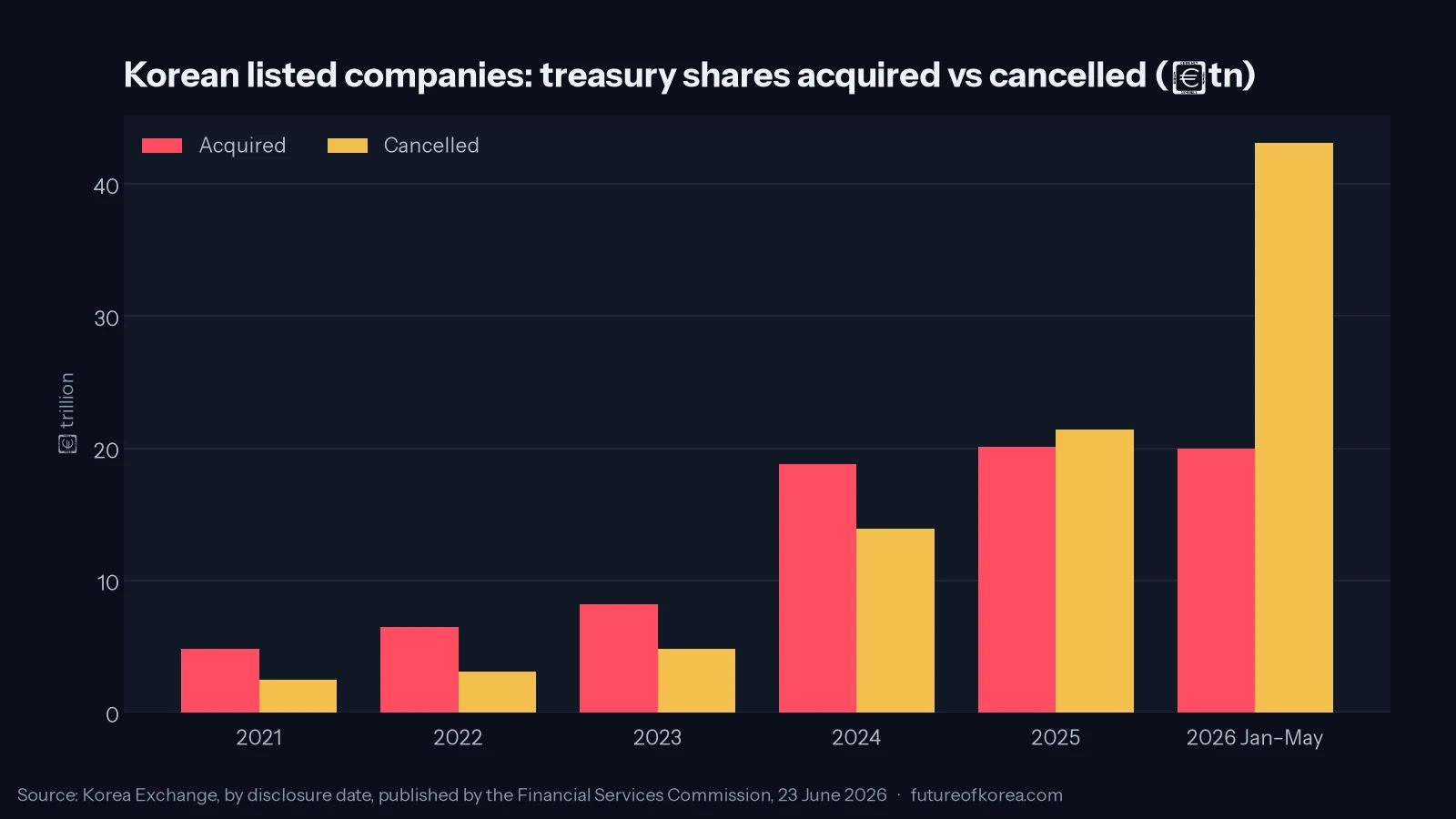
Korean companies cancelled ₩43.1tn of their own shares in five months — and bought only ₩20tn
A law that took effect on 6 March 2026 turned the treasury share from a control device into a countdown. Companies have until September 2027 to empty the vault, and the Korea Exchange numbers show them doing it faster than they are refilling it.
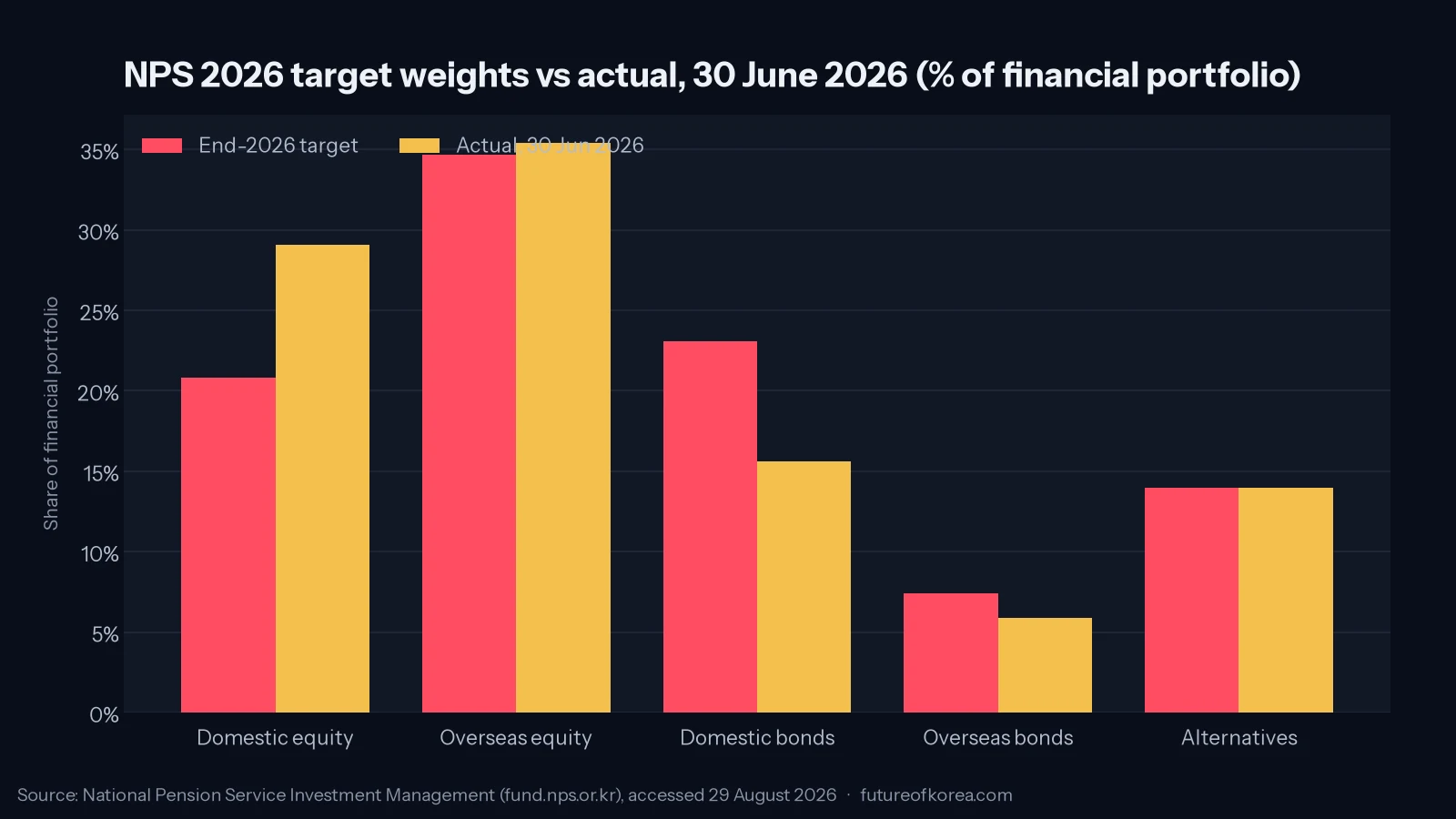
The National Pension Service raised its Korea target to 20.8%. It was already holding 29.1%.
On 28 May the National Pension Service raised its 2026 target weight in Korean shares from 14.9% to 20.8%. Five weeks later the fund held 29.1%. The gap, and what the fund is quietly underweight, matter more than the headline.
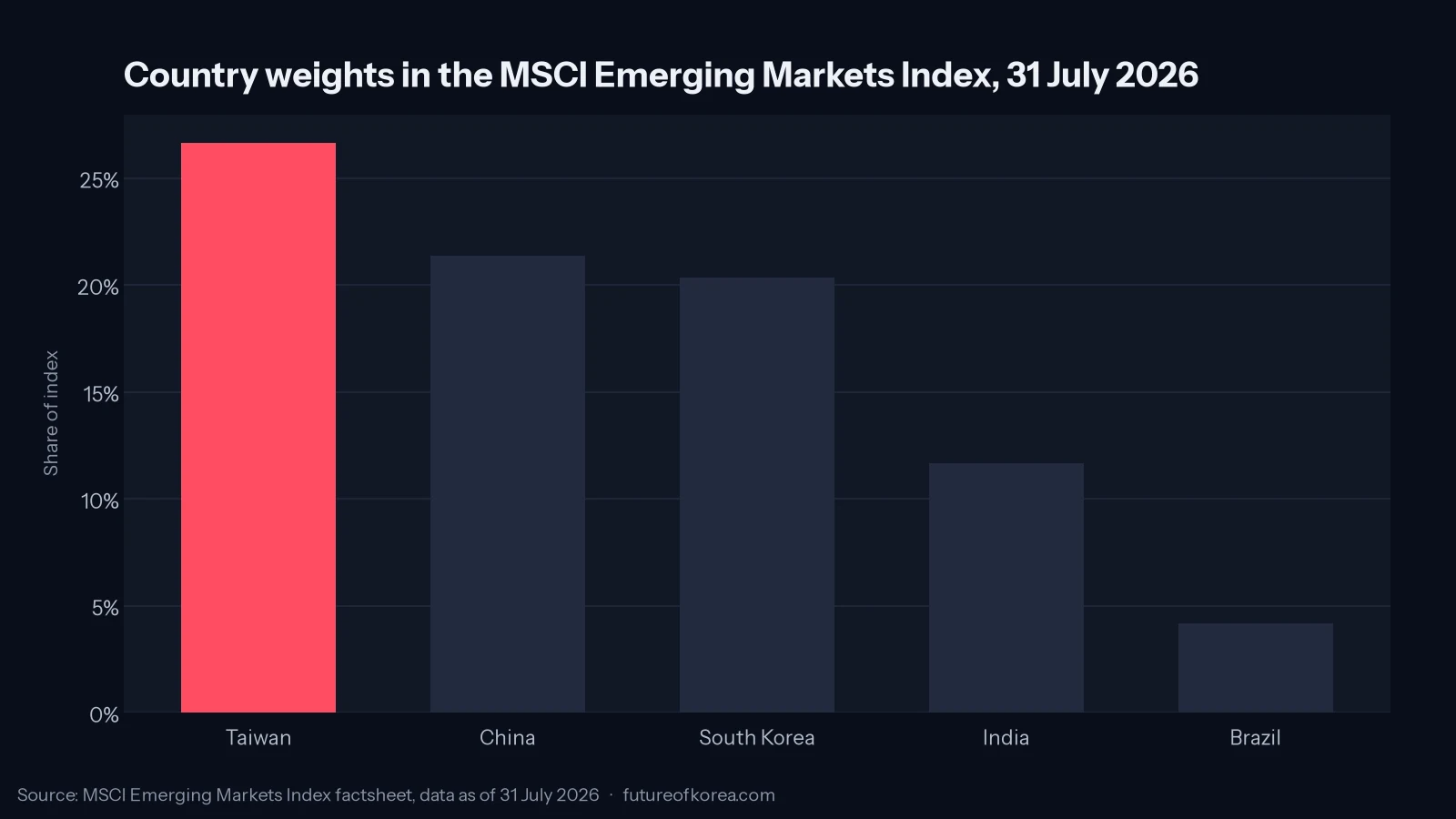
FTSE calls Korea a developed market. MSCI still calls it emerging.
Two index providers look at the same exchange and reach opposite conclusions. The disagreement is about the won, and the arithmetic of an upgrade is less flattering than the campaign for one suggests.